Website Preview
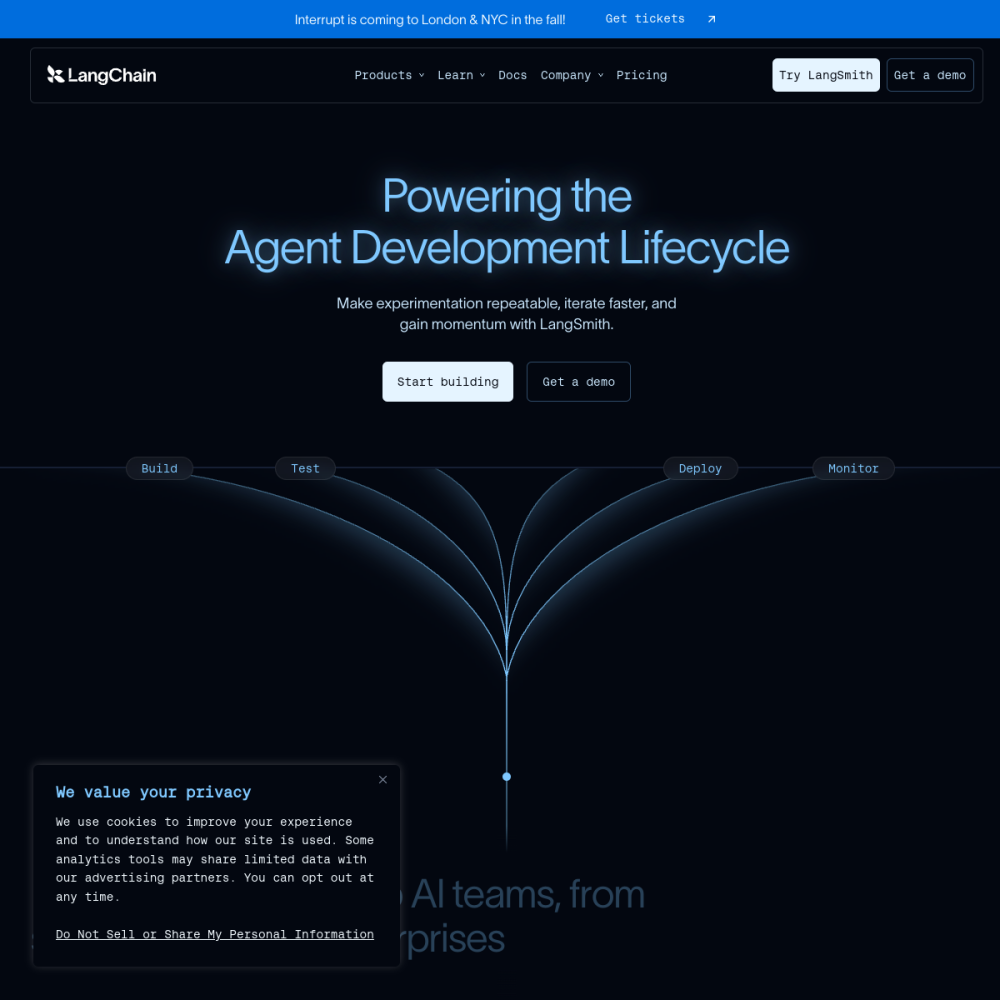
Tool Guide
LangChain operates as an AI dev platform focused on LLM app orchestration and agents. It provides the structural components necessary for developers to connect large language models with external data sources and tools. This framework simplifies the complexity of building robust applications powered by generative AI.
By standardizing how models interact with various systems, LangChain enables teams to move from prototype to production more efficiently. The platform supports the creation of agent-based workflows where AI can take actions based on user input and environmental context. This approach ensures scalability for complex software requirements.
LangChain is a platform designed to facilitate the development of applications using large language models. It acts as a middleware layer that manages the flow of information between the model, the user, and external APIs. This orchestration capability is central to its function within the AI development ecosystem.
The core purpose is to reduce the boilerplate code required when integrating LLMs into software products. Developers can focus on application logic rather than managing connection protocols or prompt chaining manually. This abstraction allows for more maintainable and scalable codebases.
As a development tool, it encourages iteration and testing. The platform remains a foundational element for those looking to deploy AI agents that require state management and tool usage. It streamlines the engineering process for generative AI projects.
The primary feature of LangChain is its orchestration engine for LLM applications. This allows developers to chain multiple prompts and model calls together to create complex workflows. Each step in the chain can process output from the previous step, enabling multi-step reasoning.
Agent functionality is another critical component provided by the platform. Agents allow the model to decide which tools to call based on the task at hand. This dynamic decision-making capability distinguishes it from simple prompt-response systems.
Integration support is built into the framework to connect with various data stores and APIs. This ensures that the LLM can access real-time information or execute actions outside its native context window. These features combine to create a versatile development environment.
LangChain is primarily intended for software engineers building AI-powered applications. It suits developers who need to integrate large language models into existing software stacks without starting from scratch. Technical teams looking to implement agent workflows will find the platform particularly useful.
Data scientists and machine learning engineers also benefit from the structured approach to model deployment. Those experimenting with retrieval-augmented generation or complex prompt chains can utilize the platform to test hypotheses quickly. It bridges the gap between model experimentation and software engineering.
Organizations seeking to standardize their AI development practices may adopt this platform as a core infrastructure component. It provides a common language and set of tools for teams working on generative AI projects. Collaboration is enhanced through shared architectural patterns.
A common use case involves building chatbots that can access internal company data. By orchestrating the connection between the LLM and a vector database, the bot can provide accurate answers based on proprietary documents. This reduces hallucination and increases utility for enterprise users.
Another application is creating autonomous agents that perform tasks across multiple software tools. For example, an agent might schedule meetings, send emails, and update project management systems based on natural language instructions. This automation streamlines operational workflows.
Developers also use the platform to build content generation pipelines. These pipelines can draft, edit, and format text using multiple model calls in sequence. The orchestration layer ensures consistency and quality throughout the generation process.
To begin using LangChain, developers should visit the official website at https://www.langchain.com/ for documentation and resources. The site provides guides on installation and initial setup for various programming environments. Starting with simple chains helps users understand the core mechanics before moving to complex agents.
It is recommended to start with small, contained workflows to test integration points. Developers should verify that external API connections work correctly before adding agent logic. This incremental approach reduces debugging time and ensures stability.
Community support and documentation are valuable resources for troubleshooting. Engaging with the developer community can provide insights into best practices for orchestration and agent design. Continuous learning is essential as the platform evolves alongside the AI landscape.
LangChain is designed for LLM app orchestration and agents, helping developers build applications that connect large language models with external tools and data.
It is best suited for developers with some programming experience who want to integrate AI capabilities into their applications efficiently.
Official documentation and resources are available on the LangChain website at https://www.langchain.com/.