Langfuse
Open-source LLM observability, tracing and prompt engineering
Official Preview
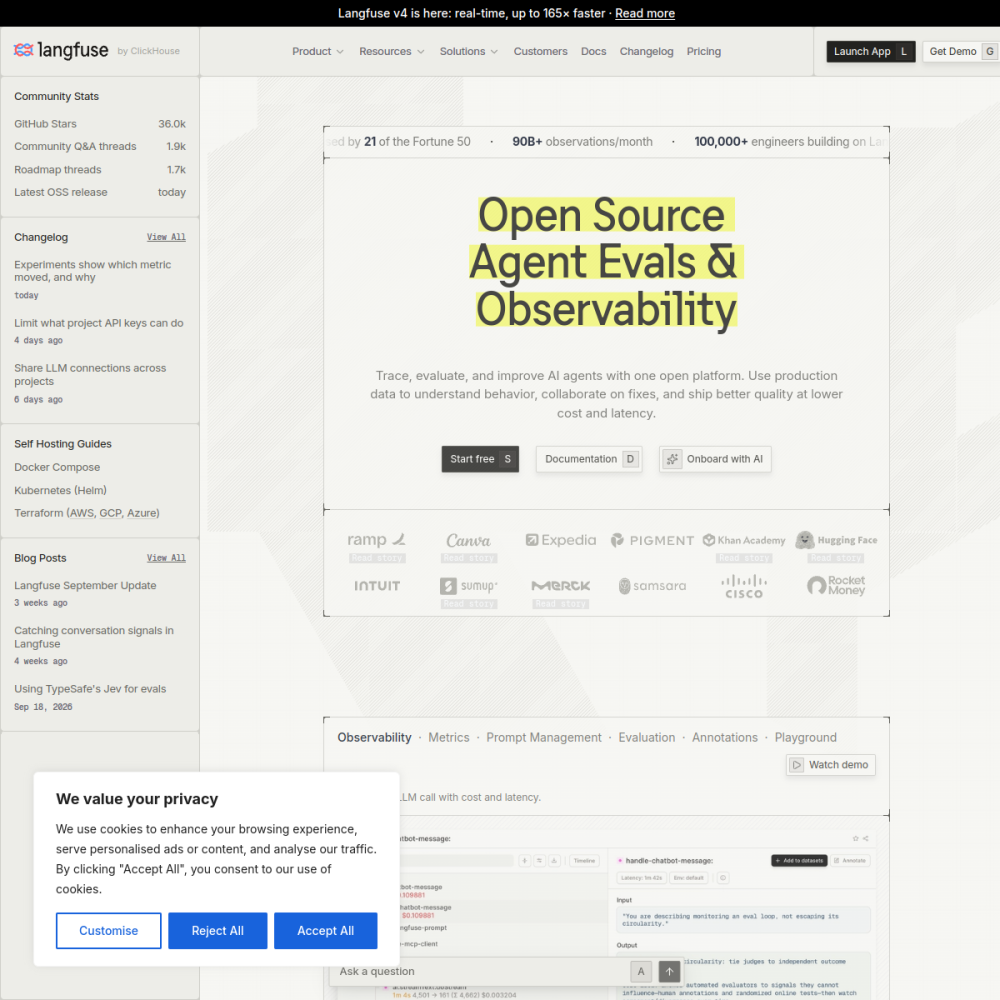
Open-source LLM observability, tracing and prompt engineering
In-Depth Review
Langfuse is an open-source platform designed to help developers observe, debug, and improve large language model applications. It provides tracing, prompt management, and evaluation tools in one place.
Whether you are building a chatbot, a RAG pipeline, or an agent workflow, Langfuse gives you visibility into every LLM call so you can iterate faster and ship more reliable AI products.
Langfuse is a developer platform focused on LLM observability. It captures traces of every model interaction—inputs, outputs, latency, and token usage—so teams can monitor performance and debug issues in real time.
The platform also includes a prompt management system that lets you version, test, and deploy prompts without redeploying code. All data is stored in a self-hosted or cloud-hosted instance, giving teams full control over their AI telemetry.
Core capabilities include distributed tracing for multi-step LLM workflows, a prompt library with versioning and A/B testing, and an evaluation framework for scoring model outputs against custom or automated criteria.
Langfuse supports integrations with popular frameworks such as LangChain, LlamaIndex, and OpenAI, making it straightforward to instrument existing projects. The open-source license allows self-hosting, while a managed cloud option is available for teams that prefer zero infrastructure overhead.
Langfuse targets ML engineers, backend developers, and product teams building production LLM applications. It is especially useful for organizations that need cost tracking, latency monitoring, or quality evaluation across multiple model providers.
Startups and enterprises alike benefit from the platform's flexibility. Teams that require data residency or compliance controls can self-host, while smaller groups can start with the free tier and scale as needed.
Teams use Langfuse to trace RAG pipelines, monitor chatbot conversations, and evaluate agent workflows. Developers can identify which prompts produce the best results, track token spend across models, and set up alerts when latency or error rates spike.
Another frequent use case is prompt iteration. Engineers store prompt variants in Langfuse, run them against test datasets, and compare scores before promoting a version to production—reducing the risk of regressions.
To begin, install the Langfuse SDK for your language (Python, TypeScript, or others) and add tracing decorators to your LLM calls. Within minutes you will see traces populate in the Langfuse dashboard.
Start by instrumenting your most critical workflow, then expand coverage gradually. Use the prompt library to centralize prompt definitions and leverage the evaluation feature to establish quality baselines before shipping changes.
Langfuse is open-source and can be self-hosted at no cost. A managed cloud version is also available with a free tier for small teams.
Yes. Langfuse is model-agnostic and supports tracing for any LLM provider, including Anthropic, Google, local models, and custom deployments.
Self-hosted deployments keep all trace data within your infrastructure. Cloud deployments follow standard data protection practices, and teams can configure retention policies to meet compliance requirements.
Ultra-fast LPU inference engine serving open LLMs
TypeScript toolkit for AI apps
Open-source LLM app platform