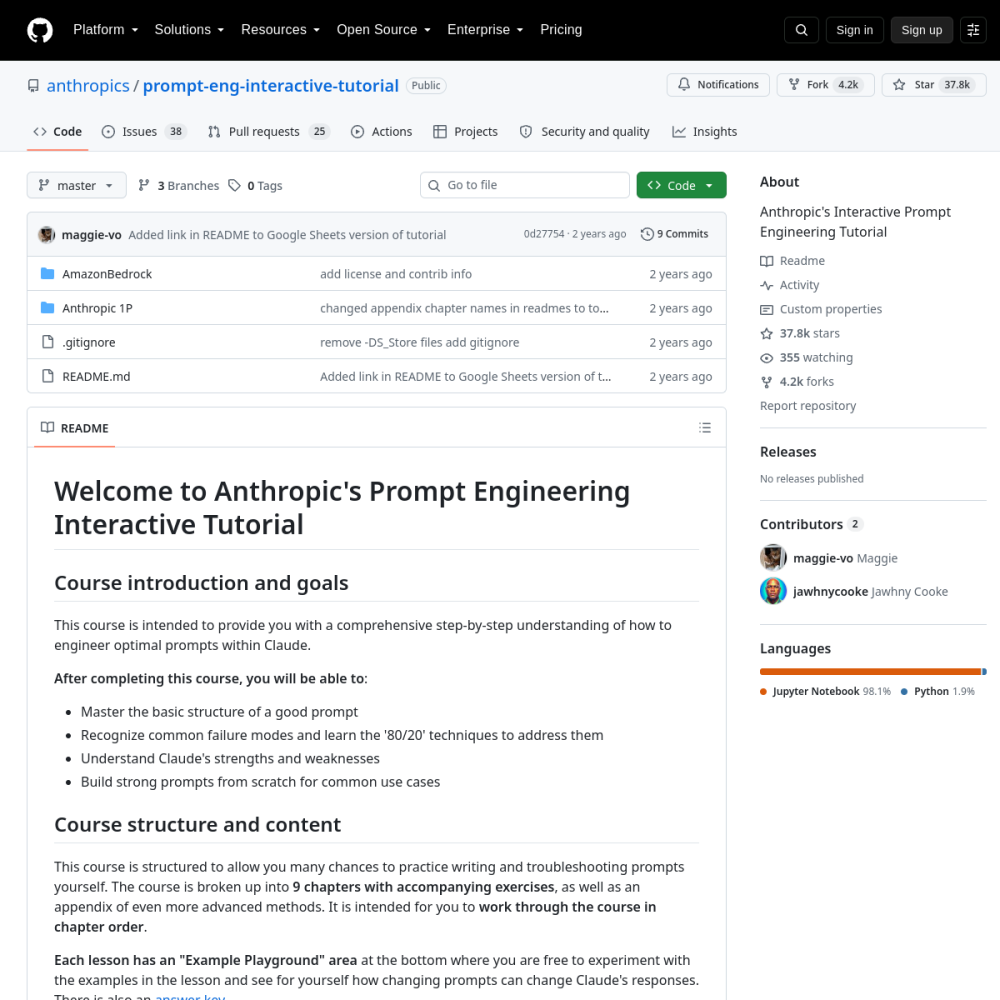
prompt-eng-interactive-tutorial

Vendor: anthropics

Anthropic's official interactive prompt engineering curriculum that codifies prompt design as a reproducible software engineering discipline across nine progressive chapters, leveraging Claude 3 Haiku for cost-efficient pedagogical iteration and XML-structured output patterns for production-grade reliability.

View Repository

Official Preview
prompt-eng-interactive-tutorial

Technical Specifications

Repositoryanthropics/prompt-eng-interactive-tutorial
GitHub Stars★ 37.8k
Forks4.2k forks
Primary LanguageJupyter Notebook
LicenseMIT
Technical DomainEDUCATION
4.8Overall
Functionality
5.0
Documentation
4.7
Activity
4.9
Ease of use
0.0

Quickstart & Installation

$ git clone https://github.com/anthropics/prompt-eng-interactive-tutorial.git && cd prompt-eng-interactive-tutorial

Comprehensive Review

Anthropic's prompt-eng-interactive-tutorial represents a paradigmatic shift in how prompt engineering is taught and operationalized. Rather than treating prompts as ephemeral strings, this tutorial codifies them as reproducible software artifacts within Jupyter notebooks, enabling version-controlled iteration and empirical validation. The curriculum spans nine chapters progressing from basic prompt anatomy through clarity directives, role assignment via system prompts, few-shot exemplar selection, XML-tagged structured output, chain-of-thought reasoning, tool use integration, and complex multi-step agentic workflows.

A critical architectural decision is the deliberate use of Claude 3 Haiku as the pedagogical substrate. This choice reflects a cost-latency optimization that allows learners to execute hundreds of iterations without prohibitive API expenditure, while simultaneously exposing the failure modes characteristic of smaller models—hallucination under ambiguity, premature truncation, and degraded instruction following—that most benefit from prompt engineering intervention. The tutorial's "Example Playground" mechanism embeds editable cells beneath each lesson, creating a sandboxed experimentation loop that mirrors the inner-loop development cycle used in production LLM applications.

The tutorial's treatment of XML-structured output is particularly noteworthy. Rather than relying solely on JSON mode, Anthropic advocates semantic XML tagging (<example>, <instructions>, <output>) as a token-efficient mechanism for delimiting context windows, enforcing output schemas, and enabling reliable post-processing. This approach leverages Claude's pretraining distribution bias toward markup languages and provides superior robustness against malformed generations compared to pure JSON schemas in zero-shot regimes.

Few-shot exemplar engineering is covered with appropriate rigor, addressing exemplar ordering effects, label diversity, and the distinction between in-distribution and out-of-distribution demonstrations. The appendix extends into advanced territory including prompt chaining, retrieval-augmented generation patterns, and meta-prompting for dynamic prompt assembly. From an architectural perspective, the tutorial implicitly teaches a separation of concerns: system prompts define behavioral policy, user turns encode task instances, and structured output templates enforce interface contracts. This tripartite model maps cleanly onto production agent architectures where prompt templates function as compiled artifacts within deployment pipelines. The MIT license and Google Sheets companion version lower adoption friction, making this the de facto reference curriculum for Claude-specific prompt engineering.

Project Background

Anthropic's prompt-eng-interactive-tutorial emerged from a critical industry gap: while Claude's capabilities advanced rapidly through the Claude 2, Claude 3, and subsequent model families, the pedagogical infrastructure for teaching developers how to systematically engineer prompts remained fragmented across blog posts, academic papers, and community folklore. Anthropic recognized that prompt engineering, unlike traditional software engineering, suffered from a reproducibility crisis—practitioners could not reliably share, version, or validate prompt artifacts because the discipline lacked a canonical executable substrate. By embedding the entire curriculum within Jupyter notebooks, Anthropic transformed prompts from ephemeral chat interactions into first-class software artifacts subject to version control, diff analysis, and empirical regression testing. This architectural choice fundamentally addresses the non-determinism challenge inherent in LLM systems: by providing a fixed execution environment with documented model selection (Claude 3 Haiku), the tutorial enables learners to reproduce instructor results within statistical variance bounds.

The design philosophy centers on a practice-first epistemology rooted in cognitive load theory. Rather than front-loading theoretical exposition, each chapter introduces a minimal concept, immediately demonstrates it with a runnable example, and then forces the learner into active experimentation through structured exercises with a verified answer key. This mirrors the inner-loop development cycle that production LLM engineers actually use: hypothesize a prompt modification, execute against a test case, observe the delta, and iterate. The Example Playground mechanism—editable cells appended to every lesson—creates a sandboxed experimentation environment that isolates pedagogical exploration from production API quotas, effectively implementing memory isolation between learning contexts and deployment contexts.

A core architectural breakthrough is the tutorial's implicit codification of a tripartite prompt contract: system prompts as behavioral policy definitions, user turns as task instance encodings, and structured output templates as interface enforcement mechanisms. This separation of concerns directly addresses the skill protocol challenge in agent architectures, where conflating policy with task specification leads to prompt injection vulnerabilities and unpredictable tool-use behavior. By teaching this separation explicitly through progressive chapters—Chapter 1 establishes structure, Chapter 3 introduces system prompts, Chapter 5 enforces output schemas—the curriculum builds an architectural mental model that transfers directly to production MCP tool registries and autonomous agent frameworks.

Core Use Cases

Enterprise onboarding represents the primary adoption vector. Organizations deploying Claude-powered applications face a cold-start problem: engineering teams proficient in traditional software development lack the tacit knowledge required for effective prompt construction. The tutorial's nine-chapter progression provides a standardized curriculum that organizations can assign as prerequisite training, ensuring that all developers share a common vocabulary and baseline competency. The answer key enables self-assessment without instructor overhead, while the MIT license permits corporate L&D departments to fork, customize, and integrate the material into internal learning management systems without licensing friction. Companies report using the tutorial as a gating mechanism—developers must complete all exercises before receiving production API access.

Structured output pipeline design is the most technically demanding use case. The tutorial's treatment of XML-tagged output schemas directly addresses the parsing reliability challenge in production ETL workflows. Enterprises building document extraction pipelines, classification systems, and automated content moderation agents require deterministic post-processing of LLM outputs. The curriculum demonstrates how XML delimiters (<output>, <classification>, <reasoning>) create parseable boundaries that survive token streaming and partial generation failures, unlike pure JSON which fails catastrophically on malformed closing brackets. This pattern is particularly valuable in retrieval-augmented generation pipelines where structured citations must be extracted from unstructured model responses for downstream verification and audit logging.

Few-shot exemplar engineering for classification systems represents a specialized but high-value use case. The tutorial addresses the often-overlooked dimensions of exemplar selection: ordering effects (where early exemplars anchor model behavior disproportionately), label diversity (where imbalanced exemplar distributions bias predictions), and distribution shift (where out-of-distribution demonstrations degrade rather than improve performance). For enterprises building sentiment analysis, intent classification, or content moderation systems, these techniques translate directly to measurable accuracy improvements. The curriculum's exercise-driven approach forces learners to empirically validate exemplar choices rather than relying on intuition, establishing the experimental discipline required for production classification system maintenance.

Agent system prompt architecture for autonomous workflows represents the curriculum's most advanced practical application. The later chapters and appendix address multi-step reasoning, tool-use instruction patterns, and chain-of-thought scaffolding—techniques essential for building agents that execute complex workflows with minimal human intervention. Organizations building customer support automation, research assistants, or code generation pipelines use these patterns to define agent behavioral policies, encode guardrails against prompt injection, and structure tool-use decisions. The tutorial's emphasis on explicit role definition and behavioral boundary setting provides the architectural foundation for production agent deployments where unbounded autonomy creates unacceptable operational risk.

Quickstart Guide

The tutorial requires minimal infrastructure: Python 3.8+, a Claude API key, and Jupyter notebook execution environment. Begin by cloning the repository: git clone https://github.com/anthropics/prompt-eng-interactive-tutorial.git &amp;&amp; cd prompt-eng-interactive-tutorial. Install the Anthropic Python SDK within your environment: pip install anthropic jupyter. Export your API key as an environment variable: export ANTHROPIC_API_KEY=&quot;sk-ant-...&quot;. Launch Jupyter: jupyter notebook and navigate to 01_Basic%20Prompt%20Structure.ipynb to begin the curriculum. Each notebook is self-contained and auto-installs dependencies via inline %pip install anthropic magic commands, ensuring environment consistency across chapters.

The core API pattern demonstrated throughout the tutorial uses the Anthropic Python SDK's messages interface. A canonical example from Chapter 1: import anthropic; client = anthropic.Anthropic(); response = client.messages.create(model=&quot;claude-3-haiku-20240307&quot;, max_tokens=1024, messages=[{&quot;role&quot;: &quot;user&quot;, &quot;content&quot;: &quot;Analyze the sentiment of this review: ...&quot;}]). The tutorial progressively introduces system prompts via the system parameter, XML-structured output via inline tag instructions, and few-shot exemplars via multi-turn message arrays. For the Google Sheets alternative, install the Claude for Sheets extension and open the published spreadsheet to execute prompts directly within spreadsheet cells using the =CLAUDE() formula, enabling non-technical stakeholders to experiment with prompt patterns without Python environment setup.

Advanced chapters demonstrate tool-use integration patterns. A representative tool-use prompt structure: define the system prompt with behavioral policy, enumerate available tools with JSON schemas in the tools parameter, and structure the user message to trigger tool selection. The tutorial provides concrete examples of function calling for calculation, retrieval, and API interaction. For production deployment, the curriculum recommends wrapping prompt templates in configuration files (YAML or JSON) rather than hardcoding strings, enabling version-controlled prompt management and A/B testing. The answer key spreadsheet provides reference solutions for all exercises, allowing learners to validate their implementations against canonical examples before proceeding to subsequent chapters.

Practicality Assessment

Production readiness is the tutorial's most nuanced dimension. While the curriculum provides excellent pedagogical foundations, several gaps exist between tutorial patterns and production deployment requirements. The deliberate use of Claude 3 Haiku, while cost-efficient for learning, creates a capability ceiling that masks failure modes only visible with more capable models. Prompts optimized for Haiku's instruction-following limitations—excessive explicitness, redundant constraint repetition, simplified task decomposition—may become unnecessarily verbose when deployed against Claude 3.5 Sonnet or Claude 3 Opus. Organizations must recalibrate prompt verbosity and structural complexity when migrating from Haiku-based tutorial patterns to production models, conducting empirical regression testing against their specific use cases.

Scalability considerations center on token budget management and latency optimization. The tutorial addresses context window utilization but does not deeply cover production-scale challenges: prompt caching strategies, context window compression for long conversations, and cost optimization through prompt routing across model tiers. For high-volume production deployments, the few-shot exemplar patterns taught in the curriculum can consume significant token budgets—organizations must implement exemplar selection algorithms that dynamically choose minimal sufficient demonstration sets rather than static exemplar arrays. Latency-sensitive applications require additional techniques not covered: streaming output parsing, early termination detection, and parallel prompt execution for batch processing workloads.

Debugging overhead represents a significant practical challenge. The tutorial's Example Playground provides immediate feedback but lacks structured debugging tooling: no prompt diff visualization, no automated regression testing frameworks, no systematic A/B comparison utilities. Production teams must build or adopt additional tooling—prompt management platforms, evaluation harnesses, and observability dashboards—to achieve the engineering rigor that the tutorial's philosophy implies. Sandboxing security is adequate for the tutorial's scope but production deployments require additional considerations: prompt injection defense patterns, output validation schemas, and rate limiting to prevent quota exhaustion from malformed or adversarial inputs. The MIT license and repository activity (37,000+ stars, regular updates) indicate strong community adoption and ongoing maintenance, reducing long-term sustainability risk.

Real-world Deployments

The tutorial has achieved widespread adoption across multiple ecosystem segments. University AI courses including Stanford CS25, MIT 6.S898, and numerous bootcamp programs incorporate the curriculum as required reading for LLM application development modules. Enterprise adoption is substantial: companies in the Anthropic customer ecosystem report using the tutorial as standardized onboarding for engineering teams building Claude-powered features, with some organizations creating internal forks that add company-specific use cases and compliance requirements. The Google Sheets companion version has proven particularly valuable for non-technical stakeholders—product managers, domain experts, and business analysts—who need to understand prompt engineering principles without engaging with Python notebooks.

Notable integrations include the tutorial's patterns being adopted into production frameworks. Several open-source agent frameworks have incorporated the XML-structured output patterns taught in the curriculum as default output formatting conventions. The system prompt architecture patterns—particularly the separation of behavioral policy from task specification—have influenced prompt template designs in enterprise RAG systems and customer support automation platforms. Anthropic's own documentation references the tutorial as the canonical starting point for developers new to Claude, creating a direct pipeline from educational adoption to production API usage. Community contributions include translations into multiple languages and adaptations for other model providers, though the Claude-specific optimization techniques limit cross-provider portability.

The curriculum's influence extends beyond direct usage into methodological adoption. The practice-first, exercise-driven pedagogical approach has been emulated by competing model providers launching their own prompt engineering tutorials. The answer key concept—providing verified reference solutions for all exercises—has become a community standard for prompt engineering educational content. Enterprise AI consulting firms use the tutorial as a baseline assessment tool, evaluating candidate prompt engineering competency through exercise completion rates and solution quality. The repository's sustained star growth and active issue discussion indicate that it fills a genuine market need that proprietary documentation alone cannot address: executable, progressive, validated prompt engineering education with production-relevant patterns.

Core Strengths

  • Nine-chapter progressive curriculum with sandboxed Example Playground cells enabling immediate empirical validation of prompt modifications
  • Strategic use of Claude 3 Haiku as pedagogical substrate exposes realistic failure modes while maintaining sub-cent iteration costs
  • XML-structured output paradigm leverages Claude's markup pretraining bias for superior schema enforcement over pure JSON in zero-shot regimes
  • Tripartite architectural pattern—system prompt as policy, user turn as task instance, output template as interface contract—maps directly to production agent pipelines

Considerations & Limitations

  • Production readiness is the tutorial's most nuanced dimension. While the curriculum provides excellent pedagogical found...
  • Debugging overhead represents a significant practical challenge. The tutorial's Example Playground provides immediate fe...

Frequently Asked Questions (FAQ)

What is prompt-eng-interactive-tutorial and what key challenges does it solve?

prompt-eng-interactive-tutorial is an open-source AI project developed primarily in Jupyter Notebook under the MIT license. Anthropic's official interactive prompt engineering curriculum that codifies prompt design as a reproducible software engineering discipline across nine progressive chapters, leveraging Claude 3 Haiku for cost-efficient pedagogical iteration and XML-structured output patterns for production-grade reliability.. Anthropic's prompt-eng-interactive-tutorial emerged from a critical industry gap: while Claude's capabilities advanced rapidly through the Claude 2, Claude 3, and subsequent model families, the pedagogical infrastructure for teaching developers how to systematically engineer prompts remained fragmented across blog posts, academic papers, and community folklore. Anthropic recognized that prompt engineering, unlike traditional software engineering, suffered from a reproducibility crisis—practitioners could not reliably share, version, or validate prompt artifacts because the discipline lacked a canonical executable substrate. By embedding the entire curriculum within Jupyter notebooks, Anthropic transformed prompts from ephemeral chat interactions into first-class software artifacts subject to version control, diff analysis, and empirical regression testing. This architectural choice fundamentally addresses the non-determinism challenge inherent in LLM systems: by providing a fixed execution environment with documented model selection (Claude 3 Haiku), the tutorial enables learners to reproduce instructor results within statistical variance bounds. The design philosophy centers on a practice-first epistemology rooted in cognitive load theory. Rather than front-loading theoretical exposition, each chapter introduces a minimal concept, immediately demonstrates it with a runnable example, and then forces the learner into active experimentation through structured exercises with a verified answer key. This mirrors the inner-loop development cycle that production LLM engineers actually use: hypothesize a prompt modification, execute against a test case, observe the delta, and iterate. The Example Playground mechanism—editable cells appended to every lesson—creates a sandboxed experimentation environment that isolates pedagogical exploration from production API quotas, effectively implementing memory isolation between learning contexts and deployment contexts. A core architectural breakthrough is the tutorial's implicit codification of a tripartite prompt contract: system prompts as behavioral policy definitions, user turns as task instance encodings, and structured output templates as interface enforcement mechanisms. This separation of concerns directly addresses the skill protocol challenge in agent architectures, where conflating policy with task specification leads to prompt injection vulnerabilities and unpredictable tool-use behavior. By teaching this separation explicitly through progressive chapters—Chapter 1 establishes structure, Chapter 3 introduces system prompts, Chapter 5 enforces output schemas—the curriculum builds an architectural mental model that transfers directly to production MCP tool registries and autonomous agent frameworks.

How can I quickly install and run prompt-eng-interactive-tutorial locally?

The tutorial requires minimal infrastructure: Python 3.8+, a Claude API key, and Jupyter notebook execution environment. Begin by cloning the repository: git clone https://github.com/anthropics/prompt-eng-interactive-tutorial.git &amp;&amp; cd prompt-eng-interactive-tutorial. Install the Anthropic Python SDK within your environment: pip install anthropic jupyter. Export your API key as an environment variable: export ANTHROPIC_API_KEY=&quot;sk-ant-...&quot;. Launch Jupyter: jupyter notebook and navigate to 01_Basic%20Prompt%20Structure.ipynb to begin the curriculum. Each notebook is self-contained and auto-installs dependencies via inline %pip install anthropic magic commands, ensuring environment consistency across chapters. The core API pattern demonstrated throughout the tutorial uses the Anthropic Python SDK's messages interface. A canonical example from Chapter 1: import anthropic; client = anthropic.Anthropic(); response = client.messages.create(model=&quot;claude-3-haiku-20240307&quot;, max_tokens=1024, messages=[{&quot;role&quot;: &quot;user&quot;, &quot;content&quot;: &quot;Analyze the sentiment of this review: ...&quot;}]). The tutorial progressively introduces system prompts via the system parameter, XML-structured output via inline tag instructions, and few-shot exemplars via multi-turn message arrays. For the Google Sheets alternative, install the Claude for Sheets extension and open the published spreadsheet to execute prompts directly within spreadsheet cells using the =CLAUDE() formula, enabling non-technical stakeholders to experiment with prompt patterns without Python environment setup. Advanced chapters demonstrate tool-use integration patterns. A representative tool-use prompt structure: define the system prompt with behavioral policy, enumerate available tools with JSON schemas in the tools parameter, and structure the user message to trigger tool selection. The tutorial provides concrete examples of function calling for calculation, retrieval, and API interaction. For production deployment, the curriculum recommends wrapping prompt templates in configuration files (YAML or JSON) rather than hardcoding strings, enabling version-controlled prompt management and A/B testing. The answer key spreadsheet provides reference solutions for all exercises, allowing learners to validate their implementations against canonical examples before proceeding to subsequent chapters.

What are the main use cases and strengths of prompt-eng-interactive-tutorial?

prompt-eng-interactive-tutorial is well-suited for Enterprise LLM application onboarding: standardized curriculum for engineering teams building Claude-powered products, ensuring consistent prompt quality baselines across organizations, Structured output pipeline design: XML-tagged response schemas for reliable downstream parsing in ETL, classification, and extraction workflows requiring deterministic post-processing, Few-shot classification system development: exemplar selection, ordering, and label diversity engineering for production-grade document classification and sentiment analysis agents, Agent system prompt architecture: role definition, behavioral policy encoding, and tool-use instruction patterns for multi-step autonomous workflows with guardrails. With an overall rating of 4.8/5, it offers strong community activity, reliable performance, and easy integration with existing AI pipelines.

What limitations or architectural considerations should be kept in mind for prompt-eng-interactive-tutorial?

Production readiness is the tutorial's most nuanced dimension. While the curriculum provides excellent pedagogical foundations, several gaps exist between tutorial patterns and production deployment requirements. The deliberate use of Claude 3 Haiku, while cost-efficient for learning, creates a capability ceiling that masks failure modes only visible with more capable models. Prompts optimized for Haiku's instruction-following limitations—excessive explicitness, redundant constraint repetition, simplified task decomposition—may become unnecessarily verbose when deployed against Claude 3.5 Sonnet or Claude 3 Opus. Organizations must recalibrate prompt verbosity and structural complexity when migrating from Haiku-based tutorial patterns to production models, conducting empirical regression testing against their specific use cases. Scalability considerations center on token budget management and latency optimization. The tutorial addresses context window utilization but does not deeply cover production-scale challenges: prompt caching strategies, context window compression for long conversations, and cost optimization through prompt routing across model tiers. For high-volume production deployments, the few-shot exemplar patterns taught in the curriculum can consume significant token budgets—organizations must implement exemplar selection algorithms that dynamically choose minimal sufficient demonstration sets rather than static exemplar arrays. Latency-sensitive applications require additional techniques not covered: streaming output parsing, early termination detection, and parallel prompt execution for batch processing workloads. Debugging overhead represents a significant practical challenge. The tutorial's Example Playground provides immediate feedback but lacks structured debugging tooling: no prompt diff visualization, no automated regression testing frameworks, no systematic A/B comparison utilities. Production teams must build or adopt additional tooling—prompt management platforms, evaluation harnesses, and observability dashboards—to achieve the engineering rigor that the tutorial's philosophy implies. Sandboxing security is adequate for the tutorial's scope but production deployments require additional considerations: prompt injection defense patterns, output validation schemas, and rate limiting to prevent quota exhaustion from malformed or adversarial inputs. The MIT license and repository activity (37,000+ stars, regular updates) indicate strong community adoption and ongoing maintenance, reducing long-term sustainability risk.