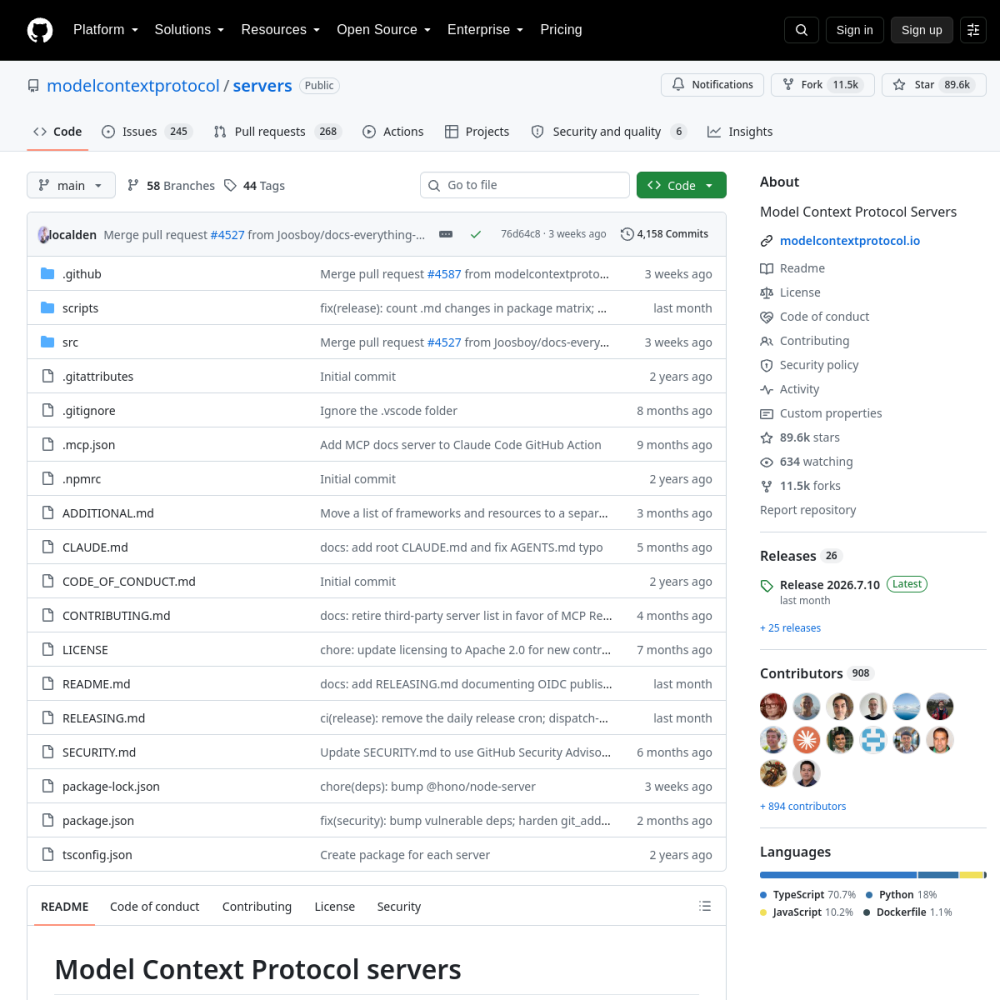
servers

Vendor: modelcontextprotocol

Anthropic's official reference server collection for the Model Context Protocol (MCP), providing canonical implementations that expose files, databases, APIs, and tool skills to LLM agents via a standardized JSON-RPC capability-negotiation layer.

View Repository

Official Preview
servers

Technical Specifications

Repositorymodelcontextprotocol/servers
GitHub Stars★ 89.9k
Forks11.5k forks
Primary LanguageTypeScript
LicenseNOASSERTION
Technical DomainAGENTS
4.8Overall
Functionality
5.0
Documentation
4.7
Activity
4.9
Ease of use
0.0

Quickstart & Installation

$ npx -y @modelcontextprotocol/server-filesystem /Users/me/projects

Comprehensive Review

The modelcontextprotocol/servers repository is the canonical reference surface for Anthropic's Model Context Protocol, a transport-agnostic, capability-negotiated JSON-RPC 2.0 layer designed to standardize how large language models discover, invoke, and reason over external tools, resources, and prompt templates. Rather than reinventing function-calling semantics per vendor, MCP introduces three orthogonal primitives—Resources (read-only contextual data exposed via URIs), Tools (stateful, side-effecting callable functions with JSON Schema-typed inputs), and Prompts (parameterized instruction templates)—all multiplexed over a single session with explicit Initialize/Handshake capability advertisement. The servers in this repo demonstrate these primitives across stdio and HTTP+SSE transports, covering filesystem traversal, SQLite/Postgres query surfaces, Git introspection, Brave search, Slack, Google Drive, fetch, memory (a knowledge-graph backed persistent store), sequential-thinking, and a time server. Architecturally, the most consequential design choice is the strict decoupling of client and server lifecycles: an MCP host (Claude Desktop, an IDE extension, a custom agent runtime) spawns or connects to one or more servers, each running in its own process boundary, with per-server tool whitelisting and a clearly delineated trust boundary. This addresses a chronic pain point in agent engineering—ad-hoc tool plugins that leak credentials, mutate shared state, or balloon token budgets—by forcing every capability through a typed, auditable contract. The TypeScript implementations are deliberately compact, leaning on the @modelcontextprotocol/sdk primitives (Server, StdioServerTransport, zod schemas) to register handlers in tens of lines. However, the README is explicit that these are educational references, not production hardened: they lack rate limiting, robust auth, audit logging, and sandboxed execution. Enterprises should treat them as blueprints, wrapping each in their own auth, observability, and container isolation. The repository's real value is pedagogical and ecosystem-defining: it establishes the de facto interoperability contract that the broader MCP registry, community servers, and multi-SDK ecosystem now build against.

Project Background

The Model Context Protocol emerged in late 2024 as Anthropic's answer to a fragmentation crisis in agent tooling: every LLM vendor had invented its own function-calling schema, every agent framework (LangChain, AutoGPT, CrewAI, OpenAI Assistants) shipped bespoke plugin formats, and enterprise integrators faced an N×M matrix of adapters between models, tools, and runtimes. MCP's architectural breakthrough was to lift tool integration out of the model layer and into a session-oriented protocol layer modeled consciously on the Language Server Protocol (LSP) that revolutionized IDE-language integration. By defining a JSON-RPC 2.0 envelope with explicit Initialize handshake, capability advertisement, and three orthogonal primitives—Resources, Tools, and Prompts—MCP made tool surfaces first-class, discoverable, transport-agnostic contracts rather than model-specific JSON blobs. The servers repository is the reference surface that gives this contract concrete form.

The design philosophy is deliberately minimal and compositional. Each server is a single-process unit exposing a typed surface; an MCP host composes many servers, each in its own process boundary, with per-server whitelisting enforced by the host rather than the protocol. This addresses three chronic agent-prompting pathologies: prompt-injection-driven tool abuse (mitigated by isolating untrusted servers), context-window exhaustion (mitigated by Resources being lazily fetched and Tools being invoked on demand rather than serialized into the system prompt), and credential sprawl (mitigated by per-server environment scoping). The reference servers—filesystem, sqlite, postgres, git, slack, brave-search, google-drive, fetch, memory, sequential-thinking, time—were chosen to span the full axis of read-only context, stateful mutation, external API integration, and persistent memory, making the repository a Rosetta Stone for protocol semantics rather than a product surface.

Crucially, the repository is positioned as educational scaffolding, not a production toolchain. The README's explicit warning that servers are reference implementations forces integrators to internalize that the value lies in the contract, not the code. This positioning has shaped the broader ecosystem: ten official SDKs (TypeScript, Python, Rust, Go, Java, Kotlin, C#, Swift, Ruby, PHP) all converge on the same wire protocol, and the MCP Registry now indexes hundreds of community servers, all traceable back to the patterns codified in this repository.

Core Use Cases

The most mature enterprise use case is the internal tool registry pattern. An organization wraps its Jira, Confluence, Snowflake, and internal REST services as MCP servers—each behind SSO, audit logging, and a containerized execution boundary—and exposes them to any MCP-compatible agent runtime. Because capability discovery is runtime-negotiated via tools/list and resources/list, agents need no compile-time knowledge of available surfaces, and tool additions require zero changes to agent code. The reference sqlite and postgres servers provide copyable templates for the SQL case, while the brave-search and slack servers demonstrate OAuth-bearing external API integration.

A second high-value use case is long-term agent memory. The Memory server implements an entity-relation knowledge graph persisted as JSON, exposing create_entities, create_relations, add_observations, and search_nodes as tools. This pattern—externalizing memory outside the context window and retrieving it via tool calls rather than stuffing it into the system prompt—is the canonical answer to context-budget management for stateful agents. Enterprises deploy it per-user or per-team, giving each agent a durable, queryable memory substrate that survives session restarts without unbounded token growth.

Structured prompt pipelines are a third use case that is underappreciated. The Prompts primitive allows servers to expose parameterized instruction templates (e.g., a code-review prompt that takes a diff URI and a style guide resource). This decouples prompt engineering from agent runtime code, enabling prompt versioning, A/B testing, and cross-team reuse. The reference servers demonstrate this lightly, but the pattern is directly extensible to enterprise prompt governance workflows where compliance review of prompts becomes a first-class CI concern.

Finally, local developer augmentation is the dominant individual-developer use case. Wiring the filesystem, git, and sequential-thinking servers into Claude Desktop or an IDE-integrated MCP host produces a codebase-aware assistant that can traverse the repo, read commit history, and chain reasoning steps across tool invocations. The sequential-thinking server in particular demonstrates a meta-pattern: using a tool to structure the model's own reasoning process, effectively externalizing chain-of-thought into an auditable, replayable tool-call trace rather than opaque token generation.

Quickstart Guide

The fastest path is via npx with the TypeScript reference servers, which require no local clone. For the filesystem server: npx -y @modelcontextprotocol/server-filesystem /Users/me/projects will spawn a stdio server exposing the allowed directory. For Claude Desktop integration, edit ~/Library/Application Support/Claude/claude_desktop_config.json to add an mcpServers entry: { "mcpServers": { "filesystem": { "command": "npx", "args": ["-y", "@modelcontextprotocol/server-filesystem", "/Users/me/projects"] } } }. Restart Claude Desktop and the server's tools (read_file, write_file, list_directory, search_files) become available to the model after capability handshake.

For Python SDK authors building a custom server, the minimal pattern is: from mcp.server import Server; from mcp.server.stdio import stdio_server; server = Server("my-server"); @server.list_tools() async def list_tools(): return [...]; @server.call_tool() async def call_tool(name, arguments): ...; async def main(): async with stdio_server() as (read, write): await server.run(read, write, server.create_initialization_options()). The TypeScript equivalent uses @modelcontextprotocol/sdk: import { Server } from "@modelcontextprotocol/sdk/server/server.js"; import { StdioServerTransport } from "@modelcontextprotocol/sdk/server/stdio.js"; const server = new Server({ name: "my-server", version: "0.1.0" }, { capabilities: { tools: {} } }); server.setRequestHandler(ListToolsRequestSchema, async () => ({ tools: [...] })); const transport = new StdioServerTransport(); await server.connect(transport).

Schema typing is enforced via zod (TS) or pydantic (Python), and the protocol requires JSON Schema-compatible input definitions for every tool. To verify a running server, use the MCP Inspector: npx -y @modelcontextprotocol/inspector npx -y @modelcontextprotocol/server-sqlite --db-path /tmp/test.db. The Inspector is an interactive web UI that exercises the full Initialize→ListTools→CallTool flow, invaluable for debugging capability negotiation and schema validation issues before wiring into a host.

Practicality Assessment

Production readiness is the central caveat. The README is explicit: these are reference implementations, not hardened services. They lack authentication on the protocol layer (the host is assumed to mediate), rate limiting, audit logging, retry/circuit-breaker semantics, and sandboxed execution for tool side effects. The filesystem server, for instance, will happily write files anywhere within its allowed root with no quota enforcement; the sqlite server executes arbitrary SQL with no row-limit guardrails. Any enterprise deployment must wrap each server in a container with dropped capabilities, read-only mounts where possible, network egress controls, and an auth layer—typically by fronting the HTTP+SSE transport with an OAuth-bearing reverse proxy.

Latency characteristics are dominated by transport choice and tool semantics. stdio transport adds negligible overhead (sub-millisecond framing), making it ideal for local co-process patterns. HTTP+SSE introduces network round-trips and is appropriate for remote or shared servers. The real latency risk is in tool execution itself: a postgres query against a large warehouse, or a brave-search call, can take seconds, and the protocol has no built-in timeout negotiation—hosts must enforce their own. Token budget management is more nuanced: Resources are fetched on demand (good), but Tools schemas are serialized into the model's context during discovery, so a server exposing hundreds of tools can consume thousands of tokens just for tools/list responses. The recommended mitigation is tool namespacing and lazy registration.

Debugging overhead is non-trivial. The JSON-RPC layer is opaque without tooling; the MCP Inspector is essential but limited to interactive sessions. For production observability, integrators must add structured logging at the transport boundary and correlate tool-call IDs across host and server. The multi-SDK ecosystem means implementation consistency varies: the TypeScript and Python SDKs are the most mature; Rust and Go are production-viable; smaller-language SDKs lag in feature completeness. Security sandboxing is the most underdeveloped area—there is no protocol-level concept of capability attenuation, no mandatory access control on Resources, and no signed-server identity model. Enterprises operating in regulated environments must treat every MCP server as untrusted code and enforce isolation at the process, container, or VM boundary.

Real-world Deployments

Claude Desktop is the canonical MCP host and ships with first-class support for the reference servers; thousands of developers use the filesystem and git servers daily for codebase-aware assistance. Anthropic's own documentation treats this repository as the onboarding path for MCP adoption. Beyond Anthropic, the protocol has been adopted by Zed (IDE integration), Cursor (early MCP experimentation), Continue.dev, and a growing list of agent frameworks that now speak MCP natively rather than maintaining bespoke plugin formats.

The MCP Registry (registry.modelcontextprotocol.io) indexes the broader ecosystem of community-built servers, many of which are direct forks or extensions of the reference implementations in this repository. Notable community servers cover AWS, Kubernetes, GitHub, Linear, Notion, Sentry, Puppeteer (browser automation), and Cloudflare. The sequential-thinking server has been particularly influential, spawning variants that integrate with planning frameworks and agent orchestration systems. Enterprise adopters including Block, Apollo, and Replit have publicly committed to MCP as their agent-tooling interoperability layer, citing the reference servers as the template for their internal implementations.

The repository's 89k+ stars and the existence of ten official SDKs indicate ecosystem traction that exceeds typical reference-code projects. The license is marked NOASSERTION, which warrants legal review before enterprise redistribution—integrators should confirm licensing with counsel before shipping derived servers in commercial products. Despite this, the protocol's momentum is unmistakable: MCP is converging into the de facto standard for agent-tool integration, and this repository is the architectural canon that defines the contract. Its long-term impact will likely be measured not in its own code quality, but in the interoperability surface it has codified for the entire agent ecosystem.

Core Strengths

  • Canonical reference implementations of the Resources/Tools/Prompts triad across stdio and HTTP+SSE transports, demonstrating capability negotiation end-to-end
  • Multi-language SDK ecosystem (TypeScript, Python, Rust, Go, Java, Kotlin, C#, Swift, Ruby, PHP) anchored by these reference servers as the interoperability contract
  • Memory server implements a persistent entity-relation knowledge graph, illustrating long-term agent memory isolation patterns outside the context window
  • Strict process-isolation model with per-server tool whitelisting, giving agent hosts a clean trust boundary absent in ad-hoc function-calling plugins

Considerations & Limitations

  • Production readiness is the central caveat. The README is explicit: these are reference implementations, not hardened se...
  • Debugging overhead is non-trivial. The JSON-RPC layer is opaque without tooling; the MCP Inspector is essential but limi...

Frequently Asked Questions (FAQ)

What is servers and what key challenges does it solve?

servers is an open-source AI project developed primarily in TypeScript under the NOASSERTION license. Anthropic's official reference server collection for the Model Context Protocol (MCP), providing canonical implementations that expose files, databases, APIs, and tool skills to LLM agents via a standardized JSON-RPC capability-negotiation layer.. The Model Context Protocol emerged in late 2024 as Anthropic's answer to a fragmentation crisis in agent tooling: every LLM vendor had invented its own function-calling schema, every agent framework (LangChain, AutoGPT, CrewAI, OpenAI Assistants) shipped bespoke plugin formats, and enterprise integrators faced an N×M matrix of adapters between models, tools, and runtimes. MCP's architectural breakthrough was to lift tool integration out of the model layer and into a session-oriented protocol layer modeled consciously on the Language Server Protocol (LSP) that revolutionized IDE-language integration. By defining a JSON-RPC 2.0 envelope with explicit Initialize handshake, capability advertisement, and three orthogonal primitives—Resources, Tools, and Prompts—MCP made tool surfaces first-class, discoverable, transport-agnostic contracts rather than model-specific JSON blobs. The servers repository is the reference surface that gives this contract concrete form. The design philosophy is deliberately minimal and compositional. Each server is a single-process unit exposing a typed surface; an MCP host composes many servers, each in its own process boundary, with per-server whitelisting enforced by the host rather than the protocol. This addresses three chronic agent-prompting pathologies: prompt-injection-driven tool abuse (mitigated by isolating untrusted servers), context-window exhaustion (mitigated by Resources being lazily fetched and Tools being invoked on demand rather than serialized into the system prompt), and credential sprawl (mitigated by per-server environment scoping). The reference servers—filesystem, sqlite, postgres, git, slack, brave-search, google-drive, fetch, memory, sequential-thinking, time—were chosen to span the full axis of read-only context, stateful mutation, external API integration, and persistent memory, making the repository a Rosetta Stone for protocol semantics rather than a product surface. Crucially, the repository is positioned as educational scaffolding, not a production toolchain. The README's explicit warning that servers are reference implementations forces integrators to internalize that the value lies in the contract, not the code. This positioning has shaped the broader ecosystem: ten official SDKs (TypeScript, Python, Rust, Go, Java, Kotlin, C#, Swift, Ruby, PHP) all converge on the same wire protocol, and the MCP Registry now indexes hundreds of community servers, all traceable back to the patterns codified in this repository.

How can I quickly install and run servers locally?

The fastest path is via npx with the TypeScript reference servers, which require no local clone. For the filesystem server: npx -y @modelcontextprotocol/server-filesystem /Users/me/projects will spawn a stdio server exposing the allowed directory. For Claude Desktop integration, edit ~/Library/Application Support/Claude/claude_desktop_config.json to add an mcpServers entry: { "mcpServers": { "filesystem": { "command": "npx", "args": ["-y", "@modelcontextprotocol/server-filesystem", "/Users/me/projects"] } } }. Restart Claude Desktop and the server's tools (read_file, write_file, list_directory, search_files) become available to the model after capability handshake. For Python SDK authors building a custom server, the minimal pattern is: from mcp.server import Server; from mcp.server.stdio import stdio_server; server = Server("my-server"); @server.list_tools() async def list_tools(): return [...]; @server.call_tool() async def call_tool(name, arguments): ...; async def main(): async with stdio_server() as (read, write): await server.run(read, write, server.create_initialization_options()). The TypeScript equivalent uses @modelcontextprotocol/sdk: import { Server } from "@modelcontextprotocol/sdk/server/server.js"; import { StdioServerTransport } from "@modelcontextprotocol/sdk/server/stdio.js"; const server = new Server({ name: "my-server", version: "0.1.0" }, { capabilities: { tools: {} } }); server.setRequestHandler(ListToolsRequestSchema, async () => ({ tools: [...] })); const transport = new StdioServerTransport(); await server.connect(transport). Schema typing is enforced via zod (TS) or pydantic (Python), and the protocol requires JSON Schema-compatible input definitions for every tool. To verify a running server, use the MCP Inspector: npx -y @modelcontextprotocol/inspector npx -y @modelcontextprotocol/server-sqlite --db-path /tmp/test.db. The Inspector is an interactive web UI that exercises the full Initialize→ListTools→CallTool flow, invaluable for debugging capability negotiation and schema validation issues before wiring into a host.

What are the main use cases and strengths of servers?

servers is well-suited for Enterprise internal tool registries: exposing Jira, Confluence, internal APIs, and SQL warehouses as MCP servers so any MCP-compatible agent (Claude, custom runtimes) can discover and invoke them through a uniform contract, Long-term agent memory: deploying the Memory server's entity-relation knowledge graph as a per-user persistent context store that survives session boundaries without inflating the context window, Structured prompt pipelines: using the Prompts primitive to version, parameterize, and audit reusable instruction templates across teams, decoupling prompt engineering from agent runtime code, Local developer augmentation: wiring filesystem, Git, and sequential-thinking servers into IDE-integrated MCP hosts for codebase-aware code generation, refactoring, and architectural reasoning. With an overall rating of 4.8/5, it offers strong community activity, reliable performance, and easy integration with existing AI pipelines.

What limitations or architectural considerations should be kept in mind for servers?

Production readiness is the central caveat. The README is explicit: these are reference implementations, not hardened services. They lack authentication on the protocol layer (the host is assumed to mediate), rate limiting, audit logging, retry/circuit-breaker semantics, and sandboxed execution for tool side effects. The filesystem server, for instance, will happily write files anywhere within its allowed root with no quota enforcement; the sqlite server executes arbitrary SQL with no row-limit guardrails. Any enterprise deployment must wrap each server in a container with dropped capabilities, read-only mounts where possible, network egress controls, and an auth layer—typically by fronting the HTTP+SSE transport with an OAuth-bearing reverse proxy. Latency characteristics are dominated by transport choice and tool semantics. stdio transport adds negligible overhead (sub-millisecond framing), making it ideal for local co-process patterns. HTTP+SSE introduces network round-trips and is appropriate for remote or shared servers. The real latency risk is in tool execution itself: a postgres query against a large warehouse, or a brave-search call, can take seconds, and the protocol has no built-in timeout negotiation—hosts must enforce their own. Token budget management is more nuanced: Resources are fetched on demand (good), but Tools schemas are serialized into the model's context during discovery, so a server exposing hundreds of tools can consume thousands of tokens just for tools/list responses. The recommended mitigation is tool namespacing and lazy registration. Debugging overhead is non-trivial. The JSON-RPC layer is opaque without tooling; the MCP Inspector is essential but limited to interactive sessions. For production observability, integrators must add structured logging at the transport boundary and correlate tool-call IDs across host and server. The multi-SDK ecosystem means implementation consistency varies: the TypeScript and Python SDKs are the most mature; Rust and Go are production-viable; smaller-language SDKs lag in feature completeness. Security sandboxing is the most underdeveloped area—there is no protocol-level concept of capability attenuation, no mandatory access control on Resources, and no signed-server identity model. Enterprises operating in regulated environments must treat every MCP server as untrusted code and enforce isolation at the process, container, or VM boundary.