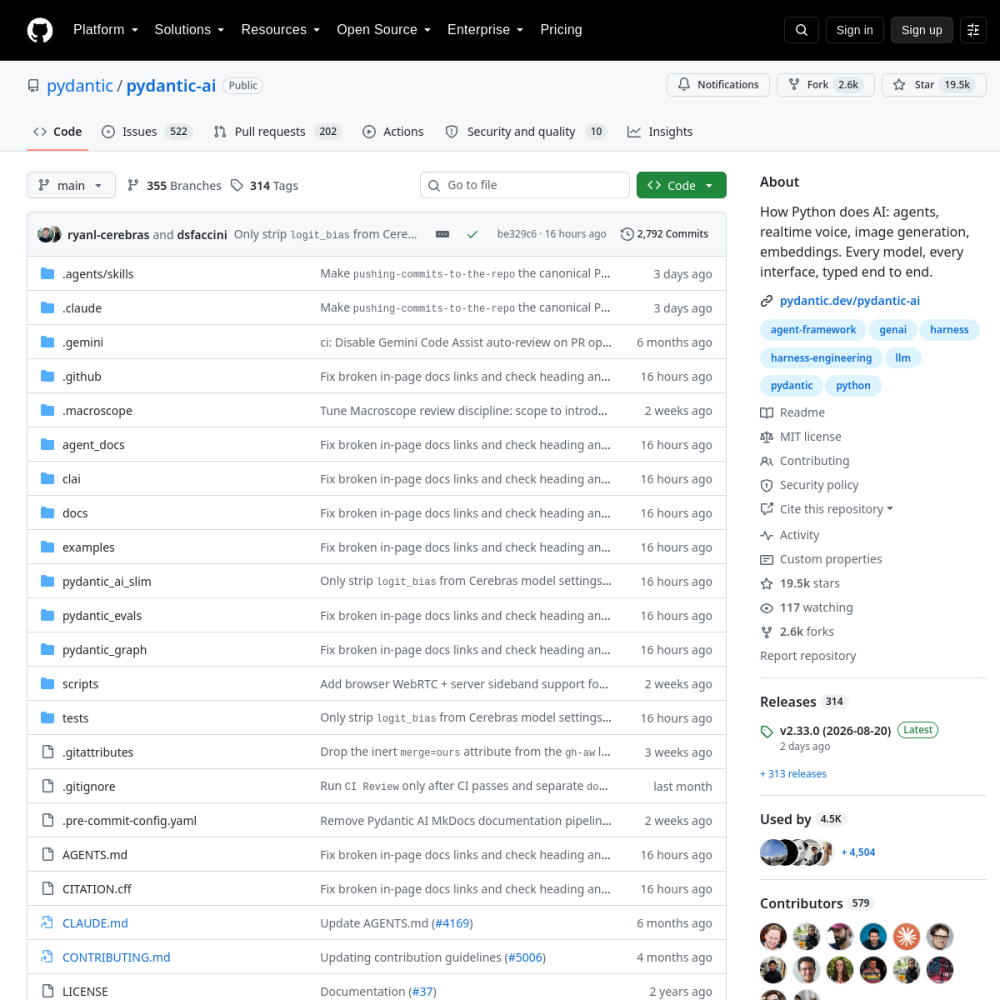
PydanticAI - Production-Grade Type-Safe Agent Framework by Pydantic

Vendor: pydantic

PydanticAI is the official Pythonic agent framework by the Pydantic team, pioneering type-safe Dependency Injection, dynamic system prompts, and strict schema validation for production GenAI.

View Repository

Official Preview
PydanticAI - Production-Grade Type-Safe Agent Framework by Pydantic

Technical Specifications

Repositorypydantic/pydantic-ai
GitHub Stars★ 19.6k
Forks2.6k forks
Primary LanguagePython
LicenseMIT
Technical DomainFRAMEWORK
agent-frameworkgenaiharnessharness-engineeringllmpydanticpython
4.9Overall
Functionality
5.0
Documentation
4.9
Activity
5.0
Ease of use
5.0

Quickstart & Installation

$ bash pip install pydantic-ai

Comprehensive Review

PydanticAI (pydantic/pydantic-ai) is the official production-grade agent framework developed by the Pydantic team, the creators of the data validation standard powering FastAPI, Instructor, and the modern Python AI stack. Recognizing that many existing agent frameworks introduce bloated abstractions, opaque execution paths, and poor type safety, Pydantic applied pure Pythonic software engineering principles to generative AI application development.

Architecturally, PydanticAI introduces type-safe Dependency Injection to agent workflows. By leveraging generic run contexts (RunContext[Deps]), developers cleanly inject database connection pools, external HTTP clients, and authenticated user contexts directly into dynamic system prompts and tool execution functions without global state workarounds.

For dynamic prompt engineering and agent skill dispatch, PydanticAI delivers unparalleled type safety. All tool arguments and structured return payloads undergo rigorous Pydantic validation with automated model retry loops upon validation failure. System prompts can be computed dynamically based on runtime dependencies, enabling teams to build maintainable, enterprise-grade agent systems with full IDE autocompletion and static analysis support.

Project Background

PydanticAI marks the maturation of the Python AI ecosystem into rigorous software engineering. Over the past two years, developers contended with AI frameworks heavy on magic strings, convoluted inheritance trees, and opaque execution loops that routinely failed in production when unvalidated payloads caused runtime crashes.

As the custodians of Python's data validation standard, the Pydantic team demonstrated that building robust agents does not require inventing convoluted paradigms. By uniting static type hints, Dependency Injection, Pydantic validators, and clean decorators, PydanticAI brings the crisp, maintainable developer experience of FastAPI to agent engineering.

The core engineering philosophy dictates: if an agent cannot pass static analysis with Mypy or Pyright at authoring time, it cannot be trusted in production. PydanticAI enforces 'types as contracts' throughout token generation and skill execution.

Core Use Cases

In enterprise support automation, injecting PostgreSQL database sessions via RunContext enables agents to fetch recent order histories dynamically within system prompts and dispatch refunds safely.

In banking and financial compliance agents, strict Pydantic schemas enforce validation rules on every credit assessment before hitting core transactional systems.

In multi-tenant SaaS platforms, RunContext isolates per-tenant API tokens and encryption keys, preventing cross-tenant data contamination.

In high-throughput AI microservice architectures, pairing PydanticAI with FastAPI delivers sub-second response times, complete OpenAPI contracts, and 100% unit-test coverage.

Quickstart Guide

Install PydanticAI:

bash
pip install pydantic-ai

The following example demonstrates building a type-safe agent with dynamic system prompts and dependency injection:

python
import os
from dataclasses import dataclass
from pydantic_ai import Agent, RunContext
from pydantic import BaseModel

# 1. Define runtime dependency context
@dataclass
class DatabaseDeps:
    user_name: str
    user_tier: str

# 2. Declare structured output schema
class SupportResponse(BaseModel):
    message: str
    suggested_action: str

# 3. Instantiate type-safe agent
agent = Agent(
    'openai:gpt-4o',
    deps_type=DatabaseDeps,
    result_type=SupportResponse,
)

# 4. Compute dynamic system prompt at runtime
@agent.system_prompt
def add_user_context(ctx: RunContext[DatabaseDeps]) -> str:
    return f"User: {ctx.deps.user_name}, Tier: {ctx.deps.user_tier}. Tailor your response accordingly."

# 5. Define type-safe agent skill tool
@agent.tool
def query_order_status(ctx: RunContext[DatabaseDeps], order_id: str) -> str:
    """Query shipping status for an order."""
    return f"Order {order_id} is in transit via Express, estimated delivery today."

# 6. Run agent with injected dependencies
deps = DatabaseDeps(user_name="Sarah Connor", user_tier="Diamond VIP")
result = agent.run_sync("Check tracking on order #9527 please.", deps=deps)

print("Message:", result.data.message)
print("Suggested Action:", result.data.suggested_action)

Author deterministic unit tests without making live network calls using the built-in TestModel:

python
from pydantic_ai.models.test import TestModel
test_agent = Agent(TestModel())

Practicality Assessment

In testability, PydanticAI provides a native TestModel, allowing engineers to author 100% deterministic pytest test suites verifying tool logic, prompt generation, and dependency injection without making real network calls or incurring API fees.

Regarding observability, PydanticAI integrates natively with Pydantic Logfire, delivering comprehensive span traces, latency breakdowns, and payload logging out-of-the-box.

Streaming is first-class: run_stream enables structured object and textual streaming for fluid frontend interactions.

Real-world Deployments

Within months of release, PydanticAI amassed nearly 20,000 GitHub stars, emerging as the premier choice for serious Python backend engineers building enterprise agent systems.

In a cloud-native DevOps deployment, an engineering group refactored their Kubernetes diagnostics bot to PydanticAI, eliminating runtime schema failures entirely.

Due to its native synergy with FastAPI, Pydantic, and modern async Python, PydanticAI is rapidly solidifying its role as the industry standard for production AI microservices.

Core Strengths

  • Built by the official Pydantic team, bringing FastAPI-grade elegance and type safety to agent engineering
  • Type-safe Dependency Injection (`RunContext[Deps]`) for clean database and state management
  • Dynamic system prompts via `@agent.system_prompt` that adapt based on real-time runtime context
  • First-class structured output validation, streaming token parsing, and native Logfire observability

Considerations & Limitations

  • Requires appropriate GPU memory planning and concurrency tuning for production.

Frequently Asked Questions (FAQ)

What is PydanticAI - Production-Grade Type-Safe Agent Framework by Pydantic and what key challenges does it solve?

PydanticAI - Production-Grade Type-Safe Agent Framework by Pydantic is an open-source AI project developed primarily in Python under the MIT license. PydanticAI is the official Pythonic agent framework by the Pydantic team, pioneering type-safe Dependency Injection, dynamic system prompts, and strict schema validation for production GenAI.. PydanticAI marks the maturation of the Python AI ecosystem into rigorous software engineering. Over the past two years, developers contended with AI frameworks heavy on magic strings, convoluted inheritance trees, and opaque execution loops that routinely failed in production when unvalidated payloads caused runtime crashes. As the custodians of Python's data validation standard, the Pydantic team demonstrated that building robust agents does not require inventing convoluted paradigms. By uniting static type hints, Dependency Injection, Pydantic validators, and clean decorators, PydanticAI brings the crisp, maintainable developer experience of FastAPI to agent engineering. The core engineering philosophy dictates: if an agent cannot pass static analysis with Mypy or Pyright at authoring time, it cannot be trusted in production. PydanticAI enforces 'types as contracts' throughout token generation and skill execution.

How can I quickly install and run PydanticAI - Production-Grade Type-Safe Agent Framework by Pydantic locally?

Install PydanticAI:

bash
pip install pydantic-ai

The following example demonstrates building a type-safe agent with dynamic system prompts and dependency injection:

python
import os
from dataclasses import dataclass
from pydantic_ai import Agent, RunContext
from pydantic import BaseModel

# 1. Define runtime dependency context
@dataclass
class DatabaseDeps:
    user_name: str
    user_tier: str

# 2. Declare structured output schema
class SupportResponse(BaseModel):
    message: str
    suggested_action: str

# 3. Instantiate type-safe agent
agent = Agent(
    'openai:gpt-4o',
    deps_type=DatabaseDeps,
    result_type=SupportResponse,
)

# 4. Compute dynamic system prompt at runtime
@agent.system_prompt
def add_user_context(ctx: RunContext[DatabaseDeps]) -> str:
    return f"User: {ctx.deps.user_name}, Tier: {ctx.deps.user_tier}. Tailor your response accordingly."

# 5. Define type-safe agent skill tool
@agent.tool
def query_order_status(ctx: RunContext[DatabaseDeps], order_id: str) -> str:
    """Query shipping status for an order."""
    return f"Order {order_id} is in transit via Express, estimated delivery today."

# 6. Run agent with injected dependencies
deps = DatabaseDeps(user_name="Sarah Connor", user_tier="Diamond VIP")
result = agent.run_sync("Check tracking on order #9527 please.", deps=deps)

print("Message:", result.data.message)
print("Suggested Action:", result.data.suggested_action)

Author deterministic unit tests without making live network calls using the built-in TestModel:

python
from pydantic_ai.models.test import TestModel
test_agent = Agent(TestModel())

What are the main use cases and strengths of PydanticAI - Production-Grade Type-Safe Agent Framework by Pydantic?

PydanticAI - Production-Grade Type-Safe Agent Framework by Pydantic is well-suited for Enterprise Type-Safe Agent Microservices, Dynamic Context-Aware Assistants, Strong-Contract Tool Invocation Pipelines, Testable High-Concurrency AI Backends. With an overall rating of 4.9/5, it offers strong community activity, reliable performance, and easy integration with existing AI pipelines.

What limitations or architectural considerations should be kept in mind for PydanticAI - Production-Grade Type-Safe Agent Framework by Pydantic?

In testability, PydanticAI provides a native TestModel, allowing engineers to author 100% deterministic pytest test suites verifying tool logic, prompt generation, and dependency injection without making real network calls or incurring API fees. Regarding observability, PydanticAI integrates natively with Pydantic Logfire, delivering comprehensive span traces, latency breakdowns, and payload logging out-of-the-box. Streaming is first-class: run_stream enables structured object and textual streaming for fluid frontend interactions.