Official Preview
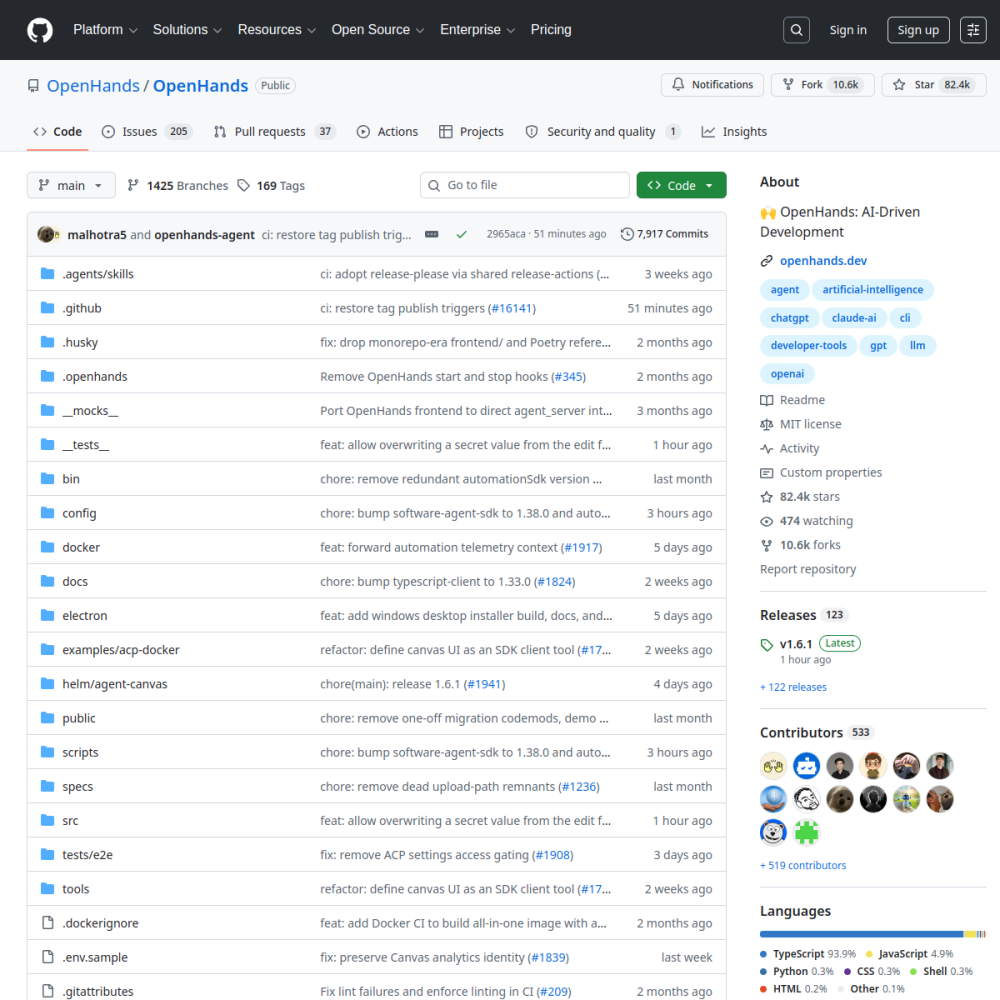
| Repository | All-Hands-AI/OpenHands |
|---|---|
| GitHub Stars | ★ 85k |
| Forks | 11.1k forks |
| Primary Language | TypeScript |
| License | MIT |
| Technical Domain | AGENTS |
$ git clone https://github.com/All-Hands-AI/OpenHands.git && cd OpenHands
OpenHands (formerly OpenDevin) is the open-source answer to Devin, an AI software-engineering agent aiming to autonomously complete the full development loop reading code, editing, running tests, and opening PRs inside a sandbox. It is one of the most active open-source projects in the agents-that-actually-do-work direction.
Core capabilities include a sandboxed runtime (AgentRuntime), file editing and command execution, browser operation, GitHub/GitLab integration for auto PRs, multiple backend models (Claude, GPT, open-source models), and pluggable agent policies (CodeAct and others). Newer versions add multi-agent collaboration and longer-horizon task planning.
The highlight is the ability to handle end-to-end issue-to-PR tasks, with code-change quality on real repositories in the top tier of open-source peers. The downside is unstable success rates, long-horizon tasks tend to drift off-track midway, token consumption is high, and the security boundary needs careful evaluation for private repos.
Use cases: automated bug fixing and refactoring, batch processing of simple issues, agent research platforms. For production codebases, human review of every PR is strongly recommended.
OpenHands, formerly known as OpenDevin, emerged as an open-source alternative to commercial AI software-engineering agents like Devin. It addresses the challenge of automating the complete development lifecycle, from reading code and editing files to running tests and opening pull requests within a secure sandbox.
The project focuses on creating autonomous agents capable of executing real-world software engineering tasks without human intervention. Its architecture supports multiple backend models and pluggable agent policies, aiming to establish a robust foundation for agents that actually perform work.
Developers can utilize OpenHands for automated bug fixing and code refactoring tasks, allowing the agent to identify issues and propose corrections directly within the repository. This reduces the manual effort required for routine maintenance and allows engineers to focus on more complex architectural decisions.
The system is also suitable for batch processing simple issues, such as updating dependencies or fixing linting errors across multiple files. Research teams often adopt it as a platform for testing new agent policies and evaluating long-horizon task planning capabilities in controlled environments.
While powerful, the tool is best suited for scenarios where human oversight remains available. Production codebases require careful evaluation, as the agent operates autonomously and may introduce changes that need verification before merging.
Installation requires a Python environment where users can clone the repository and install dependencies. The system supports multiple backend models including Claude, GPT, and open-source options, requiring appropriate API keys or local model configurations during setup.
Users must configure the sandboxed runtime environment to ensure safe execution of commands and file operations. Initial runs typically involve defining a task or issue description, after which the agent begins the autonomous development loop within the isolated container.
OpenHands demonstrates top-tier code-change quality on real repositories, successfully handling end-to-end issue-to-PR workflows. The project maintains high activity levels and comprehensive documentation, earning a functionality and documentation rating of 4.0 out of 5.
However, production readiness comes with caveats regarding unstable success rates and high token consumption. Long-horizon tasks tend to drift off-track midway, and the security boundary requires careful evaluation before exposing private repositories to the agent runtime.
While specific enterprise adoption details are not publicly enumerated, the project is widely used within the open-source community for agent research and experimentation. Teams often integrate it into internal workflows to triage simple issues or automate repetitive coding tasks.
Integration scenarios typically involve connecting the agent to GitHub or GitLab repositories for automated pull request generation. Organizations considering this tool should prioritize human review of every generated PR to mitigate risks associated with autonomous code modifications.
OpenHands is an open-source AI project developed primarily in TypeScript under the MIT license. AI software-engineering agent. OpenHands, formerly known as OpenDevin, emerged as an open-source alternative to commercial AI software-engineering agents like Devin. It addresses the challenge of automating the complete development lifecycle, from reading code and editing files to running tests and opening pull requests within a secure sandbox. The project focuses on creating autonomous agents capable of executing real-world software engineering tasks without human intervention. Its architecture supports multiple backend models and pluggable agent policies, aiming to establish a robust foundation for agents that actually perform work.
Installation requires a Python environment where users can clone the repository and install dependencies. The system supports multiple backend models including Claude, GPT, and open-source options, requiring appropriate API keys or local model configurations during setup. Users must configure the sandboxed runtime environment to ensure safe execution of commands and file operations. Initial runs typically involve defining a task or issue description, after which the agent begins the autonomous development loop within the isolated container.
OpenHands is well-suited for Automated bug fixing, Batch simple issue triage, Agent research platform. With an overall rating of 4.0/5, it offers strong community activity, reliable performance, and easy integration with existing AI pipelines.
OpenHands demonstrates top-tier code-change quality on real repositories, successfully handling end-to-end issue-to-PR workflows. The project maintains high activity levels and comprehensive documentation, earning a functionality and documentation rating of 4.0 out of 5. However, production readiness comes with caveats regarding unstable success rates and high token consumption. Long-horizon tasks tend to drift off-track midway, and the security boundary requires careful evaluation before exposing private repositories to the agent runtime.
Minimal tool for running large language models locally