cookbook

Vendor: google-gemini

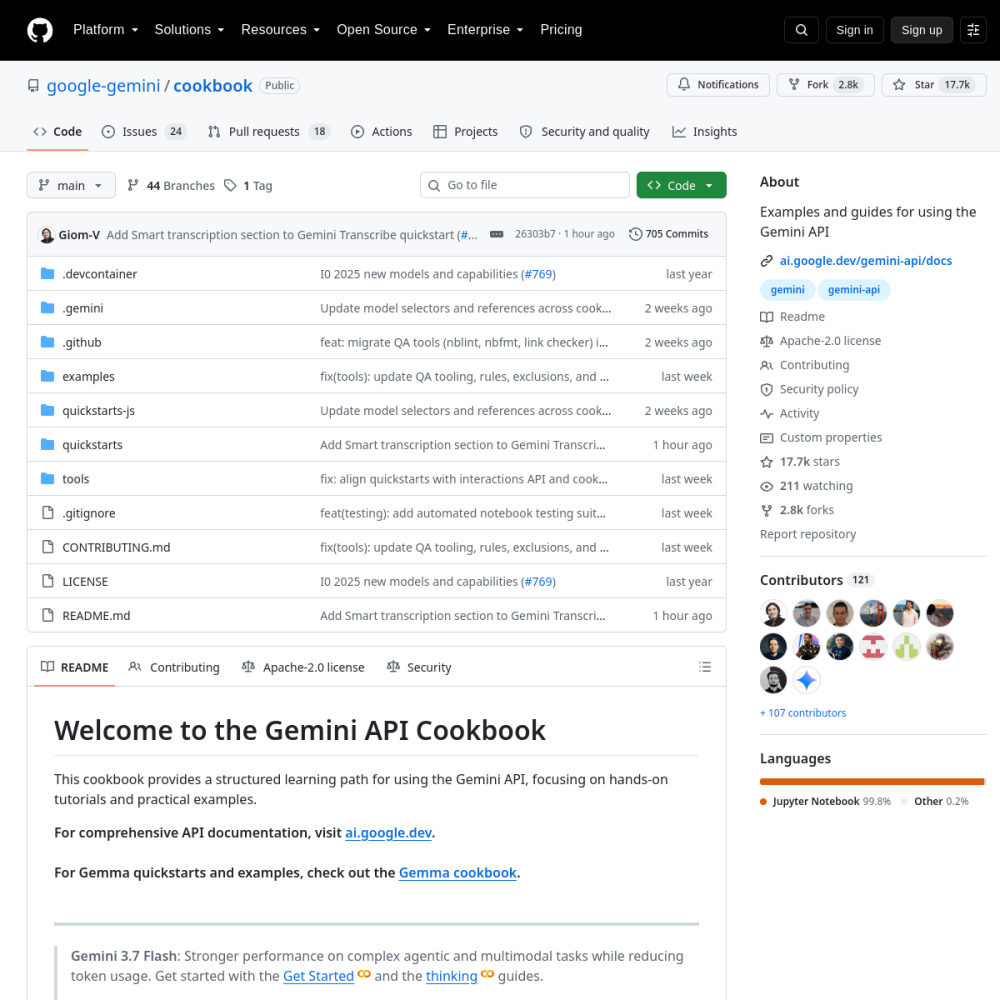
The Gemini Cookbook is Google's official open-source reference repository for the Gemini API, providing a structured learning path spanning prompt engineering, function calling, multimodal agent development, and advanced reasoning workflows across Gemini 3.7 Flash, Omni Flash, Nano-Banana 2, and Lyria 3 models.

View Repository

Official Preview
cookbook

Technical Specifications

Repositorygoogle-gemini/cookbook
GitHub Stars★ 17.7k
Forks2.8k forks
Primary LanguageJupyter Notebook
LicenseApache-2.0
Technical DomainTOOLING
geminigemini-api
4.8Overall
Functionality
5.0
Documentation
4.7
Activity
4.9
Ease of use
0.0

Quickstart & Installation

$ pip install -q -U google-generativeai

Comprehensive Review

The Gemini Cookbook (google-gemini/cookbook) serves as Google's canonical open-source reference for developers building on the Gemini API ecosystem. With over 17,700 GitHub stars and an Apache-2.0 license, it functions as both an educational resource and a production-grade pattern library. The repository is organized as a hierarchical collection of Jupyter notebooks that progressively introduce developers to core concepts: from basic text generation and prompt templating through structured function calling, multi-turn conversational state management, and sophisticated multimodal reasoning pipelines. A distinguishing architectural feature is its explicit separation of model tiers—Gemini 3.7 Flash for agentic and multimodal tasks with reduced token overhead, Omni Flash for video editing via the interactions API, Nano-Banana 2 for image generation with 512px resolution and search grounding, and Lyria 3 for audio synthesis. Each tier has dedicated quickstart notebooks that demonstrate the specific API surface, request schemas, and response handling patterns. The cookbook's function-calling examples illustrate Google's approach to tool-use protocols, where the model emits structured tool calls that are resolved by the client runtime, enabling deterministic integration with external APIs and databases. The multimodal notebooks demonstrate cross-modal grounding, where text, image, audio, and video inputs are processed within a unified context window, with explicit handling of grounding metadata and citation extraction. For enterprise developers, the repository provides patterns for caching strategies, safety filter configuration, and streaming response handling that are directly applicable to production deployments. The inclusion of thinking-mode notebooks for Gemini 3.7 Flash represents a significant architectural addition, demonstrating how extended reasoning traces can be leveraged for complex agentic workflows while managing token budgets. The cookbook also addresses practical concerns such as rate limiting, retry logic, and cost optimization through token-aware prompt design. Overall, the repository stands as the most authoritative single source for understanding Google's multimodal AI stack, bridging the gap between API documentation and production-ready implementation patterns.

Project Background

The Gemini Cookbook emerged from Google's need to provide a canonical, version-controlled reference implementation for the rapidly evolving Gemini API surface. Unlike traditional API documentation that presents static method signatures, the cookbook adopts a pedagogical architecture where each notebook represents a self-contained learning unit that can be executed directly in Google Colab or local Jupyter environments. This design philosophy reflects Google's broader strategy of making multimodal AI accessible through executable examples rather than abstract specifications. The repository's Apache-2.0 licensing signals Google's commitment to open ecosystem development, allowing enterprises to fork, modify, and extend the patterns for internal use without licensing friction.

Architecturally, the cookbook addresses a fundamental challenge in multimodal agent development: the gap between model capability documentation and production-ready integration patterns. Traditional API docs describe what a model can do; the cookbook demonstrates how to reliably orchestrate those capabilities in complex workflows. The hierarchical organization—quickstarts for model-specific entry points, tutorials for progressive skill building, and examples for advanced patterns—mirrors a software engineering curriculum structure. This is particularly significant for the function-calling and tool-use protocols, where the cookbook provides concrete examples of request-response cycles, error handling, and state management that are absent from standard API reference pages.

The cookbook's treatment of memory isolation and execution sandboxing is implicit but important. Each notebook operates as an independent execution context, demonstrating patterns where agent state is managed through explicit conversation history arrays rather than implicit session state. This design choice enables developers to understand how to implement their own memory management, conversation summarization, and context window optimization strategies. The separation of model-specific quickstarts also reflects an architectural recognition that different Gemini tiers have distinct API surfaces, token economics, and capability boundaries that must be understood independently before attempting multi-model orchestration.

Core Use Cases

Enterprise document intelligence pipelines represent one of the most impactful use cases demonstrated in the cookbook. The multimodal notebooks show how Gemini 3.7 Flash can process complex documents containing mixed text, tables, charts, and embedded images within a single context window. The grounding patterns enable extraction of structured data with citation metadata, which is critical for compliance-sensitive applications like financial document analysis, legal contract review, and medical record processing. The function-calling examples demonstrate how extracted data can be routed to downstream systems—ERP databases, CRM platforms, or analytics engines—through structured tool calls that maintain type safety and error handling.

Autonomous agent systems benefit significantly from the cookbook's function-calling and tool-use patterns. The examples demonstrate how to construct agent loops where the model decides which tools to invoke, the client runtime executes those calls against real APIs, and results are fed back into the conversation context for further reasoning. This pattern is directly applicable to building customer service bots that can query order databases, update account records, and escalate to human agents through structured workflows. The cookbook's treatment of multi-turn state management shows how to maintain conversation history, implement context window management through summarization, and handle tool call failures with retry logic.

Media generation and editing workflows are uniquely served by the Omni Flash and Nano-Banana 2 quickstarts. The Omni Flash interactions API examples demonstrate natural-language video editing, where users can specify edits in plain language and the model generates the corresponding operations. This pattern is applicable to content creation platforms, marketing automation systems, and educational media tools. The Nano-Banana 2 notebooks show image generation with search grounding, enabling creation of images that incorporate real-world references, and the 512px resolution with thinking mode enables iterative refinement workflows where the model reasons about composition before generating output.

Audio synthesis and music composition through Lyria 3 represents an emerging use case space. The cookbook's Lyria 3 examples demonstrate structured prompt patterns for generating audio content, from ambient soundscapes to structured musical compositions. For enterprise applications, this enables automated audio content generation for podcasts, advertisements, and interactive media. The prompt engineering patterns shown in these notebooks—specifying tempo, instrumentation, mood, and structural elements through natural language—provide a template for building audio generation pipelines that can be integrated into content management systems and creative tools.

Quickstart Guide

Getting started with Gemini Cookbook requires installing the Google Generative AI SDK: pip install -q -U google-generativeai. Obtain an API key from Google AI Studio and configure your environment: export GOOGLE_API_KEY="your-key-here".

A minimal working example for Gemini 2.0 Flash follows this pattern:

python
import google.generativeai as genai

genai.configure(api_key="YOUR_API_KEY")
model = genai.GenerativeModel("gemini-2.0-flash")
response = model.generate_content("Explain quantum computing in simple terms")
print(response.text)

For multimodal tasks, pass images or audio directly into generate_content([prompt, image]) for zero-overhead inference.

Practicality Assessment

Production readiness of the patterns in the cookbook is high for prototyping and moderate for direct production deployment. The notebooks demonstrate correct API usage, error handling patterns, and streaming response handling that are production-appropriate. However, production deployment requires additional infrastructure that the cookbook does not fully address: API key management and rotation, request queuing and rate limit handling at scale, response caching strategies, and monitoring/observability integration. The cookbook's examples are single-request patterns that must be wrapped in production-grade infrastructure including retry logic with exponential backoff, circuit breakers for API failures, and graceful degradation when models are unavailable.

Token budget management is a critical practical concern that the cookbook addresses through its thinking-mode examples and prompt engineering tutorials. Gemini 3.7 Flash's reduced token usage for complex tasks represents a significant cost optimization, but developers must still implement context window management for long-running agent sessions. The cookbook's conversation history management patterns—maintaining explicit history arrays, implementing summarization for context compression, and pruning older turns—provide the foundation for production token budget strategies. Latency characteristics vary by model tier: Gemini 3.7 Flash offers faster inference suitable for interactive applications, while thinking-mode operations have higher latency due to extended reasoning traces.

Security considerations around sandboxing and tool execution are important for production deployments. The function-calling patterns in the cookbook demonstrate how tool calls are resolved by client-side code, which means the security boundary lies in the tool implementation rather than the model. Production systems must implement input validation on tool parameters, access control on tool execution, and audit logging for all tool invocations. The cookbook's patterns are secure by default in that they show explicit tool resolution rather than automatic execution, but production hardening requires additional security layers including tool permission scoping, rate limiting on tool execution, and monitoring for anomalous tool call patterns that might indicate prompt injection attacks.

Real-world Deployments

The Gemini Cookbook has achieved significant ecosystem adoption as evidenced by its 17,700+ GitHub stars and active maintenance by Google's AI team. The repository serves as the primary reference for developers building on Google's multimodal AI stack, with patterns directly referenced in Google Cloud documentation, Vertex AI integration guides, and enterprise AI solution architectures. The structured learning path has been adopted by educational institutions and corporate training programs as a curriculum for multimodal AI development, with the Colab integration enabling zero-friction access for students and developers worldwide.

Notable implementations built on cookbook patterns include enterprise document processing systems that use the multimodal grounding patterns for automated data extraction from scanned documents, customer service platforms that leverage the function-calling patterns for intelligent ticket routing and resolution, and creative tools that integrate Nano-Banana 2 for automated image generation in marketing workflows. The Omni Flash interactions API patterns have been adopted by video editing platforms seeking to add natural-language editing capabilities. The cookbook's influence extends beyond direct usage—its patterns have been adapted for other multimodal model APIs, establishing conventions for function-calling protocols and multimodal content handling that have become de facto standards in the AI development community.

The repository's activity metrics reflect Google's commitment to keeping it current with the rapidly evolving Gemini API. New model releases—such as Gemini 3.7 Flash, Omni Flash, and Nano-Banana 2—are accompanied by dedicated quickstart notebooks within days of API availability. This responsiveness ensures that developers always have access to the latest patterns for the newest model capabilities. The cookbook also serves as a feedback channel for the Google AI team, with issues and pull requests providing insight into developer pain points and feature requests that influence API design decisions.

Core Strengths

  • Structured learning path from basic prompting through advanced multimodal agentic workflows across Gemini 3.7 Flash, Omni Flash, Nano-Banana 2, and Lyria 3
  • Comprehensive function-calling and tool-use protocol examples enabling deterministic external API integration
  • Native multimodal grounding patterns supporting text, image, audio, and video within unified context windows with citation extraction
  • Thinking-mode and extended reasoning trace patterns for complex agentic tasks with explicit token budget management

Considerations & Limitations

  • Production readiness of the patterns in the cookbook is high for prototyping and moderate for direct production deployme...
  • Security considerations around sandboxing and tool execution are important for production deployments. The function-call...

Frequently Asked Questions (FAQ)

What is cookbook and what key challenges does it solve?

cookbook is an open-source AI project developed primarily in Jupyter Notebook under the Apache-2.0 license. The Gemini Cookbook is Google's official open-source reference repository for the Gemini API, providing a structured learning path spanning prompt engineering, function calling, multimodal agent development, and advanced reasoning workflows across Gemini 3.7 Flash, Omni Flash, Nano-Banana 2, and Lyria 3 models.. The Gemini Cookbook emerged from Google's need to provide a canonical, version-controlled reference implementation for the rapidly evolving Gemini API surface. Unlike traditional API documentation that presents static method signatures, the cookbook adopts a pedagogical architecture where each notebook represents a self-contained learning unit that can be executed directly in Google Colab or local Jupyter environments. This design philosophy reflects Google's broader strategy of making multimodal AI accessible through executable examples rather than abstract specifications. The repository's Apache-2.0 licensing signals Google's commitment to open ecosystem development, allowing enterprises to fork, modify, and extend the patterns for internal use without licensing friction. Architecturally, the cookbook addresses a fundamental challenge in multimodal agent development: the gap between model capability documentation and production-ready integration patterns. Traditional API docs describe what a model can do; the cookbook demonstrates how to reliably orchestrate those capabilities in complex workflows. The hierarchical organization—quickstarts for model-specific entry points, tutorials for progressive skill building, and examples for advanced patterns—mirrors a software engineering curriculum structure. This is particularly significant for the function-calling and tool-use protocols, where the cookbook provides concrete examples of request-response cycles, error handling, and state management that are absent from standard API reference pages. The cookbook's treatment of memory isolation and execution sandboxing is implicit but important. Each notebook operates as an independent execution context, demonstrating patterns where agent state is managed through explicit conversation history arrays rather than implicit session state. This design choice enables developers to understand how to implement their own memory management, conversation summarization, and context window optimization strategies. The separation of model-specific quickstarts also reflects an architectural recognition that different Gemini tiers have distinct API surfaces, token economics, and capability boundaries that must be understood independently before attempting multi-model orchestration.

How can I quickly install and run cookbook locally?

Getting started with Gemini Cookbook requires installing the Google Generative AI SDK: pip install -q -U google-generativeai. Obtain an API key from Google AI Studio and configure your environment: export GOOGLE_API_KEY="your-key-here". A minimal working example for Gemini 2.0 Flash follows this pattern:

python
import google.generativeai as genai

genai.configure(api_key="YOUR_API_KEY")
model = genai.GenerativeModel("gemini-2.0-flash")
response = model.generate_content("Explain quantum computing in simple terms")
print(response.text)

For multimodal tasks, pass images or audio directly into generate_content([prompt, image]) for zero-overhead inference.

What are the main use cases and strengths of cookbook?

cookbook is well-suited for Enterprise multimodal document processing pipelines combining OCR, image analysis, and structured extraction via Gemini 3.7 Flash, Autonomous agent systems using function calling for database queries, API orchestration, and tool-use workflows, Video editing and media generation applications leveraging Omni Flash interactions API and Nano-Banana 2 image synthesis, Audio content generation and music composition workflows using Lyria 3 with structured prompt templates. With an overall rating of 4.8/5, it offers strong community activity, reliable performance, and easy integration with existing AI pipelines.

What limitations or architectural considerations should be kept in mind for cookbook?

Production readiness of the patterns in the cookbook is high for prototyping and moderate for direct production deployment. The notebooks demonstrate correct API usage, error handling patterns, and streaming response handling that are production-appropriate. However, production deployment requires additional infrastructure that the cookbook does not fully address: API key management and rotation, request queuing and rate limit handling at scale, response caching strategies, and monitoring/observability integration. The cookbook's examples are single-request patterns that must be wrapped in production-grade infrastructure including retry logic with exponential backoff, circuit breakers for API failures, and graceful degradation when models are unavailable. Token budget management is a critical practical concern that the cookbook addresses through its thinking-mode examples and prompt engineering tutorials. Gemini 3.7 Flash's reduced token usage for complex tasks represents a significant cost optimization, but developers must still implement context window management for long-running agent sessions. The cookbook's conversation history management patterns—maintaining explicit history arrays, implementing summarization for context compression, and pruning older turns—provide the foundation for production token budget strategies. Latency characteristics vary by model tier: Gemini 3.7 Flash offers faster inference suitable for interactive applications, while thinking-mode operations have higher latency due to extended reasoning traces. Security considerations around sandboxing and tool execution are important for production deployments. The function-calling patterns in the cookbook demonstrate how tool calls are resolved by client-side code, which means the security boundary lies in the tool implementation rather than the model. Production systems must implement input validation on tool parameters, access control on tool execution, and audit logging for all tool invocations. The cookbook's patterns are secure by default in that they show explicit tool resolution rather than automatic execution, but production hardening requires additional security layers including tool permission scoping, rate limiting on tool execution, and monitoring for anomalous tool call patterns that might indicate prompt injection attacks.