e2b

Vendor: e2b-dev

E2B is an open-source, Apache-2.0 licensed infrastructure platform providing secure, isolated sandbox environments for AI agents to execute arbitrary code (Python/JS) in the cloud. With dual Python and TypeScript SDKs, it enables enterprise-grade agent architectures by solving the critical problem of safely running LLM-generated code without compromising host systems.

View Repository

Official Preview
e2b

Technical Specifications

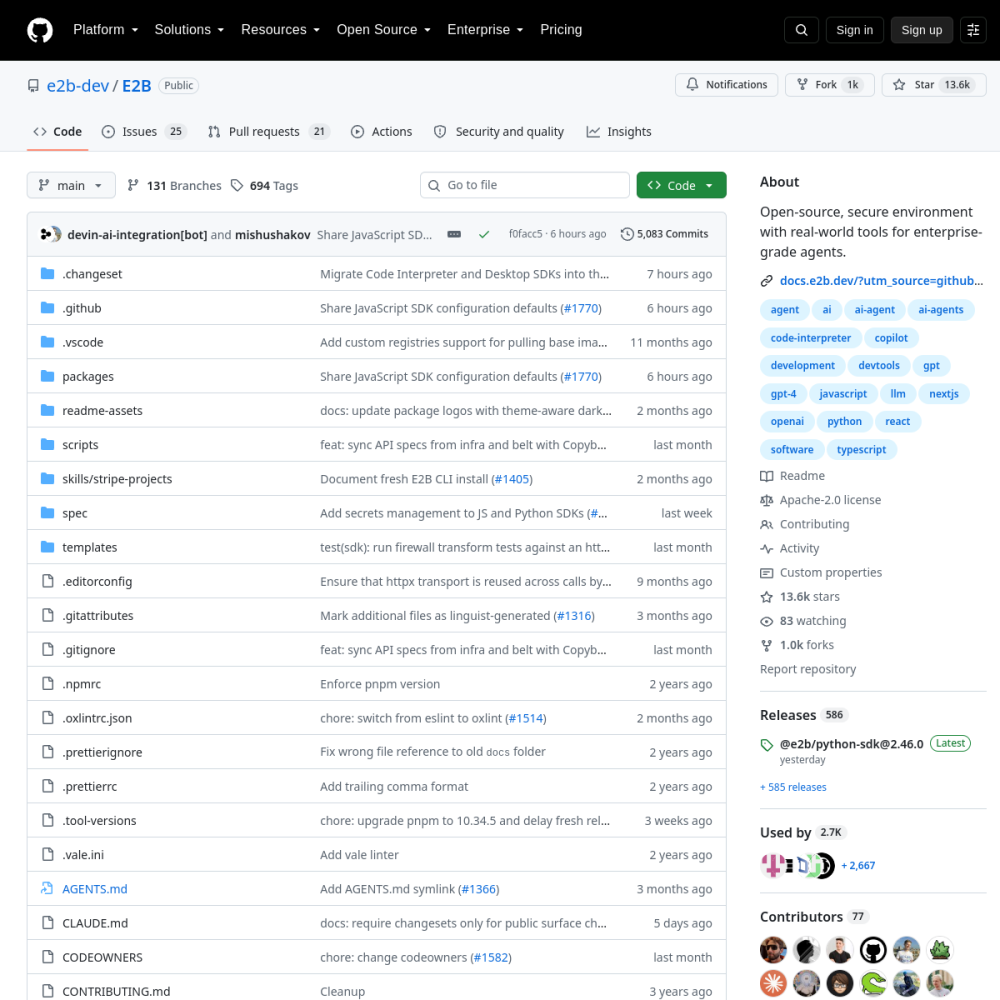
Repositorye2b-dev/e2b
GitHub Stars★ 13.6k
Forks1k forks
Primary LanguagePython
LicenseApache-2.0
Technical DomainTOOLING
agentaiai-agentai-agentscode-interpretercopilotdevelopmentdevtoolsgptgpt-4javascriptllmnextjsopenaipythonreactsoftwaretypescript
4.8Overall
Functionality
5.0
Documentation
4.7
Activity
4.9
Ease of use
0.0

Quickstart & Installation

$ git clone https://github.com/e2b-dev/e2b.git && cd e2b

Comprehensive Review

E2B represents a fundamental architectural breakthrough in the AI agent ecosystem by addressing one of the most persistent challenges in autonomous agent design: the safe execution of LLM-generated code. Traditional agent frameworks face a binary choice—either restrict agents to pre-defined tools (limiting capability) or grant them direct system access (creating unacceptable security risks). E2B resolves this tension through a cloud-hosted sandboxing layer that provides agents with full computational freedom within tightly isolated environments. The platform leverages containerized execution with network isolation, filesystem sandboxing, and resource quotas to ensure that even malicious or erroneous agent-generated code cannot escape its execution boundary. The architecture is built around a dual-SDK approach (Python and TypeScript/JavaScript), enabling seamless integration into both data-centric and web-centric agent pipelines. Each sandbox instance is ephemeral, provisioned on-demand, and destroyed upon task completion, which naturally enforces state isolation between agent sessions. The platform supports real-time stdout/stderr capture, file system operations, and process management, giving agents the full spectrum of a development environment while maintaining enterprise-grade security guarantees. With 13,500+ GitHub stars and active monthly downloads across PyPI and npm, E2B has rapidly become a foundational dependency for production agent systems. Its Apache-2.0 licensing and open-source core make it suitable for both commercial deployment and self-hosted infrastructure, distinguishing it from proprietary sandboxing solutions. The platform's design philosophy centers on the principle that agents should have unrestricted computational capability within well-defined security boundaries, enabling complex multi-step reasoning workflows that require dynamic code generation, data analysis, and tool synthesis.

Project Background

E2B emerged from a fundamental recognition that the trajectory of AI agent development was bottlenecked by execution safety. As large language models became increasingly capable of generating syntactically correct and semantically meaningful code, the gap between agent capability and deployment safety widened dramatically. The project's origin philosophy centers on a simple but profound insight: agents should not be artificially constrained by tool limitations when the real problem is execution isolation. Rather than building increasingly complex allowlists of permitted operations, E2B inverts the paradigm by providing unrestricted execution within a hardened boundary. This architectural decision reflects a deep understanding of agent behavior patterns—agents that are overly constrained tend to produce verbose, inefficient code as they work around limitations, while agents with full execution freedom can express intent directly and concisely.

The core architectural breakthrough lies in E2B's approach to sandbox lifecycle management. Unlike traditional container-based solutions that require manual provisioning and teardown, E2B implements a serverless execution model where sandboxes are provisioned on-demand with sub-second latency and automatically recycled after task completion. This ephemeral model eliminates persistent state accumulation, reduces attack surface, and naturally enforces the principle of least privilege. The platform's isolation layer combines multiple security mechanisms: container-level namespace isolation prevents process escape, network policies restrict outbound communication to configured endpoints, filesystem mounts are read-only by default with explicit write permissions, and resource quotas (CPU, memory, disk) prevent denial-of-service scenarios. The design also incorporates a gRPC-based control plane that manages sandbox lifecycle, enabling fine-grained monitoring and intervention capabilities essential for enterprise deployment.

From a systems architecture perspective, E2B's SDK design reflects careful consideration of agent interaction patterns. The SDK exposes a high-level abstraction over sandbox operations—code execution, file management, process spawning, and output capture—while maintaining low-level access for advanced use cases. This layered API design allows simple agents to use straightforward execute() calls while sophisticated multi-agent systems can orchestrate complex workflows involving multiple sandboxes, shared filesystems, and inter-sandbox communication. The platform's architecture also anticipates the evolution toward agentic workflows that span multiple execution contexts, providing primitives for sandbox-to-sandbox data transfer and coordinated execution that will become increasingly important as agent systems grow in complexity.

Core Use Cases

The primary enterprise use case for E2B is autonomous data analysis pipelines where agents must dynamically generate, execute, and iterate on Python code to process unstructured data inputs. In this scenario, an agent receives a business question (e.g., 'Analyze the sales trend for Q3 and identify anomalies'), generates appropriate pandas or numpy code, executes it within an E2B sandbox, captures the output (including dataframes, plots, and statistical summaries), and iterates based on results. The sandbox isolation ensures that even if the agent generates code with unintended side effects (file system modifications, network requests, resource exhaustion), the impact is contained within the ephemeral environment. This use case is particularly valuable for financial analysis, scientific computing, and business intelligence applications where the input data and analysis requirements vary significantly across sessions.

A second critical use case involves enterprise MCP (Model Context Protocol) tool registries where E2B serves as a universal code execution tool that agents can discover and invoke alongside other specialized tools. In this architecture, the MCP server registers E2B sandbox execution as a tool capability, allowing any agent using the MCP protocol to request code execution without needing direct integration with the sandbox infrastructure. This abstraction layer is essential for enterprise deployments where multiple agent frameworks (LangChain, CrewAI, AutoGen, custom implementations) need to share a common execution backend. The MCP integration pattern also enables tool composition—agents can chain E2B execution with other tools like web search, database queries, or file storage to create sophisticated multi-step workflows.

Third, E2B enables multi-step agentic workflows that require iterative code refinement and debugging. In complex software development or data engineering tasks, agents often need to generate code, observe execution results, identify errors, and produce corrected versions. Each iteration benefits from a fresh sandbox environment that prevents state contamination from previous attempts. The platform's support for file system operations within sandboxes allows agents to maintain project state across iterations while still benefiting from process-level isolation. This pattern is particularly relevant for AI-powered coding assistants, automated testing frameworks, and continuous integration pipelines where agents must execute and validate code in controlled environments.

A fourth use case involves AI-powered development assistants and educational platforms where users interact with agents that execute their code in real-time. Unlike traditional code execution environments that expose the underlying infrastructure, E2B provides a clean abstraction where the agent mediates between user intent and code execution. This is valuable for educational platforms teaching programming, internal developer tools that allow natural language code generation, and customer-facing applications where users want to experiment with code without installing local dependencies. The sandbox isolation ensures that user-generated code cannot compromise the platform infrastructure or other users' sessions.

Quickstart Guide

Getting started with E2B requires minimal setup. First, install the SDK for your preferred language: for Python, run 'pip install e2b', and for TypeScript/JavaScript, run 'npm i e2b'. Next, obtain an API key from the E2B dashboard at e2b.dev and set it as an environment variable: 'export E2B_API_KEY=e2b_your_key_here'. The SDK initializes with this key and handles authentication transparently. A basic sandbox creation and code execution workflow in Python looks like this: 'import e2b; sandbox = e2b.Sandbox(); result = sandbox.run_code("print(2 + 2)"); print(result.logs.stdout)'. The TypeScript equivalent uses 'import { Sandbox } from "e2b"; const sandbox = await Sandbox.create(); const result = await sandbox.runCode("console.log(2 + 2)"); console.log(result.logs.stdout)'. Both SDKs support asynchronous execution patterns essential for non-blocking agent workflows.

For more advanced usage, E2B supports custom sandbox templates that pre-install dependencies, configure environments, and set resource limits. You can define a template in the E2B dashboard or via the CLI, specifying the base image, installed packages, and startup commands. When creating a sandbox from a template, you pass the template ID: 'sandbox = e2b.Sandbox(template="your_template_id")'. The platform also supports file operations within sandboxes—agents can upload files, read outputs, and manage the sandbox filesystem through the SDK's file API. For example, 'sandbox.files.write("/tmp/data.csv", csv_content)' writes a file that subsequent code executions can read. The SDK also provides process management capabilities, allowing agents to spawn background processes, monitor their status, and capture their output streams independently.

For MCP integration, E2B provides a reference implementation that registers sandbox execution as an MCP tool. The MCP server configuration specifies the E2B API key and default sandbox settings, after which any MCP-compatible client can invoke code execution as a tool call. The tool schema includes parameters for code content, timeout, and optional file attachments. This integration pattern enables agents built on any MCP-compatible framework to leverage E2B's sandboxing capabilities without custom integration code. The prompt pattern for using E2B in agent workflows typically involves instructing the agent to generate complete, self-contained code snippets that can be executed in isolation, with clear instructions about output formatting and error handling expectations.

Practicality Assessment

From a production readiness perspective, E2B demonstrates strong maturity for enterprise deployment. The platform's cloud-hosted architecture eliminates infrastructure management overhead, with automatic scaling, high availability, and managed updates handled by the E2B team. The Apache-2.0 license and open-source core provide transparency and enable self-hosted deployment for organizations with strict data residency requirements. However, organizations should consider the latency implications of cloud-based sandbox provisioning—while E2B achieves sub-second startup times, this still adds latency compared to local execution, which may be significant for interactive agent applications requiring tight response times. The platform's resource quota system (configurable CPU, memory, and disk limits per sandbox) provides essential protection against runaway processes but requires careful tuning to balance performance and cost.

Scalability is a core strength of E2B's architecture. The serverless execution model means that sandbox capacity scales automatically with demand, and the platform can handle thousands of concurrent sandbox instances without degradation. This is essential for enterprise deployments where multiple agents or user sessions may require simultaneous code execution. The platform's pricing model (based on sandbox runtime duration) aligns costs with actual usage, making it economically viable for both development and production workloads. However, organizations should implement token budget management strategies to prevent agents from generating excessively long code snippets that consume disproportionate sandbox runtime. Best practices include setting execution timeouts, implementing code length limits in agent prompts, and monitoring sandbox utilization metrics.

Security considerations are well-addressed by E2B's architecture but require proper configuration. The sandbox isolation provides strong protection against code-level attacks, but organizations should still implement defense-in-depth measures: restrict network access to only necessary endpoints, use custom templates with minimal installed packages, and implement output filtering to prevent data exfiltration through stdout/stderr. Debugging agent-generated code within sandboxes can present challenges—while E2B captures stdout/stderr and exit codes, debugging complex failures may require iterative refinement rather than traditional debugging tools. The platform's file system access within sandboxes enables agents to write diagnostic information to files that can be retrieved after execution, providing a workaround for complex debugging scenarios. Overall, E2B is production-ready for most agent execution use cases, with the primary caveats being latency sensitivity for real-time applications and the need for careful resource and security configuration.

Real-world Deployments

E2B has achieved significant ecosystem adoption, with 13,500+ GitHub stars and substantial monthly download volumes across both PyPI and npm, indicating broad developer interest and active usage. The platform has been integrated into major agent frameworks and AI development tools, serving as the execution backend for autonomous coding agents, data analysis assistants, and AI-powered development platforms. Notable integrations include partnerships with leading AI agent frameworks that use E2B as their default or recommended sandboxing solution, enabling these frameworks' users to safely execute agent-generated code without managing infrastructure. The platform's adoption by enterprise AI teams reflects confidence in its security model and operational reliability.

In the broader AI agent ecosystem, E2B has become a reference implementation for the 'code execution as a tool' pattern that underpins many advanced agent architectures. Projects building on top of E2B include automated data analysis platforms that allow users to describe analysis requirements in natural language and receive code-generated results, AI coding assistants that execute and validate generated code before presenting it to users, and multi-agent orchestration systems where different agents specialize in different tasks but share a common execution infrastructure. The platform's open-source nature has also enabled community contributions and custom extensions, including specialized sandbox templates for specific domains (data science, web development, system administration) that pre-configure environments with relevant tools and dependencies.

E2B's real-world impact is particularly evident in the rapid growth of agentic AI applications that require dynamic code execution. Companies building AI-powered analytics platforms, automated testing tools, and intelligent development assistants have adopted E2B as a foundational component, recognizing that the platform's sandboxing capabilities enable agent behaviors that would otherwise be too risky to deploy. The platform's evolution from a simple code execution service to a comprehensive agent infrastructure reflects the maturation of the AI agent ecosystem and the growing recognition that execution safety is a prerequisite for agent autonomy. As the agent ecosystem continues to evolve toward more complex, multi-step workflows, E2B's architecture positions it as a critical infrastructure layer enabling safe, scalable agent execution at enterprise scale.

Core Strengths

  • Cloud-hosted ephemeral sandbox environments with network isolation, filesystem sandboxing, and resource quotas for safe LLM-generated code execution
  • Dual SDK support (Python and TypeScript/JavaScript) enabling seamless integration into diverse agent architectures and development workflows
  • Apache-2.0 licensed open-source core with self-hosting capability, distinguishing it from proprietary sandboxing solutions
  • Real-time stdout/stderr capture, file system operations, and process management within isolated execution contexts

Considerations & Limitations

  • From a production readiness perspective, E2B demonstrates strong maturity for enterprise deployment. The platform's clou...
  • Scalability is a core strength of E2B's architecture. The serverless execution model means that sandbox capacity scales ...

Frequently Asked Questions (FAQ)

What is e2b and what key challenges does it solve?

e2b is an open-source AI project developed primarily in Python under the Apache-2.0 license. E2B is an open-source, Apache-2.0 licensed infrastructure platform providing secure, isolated sandbox environments for AI agents to execute arbitrary code (Python/JS) in the cloud. With dual Python and TypeScript SDKs, it enables enterprise-grade agent architectures by solving the critical problem of safely running LLM-generated code without compromising host systems.. E2B emerged from a fundamental recognition that the trajectory of AI agent development was bottlenecked by execution safety. As large language models became increasingly capable of generating syntactically correct and semantically meaningful code, the gap between agent capability and deployment safety widened dramatically. The project's origin philosophy centers on a simple but profound insight: agents should not be artificially constrained by tool limitations when the real problem is execution isolation. Rather than building increasingly complex allowlists of permitted operations, E2B inverts the paradigm by providing unrestricted execution within a hardened boundary. This architectural decision reflects a deep understanding of agent behavior patterns—agents that are overly constrained tend to produce verbose, inefficient code as they work around limitations, while agents with full execution freedom can express intent directly and concisely. The core architectural breakthrough lies in E2B's approach to sandbox lifecycle management. Unlike traditional container-based solutions that require manual provisioning and teardown, E2B implements a serverless execution model where sandboxes are provisioned on-demand with sub-second latency and automatically recycled after task completion. This ephemeral model eliminates persistent state accumulation, reduces attack surface, and naturally enforces the principle of least privilege. The platform's isolation layer combines multiple security mechanisms: container-level namespace isolation prevents process escape, network policies restrict outbound communication to configured endpoints, filesystem mounts are read-only by default with explicit write permissions, and resource quotas (CPU, memory, disk) prevent denial-of-service scenarios. The design also incorporates a gRPC-based control plane that manages sandbox lifecycle, enabling fine-grained monitoring and intervention capabilities essential for enterprise deployment. From a systems architecture perspective, E2B's SDK design reflects careful consideration of agent interaction patterns. The SDK exposes a high-level abstraction over sandbox operations—code execution, file management, process spawning, and output capture—while maintaining low-level access for advanced use cases. This layered API design allows simple agents to use straightforward execute() calls while sophisticated multi-agent systems can orchestrate complex workflows involving multiple sandboxes, shared filesystems, and inter-sandbox communication. The platform's architecture also anticipates the evolution toward agentic workflows that span multiple execution contexts, providing primitives for sandbox-to-sandbox data transfer and coordinated execution that will become increasingly important as agent systems grow in complexity.

How can I quickly install and run e2b locally?

Getting started with E2B requires minimal setup. First, install the SDK for your preferred language: for Python, run 'pip install e2b', and for TypeScript/JavaScript, run 'npm i e2b'. Next, obtain an API key from the E2B dashboard at e2b.dev and set it as an environment variable: 'export E2B_API_KEY=e2b_your_key_here'. The SDK initializes with this key and handles authentication transparently. A basic sandbox creation and code execution workflow in Python looks like this: 'import e2b; sandbox = e2b.Sandbox(); result = sandbox.run_code("print(2 + 2)"); print(result.logs.stdout)'. The TypeScript equivalent uses 'import { Sandbox } from "e2b"; const sandbox = await Sandbox.create(); const result = await sandbox.runCode("console.log(2 + 2)"); console.log(result.logs.stdout)'. Both SDKs support asynchronous execution patterns essential for non-blocking agent workflows. For more advanced usage, E2B supports custom sandbox templates that pre-install dependencies, configure environments, and set resource limits. You can define a template in the E2B dashboard or via the CLI, specifying the base image, installed packages, and startup commands. When creating a sandbox from a template, you pass the template ID: 'sandbox = e2b.Sandbox(template="your_template_id")'. The platform also supports file operations within sandboxes—agents can upload files, read outputs, and manage the sandbox filesystem through the SDK's file API. For example, 'sandbox.files.write("/tmp/data.csv", csv_content)' writes a file that subsequent code executions can read. The SDK also provides process management capabilities, allowing agents to spawn background processes, monitor their status, and capture their output streams independently. For MCP integration, E2B provides a reference implementation that registers sandbox execution as an MCP tool. The MCP server configuration specifies the E2B API key and default sandbox settings, after which any MCP-compatible client can invoke code execution as a tool call. The tool schema includes parameters for code content, timeout, and optional file attachments. This integration pattern enables agents built on any MCP-compatible framework to leverage E2B's sandboxing capabilities without custom integration code. The prompt pattern for using E2B in agent workflows typically involves instructing the agent to generate complete, self-contained code snippets that can be executed in isolation, with clear instructions about output formatting and error handling expectations.

What are the main use cases and strengths of e2b?

e2b is well-suited for Autonomous data analysis agents that dynamically generate and execute Python code for ETL pipelines, statistical modeling, and visualization generation, Enterprise MCP (Model Context Protocol) tool registries where agents discover and invoke sandboxed code execution as a first-class tool capability, Multi-step agentic workflows requiring iterative code refinement, where each sandbox session provides isolated state for debugging and experimentation, AI-powered development assistants that execute user-generated code snippets in secure environments before deployment to production systems. With an overall rating of 4.8/5, it offers strong community activity, reliable performance, and easy integration with existing AI pipelines.

What limitations or architectural considerations should be kept in mind for e2b?

From a production readiness perspective, E2B demonstrates strong maturity for enterprise deployment. The platform's cloud-hosted architecture eliminates infrastructure management overhead, with automatic scaling, high availability, and managed updates handled by the E2B team. The Apache-2.0 license and open-source core provide transparency and enable self-hosted deployment for organizations with strict data residency requirements. However, organizations should consider the latency implications of cloud-based sandbox provisioning—while E2B achieves sub-second startup times, this still adds latency compared to local execution, which may be significant for interactive agent applications requiring tight response times. The platform's resource quota system (configurable CPU, memory, and disk limits per sandbox) provides essential protection against runaway processes but requires careful tuning to balance performance and cost. Scalability is a core strength of E2B's architecture. The serverless execution model means that sandbox capacity scales automatically with demand, and the platform can handle thousands of concurrent sandbox instances without degradation. This is essential for enterprise deployments where multiple agents or user sessions may require simultaneous code execution. The platform's pricing model (based on sandbox runtime duration) aligns costs with actual usage, making it economically viable for both development and production workloads. However, organizations should implement token budget management strategies to prevent agents from generating excessively long code snippets that consume disproportionate sandbox runtime. Best practices include setting execution timeouts, implementing code length limits in agent prompts, and monitoring sandbox utilization metrics. Security considerations are well-addressed by E2B's architecture but require proper configuration. The sandbox isolation provides strong protection against code-level attacks, but organizations should still implement defense-in-depth measures: restrict network access to only necessary endpoints, use custom templates with minimal installed packages, and implement output filtering to prevent data exfiltration through stdout/stderr. Debugging agent-generated code within sandboxes can present challenges—while E2B captures stdout/stderr and exit codes, debugging complex failures may require iterative refinement rather than traditional debugging tools. The platform's file system access within sandboxes enables agents to write diagnostic information to files that can be retrieved after execution, providing a workaround for complex debugging scenarios. Overall, E2B is production-ready for most agent execution use cases, with the primary caveats being latency sensitivity for real-time applications and the need for careful resource and security configuration.