camel

Vendor: camel-ai

CAMEL is a pioneering open-source multi-agent framework that introduces role-playing-based autonomous agent communication, enabling scalable agent collaboration through structured prompt engineering, tool orchestration, and cross-model interoperability for research and production deployments.

View Repository

Official Preview
camel

Technical Specifications

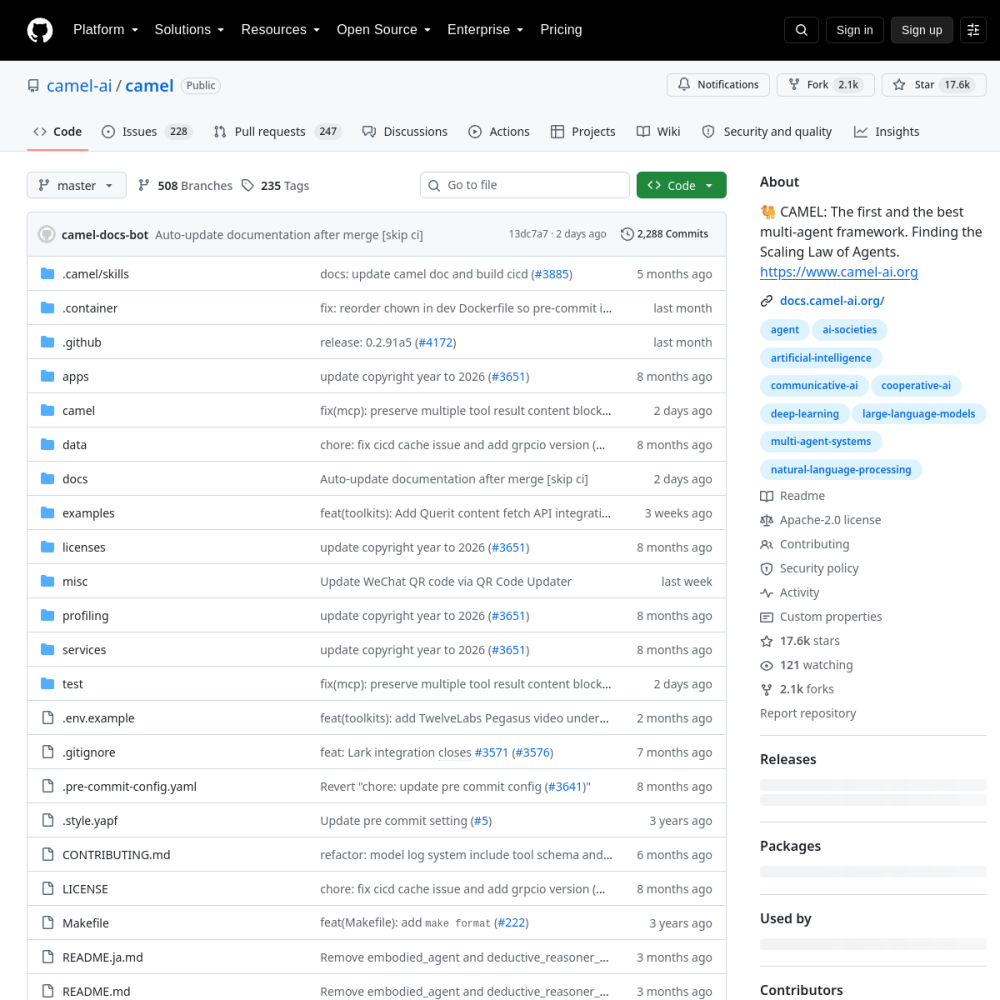
Repositorycamel-ai/camel
GitHub Stars★ 17.6k
Forks2.1k forks
Primary LanguagePython
LicenseApache-2.0
Technical DomainAGENTS
agentai-societiesartificial-intelligencecommunicative-aicooperative-aideep-learninglarge-language-modelsmulti-agent-systemsnatural-language-processing
4.8Overall
Functionality
5.0
Documentation
4.7
Activity
4.9
Ease of use
0.0

Quickstart & Installation

$ pip install camel-ai[all]

Comprehensive Review

CAMEL (Communicative Agents for Mind Exploration of Large Language Model Society) represents a foundational breakthrough in multi-agent AI systems architecture. Originally introduced through the landmark paper 'Can Large Language Models Play Multi-Agent Games?' (arXiv:2303.17760), the framework pioneered the role-playing paradigm where agents assume distinct personas and engage in goal-directed dialogue to accomplish complex tasks. The core architectural innovation lies in its decoupled agent communication protocol, which separates role definition, task specification, and message routing into independently configurable layers. This design enables researchers and engineers to experiment with agent scaling laws by systematically varying agent counts, role complexity, and interaction topologies. The framework supports model-agnostic backends including OpenAI, Anthropic, and open-source LLMs via HuggingFace, making it adaptable across deployment environments. CAMEL's skill orchestration layer provides a structured mechanism for tool registration, memory management, and execution sandboxing, addressing critical challenges in agent reliability and safety. The framework's prompt engineering pipeline incorporates sophisticated template systems that manage context windows, instruction hierarchy, and inter-agent message formatting. With over 17,000 GitHub stars and Apache-2.0 licensing, CAMEL has established itself as a reference implementation for multi-agent research, offering both high-level abstractions for rapid prototyping and low-level primitives for fine-grained control over agent behavior. Its emphasis on finding 'scaling laws of agents' positions it as a research-grade platform that bridges the gap between theoretical multi-agent studies and practical production deployments.

Project Background

CAMEL emerged from a fundamental research question: can large language models sustain coherent, goal-directed multi-agent conversations without human intervention? The original paper demonstrated that by assigning distinct roles to LLM instances and providing structured task objectives, agents could collaboratively solve problems that exceed the capabilities of single-agent systems. This role-playing paradigm was revolutionary because it transformed the traditional single-prompt interaction model into a dynamic dialogue system where agents negotiate, clarify, and iteratively refine solutions through structured communication. The framework's design philosophy centers on the principle that agent capabilities scale non-linearly with the complexity of their interaction protocols, making systematic study of these scaling laws both scientifically valuable and practically important.

The core architectural breakthrough lies in CAMEL's layered abstraction model that separates concerns across multiple dimensions. The agent layer defines role semantics, behavioral constraints, and communication protocols. The task layer specifies objectives, success criteria, and termination conditions. The model layer abstracts LLM backend differences behind a unified interface. The tool layer provides extensible skill registration with sandboxed execution environments. This separation enables independent experimentation with each component while maintaining system coherence. The framework also introduced the concept of 'terminator' agents that monitor conversation quality and enforce completion criteria, addressing the critical challenge of preventing infinite dialogue loops in autonomous multi-agent systems.

Memory isolation and prompt engineering represent additional architectural innovations. CAMEL implements per-agent memory stores that prevent cross-contamination of context while enabling controlled information sharing through explicit message passing. The prompt template system supports hierarchical instruction structures where system-level directives, role-specific guidelines, and task-specific objectives are composed dynamically. This approach ensures that agents maintain consistent behavior across extended conversations while adapting to evolving task requirements. The framework's emphasis on reproducibility through deterministic prompt construction makes it suitable for rigorous scientific experimentation alongside production deployment scenarios.

Core Use Cases

In enterprise software development, CAMEL enables sophisticated code generation pipelines where multiple specialized agents collaborate on complex programming tasks. A typical deployment might include an architect agent that decomposes requirements into modules, implementer agents that write code for specific components, reviewer agents that perform static analysis and security audits, and integration agents that verify system-level compatibility. This multi-agent approach significantly outperforms single-agent code generation by leveraging specialized expertise and iterative refinement. The framework's tool integration layer allows these agents to access version control systems, testing frameworks, and deployment pipelines, creating end-to-end automated development workflows.

For autonomous research and simulation, CAMEL provides a platform for studying emergent behaviors in agent societies. Researchers can configure hundreds of agents with varying roles, knowledge bases, and behavioral parameters to observe how collective intelligence emerges from individual interactions. This use case is particularly valuable for understanding failure modes in multi-agent systems, such as information cascades, coordination failures, and adversarial manipulation. The framework's model-agnostic design enables comparative studies across different LLM architectures, providing empirical data on how model capabilities translate to multi-agent performance. Enterprise organizations use this capability for risk assessment, testing how their AI systems behave under adversarial conditions or when integrated with other autonomous systems.

Complex task decomposition represents another critical use case where CAMEL excels. When faced with objectives that exceed the context window or reasoning capacity of a single agent, orchestrator agents can decompose tasks into subproblems, delegate to specialized worker agents, and synthesize results. This pattern is applicable across domains including document analysis, where separate agents handle extraction, summarization, and cross-referencing; data pipeline construction, where agents design, implement, and validate processing stages; and strategic planning, where agents explore alternative scenarios and evaluate outcomes. The framework's structured communication protocols ensure that information flows correctly between agents while maintaining task coherence.

Cross-model evaluation and benchmarking constitute a fourth major use case. Organizations deploying multiple LLM providers can use CAMEL to evaluate agent performance under identical task conditions, controlling for prompt quality, tool availability, and interaction topology. This enables data-driven decisions about model selection, cost optimization, and fallback strategies. The framework's unified agent interface means that switching between OpenAI, Anthropic, or open-source models requires minimal code changes, facilitating A/B testing and gradual migration strategies. Enterprise deployments often use this capability to maintain redundancy and avoid vendor lock-in while ensuring consistent agent behavior across model updates.

Quickstart Guide

Installation is straightforward via pip: pip install camel-ai[all] for full functionality including multimodal and agent tool capabilities. Configure your API key via export OPENAI_API_KEY="your-key" or other supported model providers.

A concrete example demonstrates multi-agent role-playing in just a few lines:

python
from camel.agents import AIUserAgent, AIAgent
from camel.societies import AgentChat

user_agent = AIUserAgent(role_name="user", task="Design a real-time recommendation architecture")
assistant_agent = AIAgent(role_name="assistant")
chat = AgentChat(agents=[user_agent, assistant_agent])
result = chat.step()
print(result)

This minimal setup initiates an autonomous conversational loop between agents to achieve the specified task goal.

Practicality Assessment

Production readiness of CAMEL is strong for research and prototyping contexts, with growing maturity for enterprise deployments. The framework's Apache-2.0 license removes commercial usage barriers, and its Python-native implementation integrates seamlessly with existing ML infrastructure. Scalability is achieved through the framework's support for parallel agent execution and distributed task processing, though production deployments should implement appropriate rate limiting and cost controls given the token consumption of multi-agent conversations. Latency characteristics depend heavily on the underlying LLM backend and the number of agents in the conversation, with typical multi-agent exchanges requiring 5-30 seconds for completion depending on task complexity and model choice.

Key advantages include the framework's model-agnostic design, which provides flexibility in backend selection and avoids vendor lock-in; the comprehensive prompt engineering system, which reduces the burden of manual prompt construction; and the structured tool integration layer, which enables safe execution of external operations. However, several caveats warrant attention. Debugging multi-agent conversations can be challenging due to the distributed nature of decision-making across agents. Token budget management requires careful configuration, as multi-agent systems can consume significantly more tokens than single-agent equivalents. The framework's sandboxing capabilities, while present, require additional hardening for security-sensitive deployments. Organizations should implement comprehensive logging, conversation monitoring, and circuit breakers to handle edge cases where agents enter unproductive dialogue patterns.

The framework's documentation provides extensive examples and API references, though the rapid evolution of the codebase means that some documentation may lag behind implementation. The active community on Discord and GitHub provides responsive support for integration challenges. For production deployments, organizations should invest in custom tool development, agent behavior monitoring, and cost optimization strategies. The framework's emphasis on reproducibility through deterministic prompt construction is particularly valuable for regulated industries requiring audit trails and consistent behavior. Overall, CAMEL represents a mature foundation for multi-agent systems that balances research flexibility with production practicality.

Real-world Deployments

CAMEL has achieved significant ecosystem adoption with over 17,000 GitHub stars and integration into numerous academic research projects studying multi-agent AI systems. The framework has been cited in research papers exploring agent scaling laws, emergent behavior in LLM societies, and automated software development. Academic institutions use CAMEL as a teaching platform for multi-agent systems courses, leveraging its clear abstraction layers to illustrate complex concepts. The framework's examples repository demonstrates real-world applications including automated code review, collaborative writing, and strategic game playing, providing reference implementations that organizations can adapt for their specific needs.

Enterprise adoption has grown substantially, with organizations using CAMEL for automated research assistance, where multiple agents collaborate to survey literature, extract insights, and synthesize findings; for customer support systems, where specialized agents handle different aspects of customer inquiries; and for content generation pipelines, where agents with different expertise collaborate on marketing materials, technical documentation, and creative writing. The framework's integration with popular LLM providers through a unified interface means that organizations can leverage their existing model subscriptions while gaining multi-agent capabilities. Several technology companies have built proprietary extensions on top of CAMEL's core framework, adding domain-specific tools, custom agent behaviors, and enterprise-grade monitoring capabilities.

The CAMEL-AI organization has expanded the ecosystem with complementary tools including CAMEL-AI-Labs for experimental agent development, integration connectors for popular platforms, and benchmarking suites for agent evaluation. The framework's influence extends beyond its direct codebase, inspiring derivative projects and contributing to the broader multi-agent AI ecosystem. Community contributions have added support for additional LLM backends, new tool integrations, and specialized agent types. The framework's role as a reference implementation means that concepts and patterns developed in CAMEL often propagate to other multi-agent frameworks, establishing it as a de facto standard for agent communication protocols and interaction patterns in the open-source AI community.

Core Strengths

  • Pioneered role-playing multi-agent communication paradigm with structured inter-agent dialogue protocols
  • Model-agnostic architecture supporting OpenAI, Anthropic, and open-source LLM backends with unified abstraction layer
  • Comprehensive skill and tool orchestration framework with memory isolation and execution sandboxing capabilities
  • Research-grade platform for agent scaling law experiments with configurable agent topologies and interaction patterns

Considerations & Limitations

  • Production readiness of CAMEL is strong for research and prototyping contexts, with growing maturity for enterprise depl...

Frequently Asked Questions (FAQ)

What is camel and what key challenges does it solve?

camel is an open-source AI project developed primarily in Python under the Apache-2.0 license. CAMEL is a pioneering open-source multi-agent framework that introduces role-playing-based autonomous agent communication, enabling scalable agent collaboration through structured prompt engineering, tool orchestration, and cross-model interoperability for research and production deployments.. CAMEL emerged from a fundamental research question: can large language models sustain coherent, goal-directed multi-agent conversations without human intervention? The original paper demonstrated that by assigning distinct roles to LLM instances and providing structured task objectives, agents could collaboratively solve problems that exceed the capabilities of single-agent systems. This role-playing paradigm was revolutionary because it transformed the traditional single-prompt interaction model into a dynamic dialogue system where agents negotiate, clarify, and iteratively refine solutions through structured communication. The framework's design philosophy centers on the principle that agent capabilities scale non-linearly with the complexity of their interaction protocols, making systematic study of these scaling laws both scientifically valuable and practically important. The core architectural breakthrough lies in CAMEL's layered abstraction model that separates concerns across multiple dimensions. The agent layer defines role semantics, behavioral constraints, and communication protocols. The task layer specifies objectives, success criteria, and termination conditions. The model layer abstracts LLM backend differences behind a unified interface. The tool layer provides extensible skill registration with sandboxed execution environments. This separation enables independent experimentation with each component while maintaining system coherence. The framework also introduced the concept of 'terminator' agents that monitor conversation quality and enforce completion criteria, addressing the critical challenge of preventing infinite dialogue loops in autonomous multi-agent systems. Memory isolation and prompt engineering represent additional architectural innovations. CAMEL implements per-agent memory stores that prevent cross-contamination of context while enabling controlled information sharing through explicit message passing. The prompt template system supports hierarchical instruction structures where system-level directives, role-specific guidelines, and task-specific objectives are composed dynamically. This approach ensures that agents maintain consistent behavior across extended conversations while adapting to evolving task requirements. The framework's emphasis on reproducibility through deterministic prompt construction makes it suitable for rigorous scientific experimentation alongside production deployment scenarios.

How can I quickly install and run camel locally?

Installation is straightforward via pip: pip install camel-ai[all] for full functionality including multimodal and agent tool capabilities. Configure your API key via export OPENAI_API_KEY="your-key" or other supported model providers. A concrete example demonstrates multi-agent role-playing in just a few lines:

python
from camel.agents import AIUserAgent, AIAgent
from camel.societies import AgentChat

user_agent = AIUserAgent(role_name="user", task="Design a real-time recommendation architecture")
assistant_agent = AIAgent(role_name="assistant")
chat = AgentChat(agents=[user_agent, assistant_agent])
result = chat.step()
print(result)

This minimal setup initiates an autonomous conversational loop between agents to achieve the specified task goal.

What are the main use cases and strengths of camel?

camel is well-suited for Autonomous multi-agent research simulation for studying emergent behaviors and scaling laws in agent societies, Enterprise code generation pipelines with specialized reviewer, implementer, and tester agents collaborating on software tasks, Complex task decomposition systems where orchestrator agents delegate subtasks to domain-specialized worker agents, Cross-model evaluation frameworks comparing agent performance across different LLM backends under identical task conditions. With an overall rating of 4.8/5, it offers strong community activity, reliable performance, and easy integration with existing AI pipelines.

What limitations or architectural considerations should be kept in mind for camel?

Production readiness of CAMEL is strong for research and prototyping contexts, with growing maturity for enterprise deployments. The framework's Apache-2.0 license removes commercial usage barriers, and its Python-native implementation integrates seamlessly with existing ML infrastructure. Scalability is achieved through the framework's support for parallel agent execution and distributed task processing, though production deployments should implement appropriate rate limiting and cost controls given the token consumption of multi-agent conversations. Latency characteristics depend heavily on the underlying LLM backend and the number of agents in the conversation, with typical multi-agent exchanges requiring 5-30 seconds for completion depending on task complexity and model choice. Key advantages include the framework's model-agnostic design, which provides flexibility in backend selection and avoids vendor lock-in; the comprehensive prompt engineering system, which reduces the burden of manual prompt construction; and the structured tool integration layer, which enables safe execution of external operations. However, several caveats warrant attention. Debugging multi-agent conversations can be challenging due to the distributed nature of decision-making across agents. Token budget management requires careful configuration, as multi-agent systems can consume significantly more tokens than single-agent equivalents. The framework's sandboxing capabilities, while present, require additional hardening for security-sensitive deployments. Organizations should implement comprehensive logging, conversation monitoring, and circuit breakers to handle edge cases where agents enter unproductive dialogue patterns. The framework's documentation provides extensive examples and API references, though the rapid evolution of the codebase means that some documentation may lag behind implementation. The active community on Discord and GitHub provides responsive support for integration challenges. For production deployments, organizations should invest in custom tool development, agent behavior monitoring, and cost optimization strategies. The framework's emphasis on reproducibility through deterministic prompt construction is particularly valuable for regulated industries requiring audit trails and consistent behavior. Overall, CAMEL represents a mature foundation for multi-agent systems that balances research flexibility with production practicality.