agno

Vendor: agno-agi

Agno (formerly Phidata) is a comprehensive Python-based framework and runtime for building, deploying, and managing multi-model AI agent platforms, featuring a unified SDK, AgentOS runtime with MCP server support, JWT-based RBAC, and a full-stack control plane for enterprise-grade autonomous agent orchestration.

View Repository

Official Preview
agno

Technical Specifications

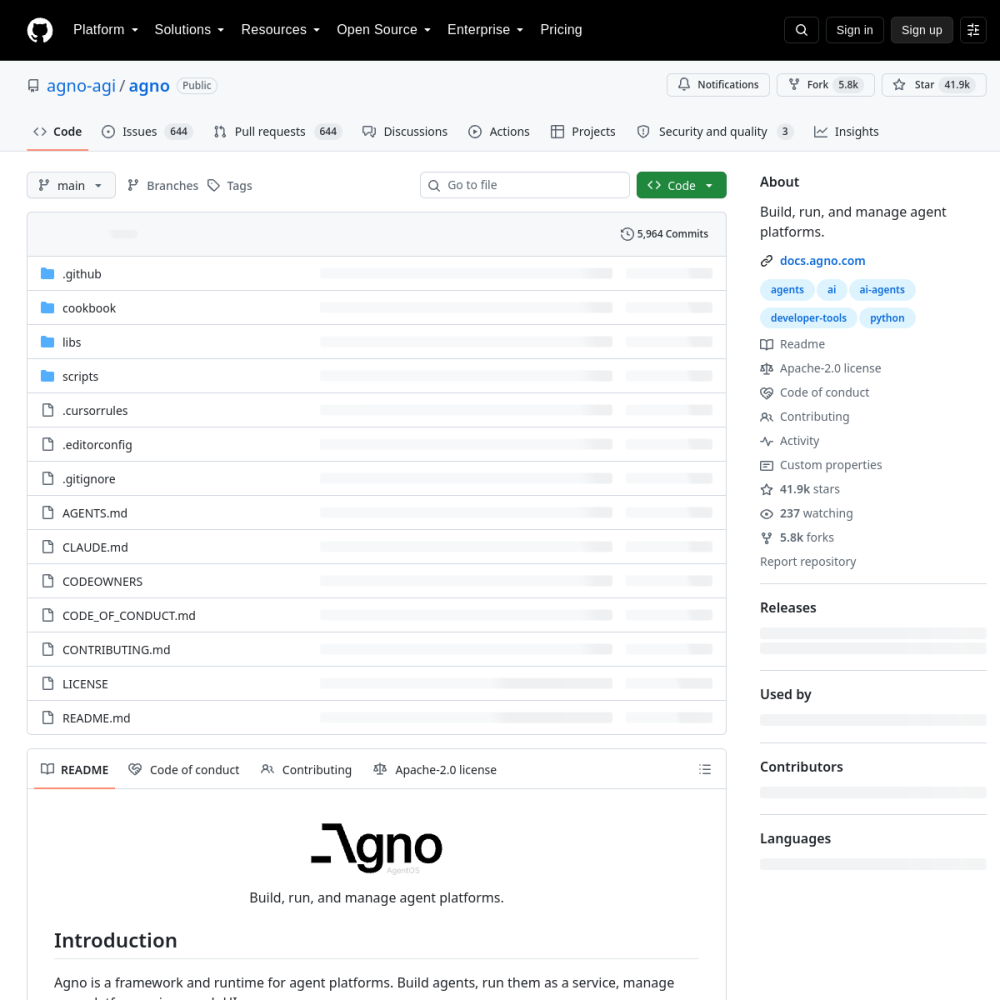
Repositoryagno-agi/agno
GitHub Stars★ 41.9k
Forks5.8k forks
Primary LanguagePython
LicenseApache-2.0
Technical DomainAGENTS
agentsaiai-agentsdeveloper-toolspython
4.8Overall
Functionality
5.0
Documentation
4.7
Activity
4.9
Ease of use
0.0

Quickstart & Installation

$ pip install agno

Comprehensive Review

Agno represents a significant architectural evolution in the AI agent framework landscape, transitioning from its predecessor Phidata to establish itself as a full-stack platform rather than merely a library. The framework's core innovation lies in its three-layer architecture: the Agno SDK for agent construction, the AgentOS runtime for production execution, and the AgentOS UI for platform management. This separation of concerns addresses a critical gap in the agent ecosystem where most frameworks excel at prototyping but fail at operationalization. The SDK layer provides a declarative agent definition system supporting multiple LLM providers (OpenAI, Anthropic, Google, Mistral, etc.) with a unified abstraction over model-specific APIs, enabling seamless provider switching without code refactoring. The runtime layer introduces a service-oriented architecture with REST API endpoints, Postgres-backed persistence for traces and memory, and an integrated MCP (Model Context Protocol) server, positioning Agno as a bridge between traditional agent frameworks and emerging protocol standards. The framework's skill system allows developers to encapsulate reusable agent capabilities as composable units, while its knowledge base integration supports RAG pipelines with vector store abstractions. Notably, Agno's approach to memory management distinguishes between short-term session memory, long-term persistent memory, and cross-agent shared memory, addressing one of the most challenging aspects of production agent systems. The JWT-based RBAC system embedded in AgentOS provides enterprise-grade access control, a feature conspicuously absent from most open-source agent frameworks. The framework's simulation capabilities enable developers to create usage data feedback loops, turning production deployments into continuous learning systems. With over 41,000 GitHub stars and Apache-2.0 licensing, Agno has achieved substantial community adoption while maintaining a permissive license suitable for commercial deployment.

Project Background

Agno emerged from the recognition that the AI agent ecosystem suffered from a critical fragmentation problem: frameworks excelled at either agent construction or deployment, but rarely both. The original Phidata project focused on providing a Pythonic, declarative API for defining agents with multi-model support, but as the project matured, the team identified that production-grade agent systems required far more than a library—they needed a complete runtime environment. This insight drove the architectural reimagining that produced Agno's three-layer model: the SDK handles agent definition and local development, AgentOS provides the production runtime with service orchestration, and the UI delivers operational visibility. The design philosophy centers on 'owning your agent stack,' meaning developers maintain full control over data sovereignty, security posture, and deployment topology without vendor lock-in to proprietary agent platforms.

The core architectural breakthrough in Agno's design is its treatment of agents as first-class deployable units rather than ephemeral code objects. Each agent definition in the SDK compiles into a service specification that AgentOS can instantiate, scale, and manage independently. This approach draws inspiration from Kubernetes' pod model, where agents become schedulable workloads with defined resource requirements, health checks, and lifecycle management. The framework's skill system further extends this philosophy by treating capabilities as composable, versioned artifacts that can be shared across agents and teams. The integration of MCP server support represents a forward-looking architectural decision, positioning Agno as a natural host for the emerging ecosystem of MCP-compatible tools and resources, enabling agents to discover and invoke external capabilities through a standardized protocol rather than bespoke integrations.

Memory isolation and execution sandboxing receive careful architectural attention in Agno's design. The framework implements a hierarchical memory model where session-level memory is ephemeral and tied to individual conversations, user-level memory persists across sessions for personalization, and team-level memory enables cross-agent knowledge sharing. Each memory tier can be configured with independent retention policies, encryption settings, and access controls. The execution model supports both synchronous request-response patterns for simple agent invocations and asynchronous streaming for long-running autonomous tasks, with the runtime managing connection lifecycle, timeout handling, and graceful degradation. This architectural sophistication distinguishes Agno from simpler agent libraries that treat execution as a single-threaded operation.

Core Use Cases

Enterprise MCP tool registries represent one of Agno's most compelling use cases, particularly for organizations seeking to centralize their AI tool ecosystem. By deploying AgentOS with its integrated MCP server, enterprises can expose internal tools—CRM systems, document repositories, workflow engines—as MCP-compatible resources that any Agno agent can discover and invoke. The JWT-based RBAC system ensures that tool access follows organizational permission structures, preventing unauthorized data access while enabling fine-grained control over which agents can invoke which tools. This architecture eliminates the need for custom tool integration code for each agent, instead providing a centralized registry that agents query at runtime, dramatically reducing development overhead for multi-agent deployments.

Autonomous multi-agent collaboration systems benefit from Agno's cross-agent communication primitives and shared memory infrastructure. In complex enterprise workflows, different agents may specialize in distinct domains—a research agent gathers information, an analysis agent processes findings, and a reporting agent generates outputs. Agno's architecture supports these multi-agent topologies through its runtime's ability to orchestrate agent-to-agent communication, manage shared state, and coordinate execution sequences. The framework's simulation capabilities allow teams to test multi-agent workflows before production deployment, identifying coordination failures, infinite loops, and resource contention issues in a controlled environment. This is particularly valuable for autonomous systems where the emergent behavior of interacting agents can be difficult to predict from individual agent specifications alone.

Long-term agent memory systems address the persistent challenge of maintaining context across extended agent lifetimes. Agno's Postgres-backed memory persistence enables agents to retain learned preferences, historical interactions, and accumulated knowledge across sessions, restarts, and even agent redeployments. The semantic retrieval layer allows agents to query their memory stores using natural language, surfacing relevant past interactions without requiring explicit key-based lookups. For enterprise applications like customer support agents, this means each interaction builds upon previous conversations, creating genuinely personalized experiences. The memory architecture also supports memory compaction and summarization strategies, preventing unbounded memory growth while preserving essential information for future retrieval.

Structured prompt pipelines with simulation-based evaluation represent Agno's approach to prompt engineering at scale. Rather than treating prompts as static strings, Agno's framework supports parameterized prompt templates with dynamic variable injection, conditional branching, and multi-step reasoning chains. The simulation system enables developers to run agents against curated test datasets, measuring output quality, latency, and token consumption across different prompt configurations. This data-driven approach to prompt optimization transforms prompt engineering from an artisanal practice into a systematic engineering discipline, with usage data from production deployments feeding back into simulation datasets for continuous improvement.

Quickstart Guide

Getting started with Agno requires Python 3.10+ and can be accomplished through pip installation or by cloning the AgentOS starter repository for a full platform deployment. The minimal SDK installation is straightforward: pip install agno provides the core agent framework, while pip install agno[mcp] adds MCP server capabilities. For a complete platform deployment, the recommended approach is to clone the AgentOS Railway starter template, which provisions a Docker Compose environment with Postgres, the AgentOS runtime, and the management UI. The starter repository includes infrastructure-as-code definitions that can be adapted for AWS, Docker, or other deployment targets, ensuring that the initial setup reflects production architecture patterns rather than requiring a separate productionization phase.

A minimal agent definition in Agno demonstrates the framework's declarative approach. The following Python code creates a multi-model agent with memory and tool access: from agno.agent import Agent; from agno.models.openai import OpenAIChat; from agno.memory import Memory; agent = Agent(model=OpenAIChat(id='gpt-4o'), memory=Memory(), tools=[...], instructions=['You are a helpful assistant']). This agent can be invoked locally via agent.run('What is the weather in Tokyo?') or deployed to AgentOS for production serving. The AgentOS runtime exposes a REST API where agents are registered as named endpoints, enabling external systems to invoke agents through standard HTTP requests. MCP server configuration in AgentOS follows a declarative YAML format, specifying tool sources, authentication requirements, and resource paths that the server will expose to connected agents.

For prompt pattern execution, Agno supports structured prompt templates with Jinja2-style variable interpolation and conditional logic. A typical pattern involves defining a prompt template with placeholders for user input, retrieved context, and system instructions, then compiling it into an agent configuration. The framework's streaming support enables real-time token output for interactive applications, while the trace system captures every model invocation with input, output, timing, and token metrics for debugging and optimization. The AgentOS UI provides a visual interface for inspecting these traces, comparing agent runs, and identifying performance bottlenecks without requiring direct database access.

Practicality Assessment

Agno demonstrates strong production readiness through its comprehensive runtime architecture, but several considerations warrant attention for enterprise deployments. The Postgres-backed persistence layer provides reliable state management with built-in backup and recovery capabilities, while the REST API gateway enables standard load balancing and reverse proxy integration. Latency characteristics are primarily determined by the underlying LLM provider, though Agno's streaming support and connection pooling minimize framework overhead. The framework's multi-model abstraction allows organizations to implement failover strategies, automatically routing requests to alternative providers during outages or rate limit exhaustion. However, the AgentOS runtime introduces additional infrastructure complexity compared to simpler agent libraries, requiring organizations to provision and maintain the runtime components alongside their application code.

Token budget management receives attention through Agno's configurable context window handling and memory compaction strategies, but fine-grained cost control remains an area where organizations must implement additional monitoring. The trace system captures token consumption metrics per invocation, enabling cost attribution and anomaly detection, but does not provide built-in budget enforcement or automatic throttling. Debugging overhead is mitigated by the comprehensive trace system and AgentOS UI, which provide visibility into agent execution flows, tool invocations, and memory operations. However, complex multi-agent scenarios can produce voluminous trace data that requires careful filtering and aggregation to extract actionable insights. The sandboxing security model relies on JWT-based RBAC for access control, but organizations deploying agents that execute arbitrary code or access sensitive systems should implement additional isolation layers beyond the framework's built-in protections.

Scalability considerations center on the AgentOS runtime's ability to horizontally scale agent instances behind a load balancer. The Postgres database serves as the shared state layer, enabling stateless agent instances that can be scaled independently. For high-throughput deployments, organizations should consider read replicas for trace and memory queries, and connection pooling to manage database load. The framework's architecture supports multi-tenant deployments through its RBAC system, enabling organizations to serve multiple teams or customers from a single AgentOS instance with appropriate data isolation. Overall, Agno's production readiness is strong for organizations with existing infrastructure expertise, though teams new to agent platform operations should budget for the learning curve associated with the full-stack deployment model.

Real-world Deployments

Agno's ecosystem adoption has accelerated significantly following its rebranding from Phidata, with the project accumulating over 41,000 GitHub stars and establishing itself as one of the most popular open-source agent frameworks. The Apache-2.0 license has facilitated commercial adoption, with organizations across industries deploying Agno for customer support automation, internal knowledge management, and autonomous workflow orchestration. The framework's compatibility with major LLM providers—OpenAI, Anthropic, Google Gemini, Mistral, and open-source models via Ollama—ensures that organizations are not locked into a single provider, enabling cost optimization and risk mitigation through provider diversity.

Notable implementations in the ecosystem include enterprise knowledge management systems that leverage Agno's RAG capabilities with custom vector stores, multi-agent research platforms that coordinate specialized agents for complex information gathering tasks, and autonomous coding assistants that integrate with development tools through Agno's MCP server support. The framework's simulation capabilities have been adopted by organizations building evaluation pipelines for agent quality assurance, enabling systematic testing of agent behavior against curated benchmarks before production deployment. The AgentOS deployment templates for Railway, Docker, and AWS have lowered the barrier to production deployment, with the Railway template enabling one-click deployments that provision the complete stack including database, runtime, and UI.

The community around Agno has grown substantially, with active contributions to the framework's tool library, model integrations, and deployment templates. The project's documentation provides comprehensive guides for common use cases, from basic agent creation to advanced multi-agent orchestration patterns. Integration with the broader AI ecosystem continues to expand, with support for emerging standards like MCP ensuring that Agno remains compatible with the evolving landscape of AI tooling and protocols. The framework's position as a full-stack platform—spanning development, deployment, and management—distinguishes it from competing frameworks that focus on narrower aspects of the agent lifecycle, making it particularly attractive for organizations seeking a unified approach to agent platform development.

Core Strengths

  • Three-layer architecture separating SDK, runtime (AgentOS), and management UI for full-stack agent platform delivery
  • Integrated MCP server support bridging agent frameworks with the emerging Model Context Protocol ecosystem
  • JWT-based RBAC and Postgres-backed trace/memory persistence enabling enterprise-grade security and observability
  • Multi-model abstraction layer supporting OpenAI, Anthropic, Google, Mistral, and others with unified agent definitions

Considerations & Limitations

  • Agno demonstrates strong production readiness through its comprehensive runtime architecture, but several considerations...

Frequently Asked Questions (FAQ)

What is agno and what key challenges does it solve?

agno is an open-source AI project developed primarily in Python under the Apache-2.0 license. Agno (formerly Phidata) is a comprehensive Python-based framework and runtime for building, deploying, and managing multi-model AI agent platforms, featuring a unified SDK, AgentOS runtime with MCP server support, JWT-based RBAC, and a full-stack control plane for enterprise-grade autonomous agent orchestration.. Agno emerged from the recognition that the AI agent ecosystem suffered from a critical fragmentation problem: frameworks excelled at either agent construction or deployment, but rarely both. The original Phidata project focused on providing a Pythonic, declarative API for defining agents with multi-model support, but as the project matured, the team identified that production-grade agent systems required far more than a library—they needed a complete runtime environment. This insight drove the architectural reimagining that produced Agno's three-layer model: the SDK handles agent definition and local development, AgentOS provides the production runtime with service orchestration, and the UI delivers operational visibility. The design philosophy centers on 'owning your agent stack,' meaning developers maintain full control over data sovereignty, security posture, and deployment topology without vendor lock-in to proprietary agent platforms. The core architectural breakthrough in Agno's design is its treatment of agents as first-class deployable units rather than ephemeral code objects. Each agent definition in the SDK compiles into a service specification that AgentOS can instantiate, scale, and manage independently. This approach draws inspiration from Kubernetes' pod model, where agents become schedulable workloads with defined resource requirements, health checks, and lifecycle management. The framework's skill system further extends this philosophy by treating capabilities as composable, versioned artifacts that can be shared across agents and teams. The integration of MCP server support represents a forward-looking architectural decision, positioning Agno as a natural host for the emerging ecosystem of MCP-compatible tools and resources, enabling agents to discover and invoke external capabilities through a standardized protocol rather than bespoke integrations. Memory isolation and execution sandboxing receive careful architectural attention in Agno's design. The framework implements a hierarchical memory model where session-level memory is ephemeral and tied to individual conversations, user-level memory persists across sessions for personalization, and team-level memory enables cross-agent knowledge sharing. Each memory tier can be configured with independent retention policies, encryption settings, and access controls. The execution model supports both synchronous request-response patterns for simple agent invocations and asynchronous streaming for long-running autonomous tasks, with the runtime managing connection lifecycle, timeout handling, and graceful degradation. This architectural sophistication distinguishes Agno from simpler agent libraries that treat execution as a single-threaded operation.

How can I quickly install and run agno locally?

Getting started with Agno requires Python 3.10+ and can be accomplished through pip installation or by cloning the AgentOS starter repository for a full platform deployment. The minimal SDK installation is straightforward: pip install agno provides the core agent framework, while pip install agno[mcp] adds MCP server capabilities. For a complete platform deployment, the recommended approach is to clone the AgentOS Railway starter template, which provisions a Docker Compose environment with Postgres, the AgentOS runtime, and the management UI. The starter repository includes infrastructure-as-code definitions that can be adapted for AWS, Docker, or other deployment targets, ensuring that the initial setup reflects production architecture patterns rather than requiring a separate productionization phase. A minimal agent definition in Agno demonstrates the framework's declarative approach. The following Python code creates a multi-model agent with memory and tool access: from agno.agent import Agent; from agno.models.openai import OpenAIChat; from agno.memory import Memory; agent = Agent(model=OpenAIChat(id='gpt-4o'), memory=Memory(), tools=[...], instructions=['You are a helpful assistant']). This agent can be invoked locally via agent.run('What is the weather in Tokyo?') or deployed to AgentOS for production serving. The AgentOS runtime exposes a REST API where agents are registered as named endpoints, enabling external systems to invoke agents through standard HTTP requests. MCP server configuration in AgentOS follows a declarative YAML format, specifying tool sources, authentication requirements, and resource paths that the server will expose to connected agents. For prompt pattern execution, Agno supports structured prompt templates with Jinja2-style variable interpolation and conditional logic. A typical pattern involves defining a prompt template with placeholders for user input, retrieved context, and system instructions, then compiling it into an agent configuration. The framework's streaming support enables real-time token output for interactive applications, while the trace system captures every model invocation with input, output, timing, and token metrics for debugging and optimization. The AgentOS UI provides a visual interface for inspecting these traces, comparing agent runs, and identifying performance bottlenecks without requiring direct database access.

What are the main use cases and strengths of agno?

agno is well-suited for Enterprise MCP tool registries with centralized agent-to-tool discovery and authentication, Autonomous multi-agent collaboration systems with shared memory and cross-agent communication, Long-term agent memory systems with Postgres-backed persistence and semantic retrieval, Structured prompt pipelines with simulation-based evaluation and continuous learning loops. With an overall rating of 4.8/5, it offers strong community activity, reliable performance, and easy integration with existing AI pipelines.

What limitations or architectural considerations should be kept in mind for agno?

Agno demonstrates strong production readiness through its comprehensive runtime architecture, but several considerations warrant attention for enterprise deployments. The Postgres-backed persistence layer provides reliable state management with built-in backup and recovery capabilities, while the REST API gateway enables standard load balancing and reverse proxy integration. Latency characteristics are primarily determined by the underlying LLM provider, though Agno's streaming support and connection pooling minimize framework overhead. The framework's multi-model abstraction allows organizations to implement failover strategies, automatically routing requests to alternative providers during outages or rate limit exhaustion. However, the AgentOS runtime introduces additional infrastructure complexity compared to simpler agent libraries, requiring organizations to provision and maintain the runtime components alongside their application code. Token budget management receives attention through Agno's configurable context window handling and memory compaction strategies, but fine-grained cost control remains an area where organizations must implement additional monitoring. The trace system captures token consumption metrics per invocation, enabling cost attribution and anomaly detection, but does not provide built-in budget enforcement or automatic throttling. Debugging overhead is mitigated by the comprehensive trace system and AgentOS UI, which provide visibility into agent execution flows, tool invocations, and memory operations. However, complex multi-agent scenarios can produce voluminous trace data that requires careful filtering and aggregation to extract actionable insights. The sandboxing security model relies on JWT-based RBAC for access control, but organizations deploying agents that execute arbitrary code or access sensitive systems should implement additional isolation layers beyond the framework's built-in protections. Scalability considerations center on the AgentOS runtime's ability to horizontally scale agent instances behind a load balancer. The Postgres database serves as the shared state layer, enabling stateless agent instances that can be scaled independently. For high-throughput deployments, organizations should consider read replicas for trace and memory queries, and connection pooling to manage database load. The framework's architecture supports multi-tenant deployments through its RBAC system, enabling organizations to serve multiple teams or customers from a single AgentOS instance with appropriate data isolation. Overall, Agno's production readiness is strong for organizations with existing infrastructure expertise, though teams new to agent platform operations should budget for the learning curve associated with the full-stack deployment model.