Official Preview
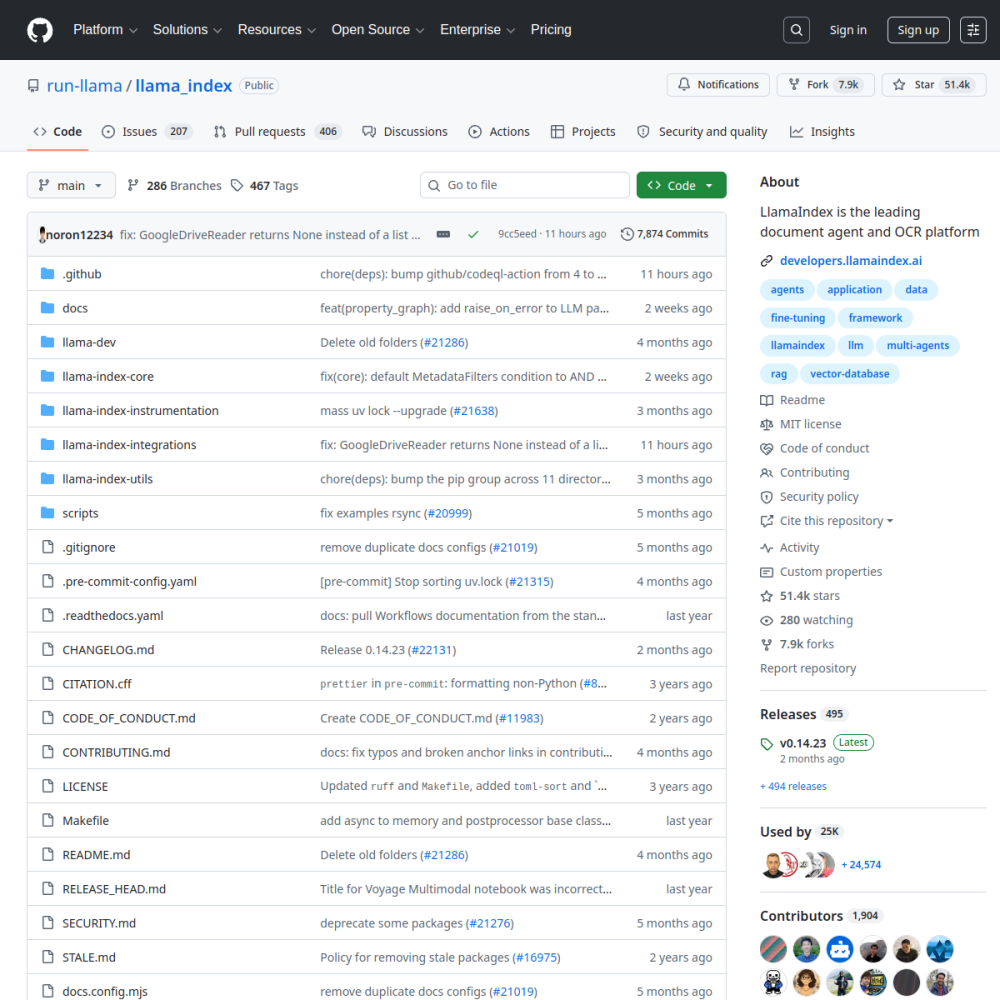
| Repository | run-llama/llama_index |
|---|---|
| GitHub Stars | ★ 51.9k |
| Forks | 8k forks |
| Primary Language | Python |
| License | MIT |
| Technical Domain | FRAMEWORK |
$ git clone https://github.com/run-llama/llama_index.git && cd llama_index
LlamaIndex positions itself as the bridge between LLMs and private data, standardizing the full pipeline of document loading, splitting, indexing, retrieval, and generation. It is one of the mainstream choices for building RAG applications. Compared with LangChain's general-framework positioning, it is more specialized in data connectivity and retrieval quality.
Core capabilities include 200+ data connectors (Notion, Confluence, SQL, PDF, etc.), multiple index types (vector, tree, keyword, knowledge graph), query engines and routers, advanced RAG strategies (sub-questions, recursive, fusion re-ranking), plus the LlamaParse document parser and LlamaCloud hosted service.
The highlight is high coverage of data source integrations and advanced RAG patterns, with substantial engineering around retrieval quality. The downside is that feature overlap with LangChain keeps growing, some advanced APIs are nested through multiple layers, debugging requires reading several layers of source, and occasional breaking changes ship between versions.
Use cases: enterprise knowledge-base Q&A, intelligent document retrieval, applications needing complex RAG strategies. For simple demos LangChain is lighter; for data-heavy scenarios LlamaIndex is smoother.
LlamaIndex positions itself as the essential bridge between Large Language Models and private data sources. It addresses the significant challenge of connecting proprietary information to LLM capabilities by standardizing the full pipeline of document loading, splitting, indexing, retrieval, and generation.
Unlike general-purpose frameworks, this project focuses specifically on data connectivity and retrieval quality. It aims to streamline the engineering effort required to build Retrieval-Augmented Generation applications by providing specialized tools for handling diverse data formats efficiently.
The framework is primarily designed for enterprise knowledge-base Q&A systems where accuracy and context retrieval are critical for business operations. Developers building intelligent document retrieval solutions benefit significantly from the extensive support for various file formats and database connections available within the ecosystem.
Target users include teams needing complex RAG strategies such as sub-question decomposition, recursive retrieval, or fusion re-ranking to enhance response quality. While simpler demos might prefer lighter alternatives, data-heavy scenarios find this tool smoother due to its specialized indexing capabilities and robust data handling.
Organizations looking to integrate private data into LLM workflows without building custom ingestion pipelines from scratch are the primary audience. The system supports scenarios ranging from simple PDF querying to complex knowledge graph interactions involving multiple data sources.
Installation requires a Python environment where users can install the package via standard package managers compatible with the project's Python language base. The project is open-source under the MIT license, allowing immediate integration into existing Python workflows without licensing barriers.
Users typically begin by loading data through one of the available connectors, such as those for PDFs, SQL databases, or enterprise tools like Notion. The framework handles the initial indexing process automatically, preparing the data for subsequent retrieval queries without manual configuration.
Once indexed, developers can query the engine using standard Python interfaces to retrieve relevant context for their models. This setup enables rapid prototyping of retrieval-augmented generation pipelines without extensive initial configuration.
The project demonstrates strong production readiness with high coverage of data source integrations and substantial engineering around retrieval quality. Strengths include built-in advanced RAG strategies and the LlamaParse document parser, which simplify complex data handling tasks for engineering teams.
However, limitations exist regarding maintainability and stability that users should consider before committing to large-scale deployments. Feature overlap with competing frameworks keeps growing, and some advanced APIs are nested through multiple layers, making debugging require reading several layers of source code. Occasional breaking changes ship between versions, requiring careful version management and testing during updates.
As one of the mainstream choices for building RAG applications, the framework is widely adopted in scenarios requiring robust data connectivity and high retrieval standards. It serves as a foundational component for applications needing to ground LLM responses in private, structured, or unstructured data securely.
Typical integration scenarios involve connecting enterprise tools like Notion or Confluence to LLM interfaces to enable conversational access to internal documentation. While specific company names are not detailed in the public review, the tool is positioned for data-heavy environments where retrieval accuracy outweighs framework simplicity.
LlamaIndex is an open-source AI project developed primarily in Python under the MIT license. LLM data framework and RAG engine. LlamaIndex positions itself as the essential bridge between Large Language Models and private data sources. It addresses the significant challenge of connecting proprietary information to LLM capabilities by standardizing the full pipeline of document loading, splitting, indexing, retrieval, and generation. Unlike general-purpose frameworks, this project focuses specifically on data connectivity and retrieval quality. It aims to streamline the engineering effort required to build Retrieval-Augmented Generation applications by providing specialized tools for handling diverse data formats efficiently.
Installation requires a Python environment where users can install the package via standard package managers compatible with the project's Python language base. The project is open-source under the MIT license, allowing immediate integration into existing Python workflows without licensing barriers. Users typically begin by loading data through one of the available connectors, such as those for PDFs, SQL databases, or enterprise tools like Notion. The framework handles the initial indexing process automatically, preparing the data for subsequent retrieval queries without manual configuration. Once indexed, developers can query the engine using standard Python interfaces to retrieve relevant context for their models. This setup enables rapid prototyping of retrieval-augmented generation pipelines without extensive initial configuration.
LlamaIndex is well-suited for Enterprise knowledge-base Q&A, Intelligent document retrieval, Complex RAG strategy apps. With an overall rating of 4.0/5, it offers strong community activity, reliable performance, and easy integration with existing AI pipelines.
The project demonstrates strong production readiness with high coverage of data source integrations and substantial engineering around retrieval quality. Strengths include built-in advanced RAG strategies and the LlamaParse document parser, which simplify complex data handling tasks for engineering teams. However, limitations exist regarding maintainability and stability that users should consider before committing to large-scale deployments. Feature overlap with competing frameworks keeps growing, and some advanced APIs are nested through multiple layers, making debugging require reading several layers of source code. Occasional breaking changes ship between versions, requiring careful version management and testing during updates.
Minimal tool for running large language models locally