servers

Vendor: modelcontextprotocol

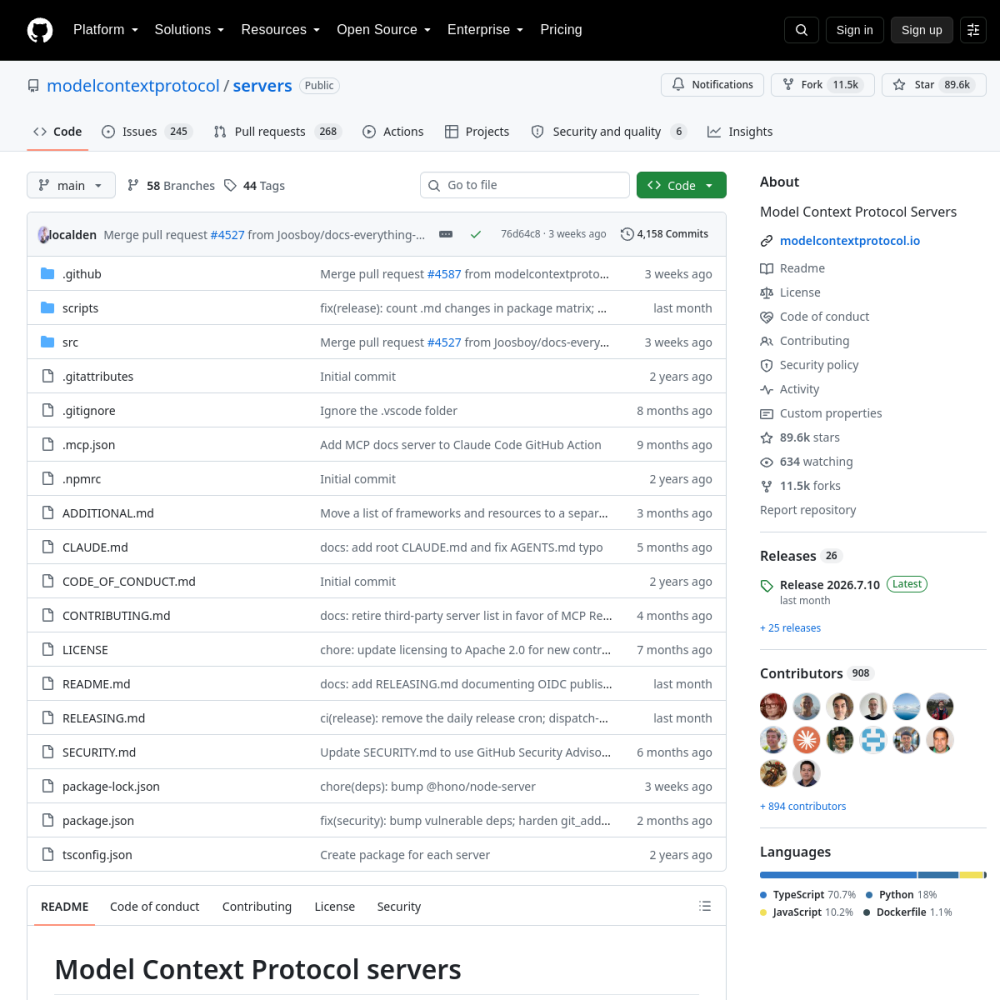
Anthropic's official MCP Servers repository provides reference implementations of the Model Context Protocol, establishing a standardized interface for LLM agents to securely connect to tools, databases, and external systems through a unified JSON-RPC-based transport layer.

View Repository

Official Preview
servers

Technical Specifications

Repositorymodelcontextprotocol/servers
GitHub Stars★ 89.9k
Forks11.5k forks
Primary LanguageTypeScript
LicenseNOASSERTION
Technical DomainAGENTS
4.8Overall
Functionality
5.0
Documentation
4.7
Activity
4.9
Ease of use
0.0

Quickstart & Installation

$ Review this ${language} code for bugs and best practices:\n\n${code}

Comprehensive Review

The MCP Servers repository represents a foundational architectural milestone in the evolution of AI agent tool-use protocols. Anthropic's Model Context Protocol (MCP) defines a standardized, language-agnostic interface that enables Large Language Models to discover, invoke, and interact with external tools and data sources through a consistent JSON-RPC transport mechanism. This repository houses reference implementations across multiple SDK languages—TypeScript, Python, Go, Rust, Java, and others—demonstrating how MCP servers can be built to expose filesystem access, database queries, web search, and custom tool capabilities to agent runtimes. The protocol's core innovation lies in its separation of concerns: MCP clients (typically agent frameworks or IDEs) maintain a persistent connection to MCP servers, which expose capabilities through a structured schema of tools, resources, and prompts. This architecture eliminates the need for bespoke integration code for each tool, replacing it with a declarative capability discovery mechanism. The reference servers in this repository—including implementations for filesystem access, PostgreSQL, GitHub, and various other integrations—serve as canonical examples of how to implement MCP's three primary capability types: tools (executable functions), resources (readable data sources), and prompts (templated instructions). From a systems architecture perspective, MCP addresses a critical gap in the agent ecosystem: the lack of a universal, secure, and sandboxable protocol for tool invocation. Unlike ad-hoc function-calling approaches that require custom serialization and error handling per integration, MCP provides a uniform envelope for capability negotiation, request routing, and response streaming. The protocol supports both stdio-based local transport and HTTP-based remote transport, enabling flexible deployment topologies ranging from co-located server processes to distributed microservice architectures. Security is addressed through explicit capability scoping, where servers declare their available tools and resources upfront, allowing clients to enforce access control policies before any invocation occurs. This repository's significance extends beyond its code: it establishes the de facto standard for agent-tool interoperability, with rapid adoption across Claude Desktop, Cursor, JetBrains IDEs, and numerous agent frameworks. The multi-language SDK ecosystem ensures that MCP servers can be built in virtually any production environment, while the reference implementations provide battle-tested patterns for handling streaming responses, error propagation, and session management.

Project Background

The Model Context Protocol emerged from Anthropic's recognition that the rapid proliferation of AI agents required a standardized, interoperable mechanism for tool integration. Prior to MCP, each agent framework—whether LangChain, AutoGPT, or custom implementations—required bespoke connectors for every external tool, creating a fragmented ecosystem where tool definitions, invocation patterns, and error handling varied wildly across implementations. The design philosophy behind MCP draws inspiration from established protocols like JSON-RPC and gRPC, applying their proven patterns of capability discovery and structured messaging to the unique challenges of LLM-driven tool use. The protocol's architecture centers on a client-server model where MCP clients (agent runtimes, IDEs, or orchestrators) maintain persistent connections to MCP servers that expose their capabilities through a declarative schema. This separation allows agents to discover available tools at runtime, negotiate capabilities, and invoke functions through a uniform interface without requiring prior knowledge of the underlying implementation.

The core architectural breakthrough of MCP lies in its three-tier capability model: tools represent executable functions that agents can invoke with structured arguments, resources represent readable data sources that agents can access through URI-like identifiers, and prompts represent templated instruction sets that can be parameterized and reused. This tripartite model elegantly separates the concerns of action, data access, and instruction, providing a clean abstraction layer between the agent's reasoning capabilities and the external systems it needs to interact with. The protocol's transport layer supports both stdio-based communication for local server processes and HTTP-based communication for remote servers, enabling flexible deployment topologies. The reference implementations in this repository demonstrate these patterns across multiple languages, providing developers with canonical examples of how to implement MCP servers for filesystem access, database queries, web search, and custom integrations. The multi-language SDK approach ensures that MCP is not locked to any single runtime ecosystem, making it viable for enterprise environments with heterogeneous technology stacks.

From a security architecture perspective, MCP addresses critical concerns around agent tool access through explicit capability scoping and declarative access control. Servers declare their available tools, resources, and prompts at connection time, allowing clients to enforce fine-grained access policies before any invocation occurs. This model supports sandboxing scenarios where agents can be granted limited access to specific tools while being restricted from others, a crucial requirement for production deployments. The protocol also supports streaming responses, enabling real-time feedback from long-running operations, and implements structured error propagation that allows agents to handle failures gracefully. These design decisions reflect a deep understanding of the operational challenges that arise when autonomous agents interact with external systems at scale.

Core Use Cases

Enterprise MCP tool registries represent one of the most significant use cases for this protocol, enabling organizations to build centralized catalogs of available tools that multiple agent instances can discover and invoke. In this pattern, a central MCP server registry maintains metadata about all available tools across the organization, including their schemas, access requirements, and operational characteristics. Agent runtimes connect to this registry at startup to discover available capabilities, then establish direct connections to individual tool servers as needed. This architecture supports multi-tenant deployments where different teams or projects have access to different subsets of tools, with access control enforced at the registry level. The reference implementations in this repository provide templates for building such registries, including the filesystem server that demonstrates resource-based access patterns and the various database servers that show how to expose query capabilities through MCP's tool interface.

Autonomous browser navigation and web interaction through MCP server abstraction enables agents to perform complex web-based tasks without requiring direct browser automation code. An MCP browser server exposes capabilities such as page navigation, element interaction, form submission, and content extraction through standardized tool interfaces. The agent's LLM can then reason about web tasks at a high level—'find the price of product X on website Y'—while the MCP server handles the low-level browser automation details. This separation of concerns allows the agent to focus on task decomposition and decision-making while the server handles the brittle details of DOM manipulation and page rendering. The protocol's streaming support is particularly valuable here, as browser interactions often involve waiting for page loads and animations, and streaming responses allow the agent to receive real-time progress updates rather than blocking on synchronous calls.

Long-term agent memory systems backed by vector databases via MCP resource interfaces represent a critical use case for building agents with persistent context and learning capabilities. An MCP memory server can expose vector database operations—embedding storage, similarity search, and semantic retrieval—as MCP resources that agents can query using natural language. This enables agents to maintain conversation history, learn from past interactions, and retrieve relevant context for current tasks without requiring the entire memory corpus to be loaded into the context window. The resource-based access pattern is particularly well-suited to this use case, as memory retrieval is fundamentally a read operation that can be expressed as a URI-like query against a structured data source. The protocol's support for resource templates allows agents to construct dynamic queries with parameters, enabling sophisticated retrieval strategies such as multi-hop reasoning and context-aware filtering.

Structured prompt pipelines enable reusable, parameterized instruction templates that can be shared across agent workflows and teams. MCP's prompt capability type allows server developers to define templates with named parameters that clients can populate at runtime, creating a standardized mechanism for prompt management and versioning. In enterprise settings, this enables centralized prompt governance where approved prompt templates are published as MCP resources that agents can discover and invoke. The prompt pipeline pattern supports complex multi-step workflows where each step is defined as a parameterized prompt, with outputs from one step feeding into the parameters of the next. This approach provides traceability and auditability for agent behavior, as each step's inputs and outputs are captured in the protocol's structured messaging format.

Quickstart Guide

Setting up an MCP server begins with installing the appropriate SDK for your target language. For TypeScript-based servers, the recommended approach is to install the @modelcontextprotocol/sdk package and implement the server using the provided Server class. The following example demonstrates a minimal MCP server that exposes a single tool for performing arithmetic operations: import { Server } from '@modelcontextprotocol/sdk/server'; import { McpServer } from '@modelcontextprotocol/sdk/server/mcp'; const server = new McpServer({ name: 'calculator', version: '1.0.0' }); server.tool('add', { a: { type: 'number' }, b: { type: 'number' } }, async ({ a, b }) => ({ content: [{ type: 'text', text: String(a + b) }] })); This server can then be connected to an MCP client using either stdio transport for local processes or HTTP transport for remote deployment. The stdio transport is the simplest option for development and local testing, as it requires no network configuration and automatically handles process lifecycle management.

For Python-based implementations, the mcp package provides equivalent functionality with a decorator-based API that many developers find more intuitive. A Python MCP server exposing a filesystem resource might look like this: from mcp.server import Server; from mcp.types import Resource, TextContent; server = Server('file-reader'); @server.resource('file://{path}') async def read_file(path: str): with open(path) as f: return [TextContent(type='text', text=f.read())]; This server can be started using the server.run() method, which automatically handles the stdio transport. For production deployments, the HTTP transport can be configured by wrapping the server in an ASGI or FastAPI application. MCP clients connect to servers using a configuration file that specifies the server command, arguments, and transport type. For example, a Claude Desktop MCP configuration might specify: { 'mcpServers': { 'my-calculator': { 'command': 'npx', 'args': ['-y', 'my-mcp-server'] } } }. This configuration causes the client to spawn the server process and establish a stdio connection automatically.

Prompt pattern execution through MCP involves defining parameterized prompts on the server side and invoking them from the client with specific arguments. A server might define a code review prompt template: server.prompt('code-review', { code: { description: 'Code to review', required: true }, language: { description: 'Programming language' } }, async ({ code, language }) => ({ messages: [{ role: 'user', content: { type: 'text', text: Review this ${language} code for bugs and best practices:\n\n${code} } }] })); Clients can then invoke this prompt with specific parameters, receiving back a fully populated prompt that can be sent to an LLM. This pattern is particularly powerful for building reusable agent workflows where the same prompt template is used across multiple contexts with different parameters. The protocol's structured schema ensures that prompt parameters are validated before execution, preventing malformed prompts from reaching the LLM and reducing the risk of prompt injection attacks.

Practicality Assessment

From a production readiness perspective, the MCP Servers repository provides solid reference implementations but explicitly disclaims production readiness for the included servers. This is an important distinction: the protocol itself is production-grade and has been adopted by major platforms including Claude Desktop, Cursor, and JetBrains IDEs, but the reference servers are educational examples that demonstrate patterns rather than hardened production systems. Developers building production MCP servers should implement additional safeguards including rate limiting, input validation, authentication, and comprehensive error handling that go beyond what the reference implementations provide. The protocol's design supports these enhancements through its structured error model and capability negotiation mechanism, but the burden of implementing them falls on server developers. For organizations deploying MCP in production, it is recommended to build custom servers based on the reference patterns rather than deploying the reference servers directly.

Scalability considerations for MCP deployments center on the transport layer and server architecture. The stdio transport is ideal for local, single-instance deployments where the server process runs alongside the client, but it does not scale horizontally. For high-throughput scenarios, the HTTP transport enables load balancing and horizontal scaling, with multiple server instances behind a reverse proxy. The protocol's stateless design—where each tool invocation is an independent request-response cycle—makes it well-suited to this scaling pattern. However, developers should be aware of latency implications: each tool invocation requires a round-trip to the MCP server, and agents that invoke many tools in sequence will accumulate latency. Strategies for mitigating this include batching related operations into single tool calls, using streaming responses for long-running operations, and implementing caching layers for frequently accessed resources. Token budget management is also a consideration, as MCP responses consume context window tokens, and servers should be designed to return concise, structured responses that minimize unnecessary token consumption.

Debugging MCP-based agent systems presents unique challenges due to the distributed nature of the architecture. When an agent fails to complete a task, the failure could originate in the LLM's reasoning, the tool invocation, the server's implementation, or the transport layer. Effective debugging requires visibility into the full request-response chain, including the agent's tool selection rationale, the serialized tool call, the server's processing, and the returned result. The protocol's JSON-RPC foundation provides a structured format that is amenable to logging and tracing, but developers must implement observability infrastructure to capture this data. Production deployments should integrate with distributed tracing systems like OpenTelemetry, tagging each MCP request with trace context to enable end-to-end visibility. Additionally, the protocol's error model should be extended with domain-specific error codes that provide actionable diagnostic information, rather than relying solely on generic error messages. Security considerations include ensuring that MCP servers validate all inputs rigorously, as they may receive arbitrary strings from LLM-driven agents that could contain injection attempts or malformed payloads designed to exploit server vulnerabilities.

Real-world Deployments

The MCP ecosystem has experienced rapid adoption since its introduction, with major platforms integrating support within months of the protocol's release. Claude Desktop, Anthropic's official desktop application, was among the first to implement MCP client support, allowing users to connect custom MCP servers directly from the application's settings interface. This integration demonstrated the protocol's practicality for end-user applications, where non-technical users can configure tool access without writing code. Cursor, the AI-powered code editor, followed with MCP support that enables developers to connect custom tools to their coding assistant, extending the editor's capabilities with organization-specific integrations. JetBrains IDEs have also adopted MCP, bringing the protocol to millions of developers who can now connect custom tools to their development environment. These platform integrations validate MCP's design as a practical, interoperable protocol that works across diverse client environments.

The community ecosystem around MCP has grown substantially, with the MCP Registry serving as a centralized directory of published servers. This registry has accumulated hundreds of community-built servers covering domains including cloud infrastructure management, CI/CD pipeline integration, monitoring and observability, and business intelligence. Notable implementations include servers for AWS resource management that expose cloud operations as MCP tools, Kubernetes cluster management servers that enable agents to inspect and modify cluster state, and database administration servers that provide structured access to query execution and schema inspection. The multi-language SDK ecosystem has enabled server implementations in virtually every major programming language, ensuring that organizations can build MCP servers in their existing technology stack without requiring language migration. This breadth of support is a significant factor in MCP's adoption, as it removes language-specific barriers that have historically limited the reach of similar protocols.

Enterprise adoption of MCP is accelerating as organizations recognize the value of standardized agent-tool integration for their AI initiatives. Companies are building internal MCP server registries that expose approved tools to agent runtimes across the organization, enabling consistent access control and auditability. The protocol's capability scoping model aligns well with enterprise security requirements, as it allows organizations to define granular access policies that control which agents can invoke which tools. Several consulting firms and technology vendors have begun offering MCP-based solutions for enterprise AI deployment, including managed MCP server hosting, tool integration services, and agent orchestration platforms built on the MCP foundation. The protocol's open specification and reference implementations ensure that these solutions remain interoperable, preventing vendor lock-in and enabling organizations to mix and match components from different providers. As the agent ecosystem matures, MCP is increasingly positioned as the foundational protocol for agent-tool interoperability, analogous to how REST APIs became the standard for web service integration.

Core Strengths

  • Standardized JSON-RPC protocol enabling universal agent-tool interoperability across languages and platforms
  • Three-tier capability model (tools, resources, prompts) providing structured access to external systems
  • Multi-language SDK ecosystem supporting TypeScript, Python, Go, Rust, Java, Kotlin, PHP, Ruby, and Swift
  • Dual transport layer supporting both stdio local and HTTP remote communication patterns

Considerations & Limitations

  • From a production readiness perspective, the MCP Servers repository provides solid reference implementations but explici...

Frequently Asked Questions (FAQ)

What is servers and what key challenges does it solve?

servers is an open-source AI project developed primarily in TypeScript under the NOASSERTION license. Anthropic's official MCP Servers repository provides reference implementations of the Model Context Protocol, establishing a standardized interface for LLM agents to securely connect to tools, databases, and external systems through a unified JSON-RPC-based transport layer.. The Model Context Protocol emerged from Anthropic's recognition that the rapid proliferation of AI agents required a standardized, interoperable mechanism for tool integration. Prior to MCP, each agent framework—whether LangChain, AutoGPT, or custom implementations—required bespoke connectors for every external tool, creating a fragmented ecosystem where tool definitions, invocation patterns, and error handling varied wildly across implementations. The design philosophy behind MCP draws inspiration from established protocols like JSON-RPC and gRPC, applying their proven patterns of capability discovery and structured messaging to the unique challenges of LLM-driven tool use. The protocol's architecture centers on a client-server model where MCP clients (agent runtimes, IDEs, or orchestrators) maintain persistent connections to MCP servers that expose their capabilities through a declarative schema. This separation allows agents to discover available tools at runtime, negotiate capabilities, and invoke functions through a uniform interface without requiring prior knowledge of the underlying implementation. The core architectural breakthrough of MCP lies in its three-tier capability model: tools represent executable functions that agents can invoke with structured arguments, resources represent readable data sources that agents can access through URI-like identifiers, and prompts represent templated instruction sets that can be parameterized and reused. This tripartite model elegantly separates the concerns of action, data access, and instruction, providing a clean abstraction layer between the agent's reasoning capabilities and the external systems it needs to interact with. The protocol's transport layer supports both stdio-based communication for local server processes and HTTP-based communication for remote servers, enabling flexible deployment topologies. The reference implementations in this repository demonstrate these patterns across multiple languages, providing developers with canonical examples of how to implement MCP servers for filesystem access, database queries, web search, and custom integrations. The multi-language SDK approach ensures that MCP is not locked to any single runtime ecosystem, making it viable for enterprise environments with heterogeneous technology stacks. From a security architecture perspective, MCP addresses critical concerns around agent tool access through explicit capability scoping and declarative access control. Servers declare their available tools, resources, and prompts at connection time, allowing clients to enforce fine-grained access policies before any invocation occurs. This model supports sandboxing scenarios where agents can be granted limited access to specific tools while being restricted from others, a crucial requirement for production deployments. The protocol also supports streaming responses, enabling real-time feedback from long-running operations, and implements structured error propagation that allows agents to handle failures gracefully. These design decisions reflect a deep understanding of the operational challenges that arise when autonomous agents interact with external systems at scale.

How can I quickly install and run servers locally?

Setting up an MCP server begins with installing the appropriate SDK for your target language. For TypeScript-based servers, the recommended approach is to install the @modelcontextprotocol/sdk package and implement the server using the provided Server class. The following example demonstrates a minimal MCP server that exposes a single tool for performing arithmetic operations: import { Server } from '@modelcontextprotocol/sdk/server'; import { McpServer } from '@modelcontextprotocol/sdk/server/mcp'; const server = new McpServer({ name: 'calculator', version: '1.0.0' }); server.tool('add', { a: { type: 'number' }, b: { type: 'number' } }, async ({ a, b }) => ({ content: [{ type: 'text', text: String(a + b) }] })); This server can then be connected to an MCP client using either stdio transport for local processes or HTTP transport for remote deployment. The stdio transport is the simplest option for development and local testing, as it requires no network configuration and automatically handles process lifecycle management. For Python-based implementations, the mcp package provides equivalent functionality with a decorator-based API that many developers find more intuitive. A Python MCP server exposing a filesystem resource might look like this: from mcp.server import Server; from mcp.types import Resource, TextContent; server = Server('file-reader'); @server.resource('file://{path}') async def read_file(path: str): with open(path) as f: return [TextContent(type='text', text=f.read())]; This server can be started using the server.run() method, which automatically handles the stdio transport. For production deployments, the HTTP transport can be configured by wrapping the server in an ASGI or FastAPI application. MCP clients connect to servers using a configuration file that specifies the server command, arguments, and transport type. For example, a Claude Desktop MCP configuration might specify: { 'mcpServers': { 'my-calculator': { 'command': 'npx', 'args': ['-y', 'my-mcp-server'] } } }. This configuration causes the client to spawn the server process and establish a stdio connection automatically. Prompt pattern execution through MCP involves defining parameterized prompts on the server side and invoking them from the client with specific arguments. A server might define a code review prompt template: server.prompt('code-review', { code: { description: 'Code to review', required: true }, language: { description: 'Programming language' } }, async ({ code, language }) => ({ messages: [{ role: 'user', content: { type: 'text', text: Review this ${language} code for bugs and best practices:\n\n${code} } }] })); Clients can then invoke this prompt with specific parameters, receiving back a fully populated prompt that can be sent to an LLM. This pattern is particularly powerful for building reusable agent workflows where the same prompt template is used across multiple contexts with different parameters. The protocol's structured schema ensures that prompt parameters are validated before execution, preventing malformed prompts from reaching the LLM and reducing the risk of prompt injection attacks.

What are the main use cases and strengths of servers?

servers is well-suited for Enterprise MCP tool registries for centralized agent capability management, Autonomous browser navigation and web interaction through MCP server abstraction, Long-term agent memory systems backed by vector databases via MCP resource interfaces, Structured prompt pipelines enabling reusable, parameterized instruction templates across agent workflows. With an overall rating of 4.8/5, it offers strong community activity, reliable performance, and easy integration with existing AI pipelines.

What limitations or architectural considerations should be kept in mind for servers?

From a production readiness perspective, the MCP Servers repository provides solid reference implementations but explicitly disclaims production readiness for the included servers. This is an important distinction: the protocol itself is production-grade and has been adopted by major platforms including Claude Desktop, Cursor, and JetBrains IDEs, but the reference servers are educational examples that demonstrate patterns rather than hardened production systems. Developers building production MCP servers should implement additional safeguards including rate limiting, input validation, authentication, and comprehensive error handling that go beyond what the reference implementations provide. The protocol's design supports these enhancements through its structured error model and capability negotiation mechanism, but the burden of implementing them falls on server developers. For organizations deploying MCP in production, it is recommended to build custom servers based on the reference patterns rather than deploying the reference servers directly. Scalability considerations for MCP deployments center on the transport layer and server architecture. The stdio transport is ideal for local, single-instance deployments where the server process runs alongside the client, but it does not scale horizontally. For high-throughput scenarios, the HTTP transport enables load balancing and horizontal scaling, with multiple server instances behind a reverse proxy. The protocol's stateless design—where each tool invocation is an independent request-response cycle—makes it well-suited to this scaling pattern. However, developers should be aware of latency implications: each tool invocation requires a round-trip to the MCP server, and agents that invoke many tools in sequence will accumulate latency. Strategies for mitigating this include batching related operations into single tool calls, using streaming responses for long-running operations, and implementing caching layers for frequently accessed resources. Token budget management is also a consideration, as MCP responses consume context window tokens, and servers should be designed to return concise, structured responses that minimize unnecessary token consumption. Debugging MCP-based agent systems presents unique challenges due to the distributed nature of the architecture. When an agent fails to complete a task, the failure could originate in the LLM's reasoning, the tool invocation, the server's implementation, or the transport layer. Effective debugging requires visibility into the full request-response chain, including the agent's tool selection rationale, the serialized tool call, the server's processing, and the returned result. The protocol's JSON-RPC foundation provides a structured format that is amenable to logging and tracing, but developers must implement observability infrastructure to capture this data. Production deployments should integrate with distributed tracing systems like OpenTelemetry, tagging each MCP request with trace context to enable end-to-end visibility. Additionally, the protocol's error model should be extended with domain-specific error codes that provide actionable diagnostic information, rather than relying solely on generic error messages. Security considerations include ensuring that MCP servers validate all inputs rigorously, as they may receive arbitrary strings from LLM-driven agents that could contain injection attempts or malformed payloads designed to exploit server vulnerabilities.