AI-For-Beginners
Vendor: microsoft
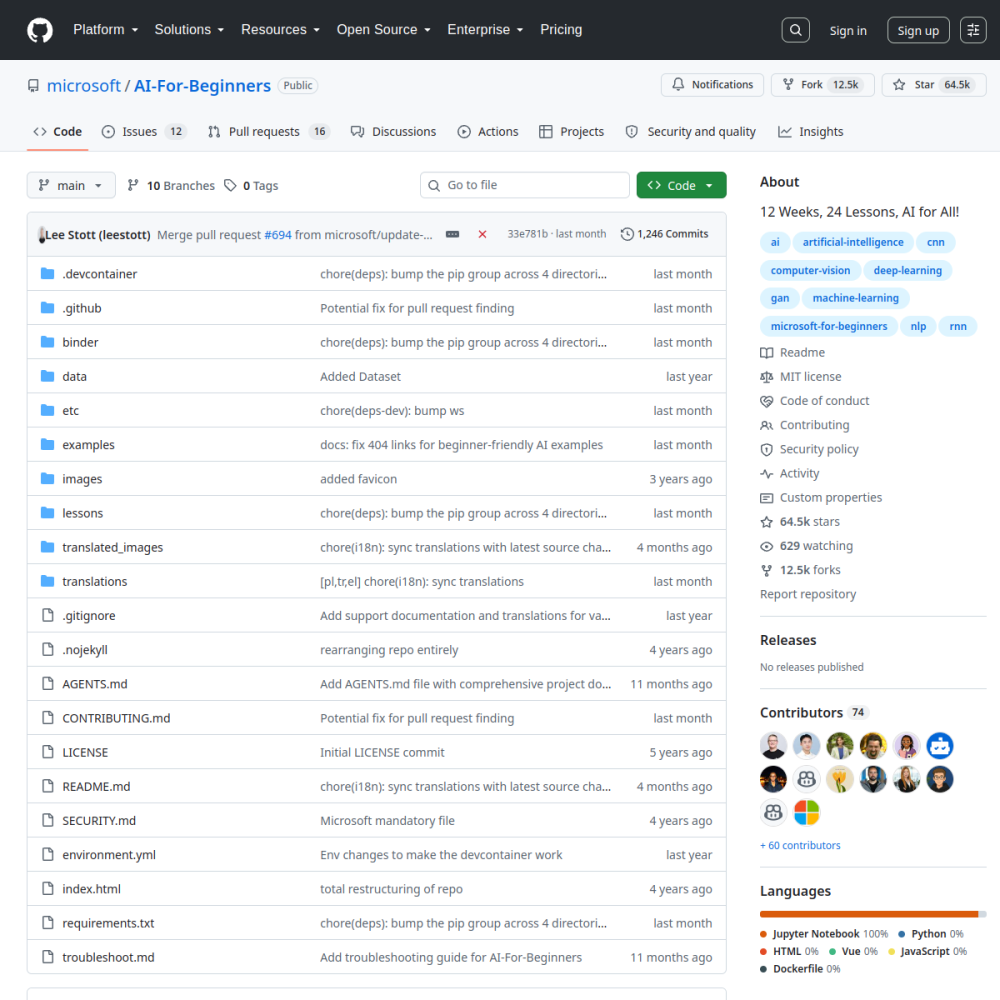
Microsoft's educational repository offering a structured 12-week course covering machine learning, deep learning, and AI fundamentals via interactive notebooks.
Official Preview
Vendor: microsoft
Microsoft's educational repository offering a structured 12-week course covering machine learning, deep learning, and AI fundamentals via interactive notebooks.
| Repository | microsoft/AI-For-Beginners |
|---|---|
| GitHub Stars | ★ 66.8k |
| Forks | 12.9k forks |
| Primary Language | Jupyter Notebook |
| License | MIT |
| Technical Domain | OTHER |
$ git clone https://github.com/microsoft/AI-For-Beginners.git && cd AI-For-Beginners
This repository serves as a comprehensive educational curriculum developed by Microsoft to democratize access to artificial intelligence knowledge. Designed as a 12-week course comprising 24 lessons, it targets individuals with little to no prior experience in the field. The project aims to bridge the gap between theoretical concepts and practical implementation, making complex topics accessible to a broad audience.
The core capabilities revolve around interactive learning through Jupyter Notebooks, allowing users to execute code alongside reading material. The curriculum covers a wide spectrum of AI disciplines, including machine learning, deep learning, computer vision, and natural language processing. Specific technical areas addressed include convolutional neural networks, recurrent neural networks, and generative adversarial networks, ensuring a well-rounded foundational understanding.
With over 63,000 stars on GitHub, the project demonstrates significant community adoption and trust. Its primary highlight is the structured progression from basic concepts to advanced models, supported by Microsoft's educational resources. However, as a beginner-focused course, it may not delve deeply into production-grade deployment strategies or advanced optimization techniques required for enterprise environments.
Typical users include students seeking introductory AI education, professionals looking to pivot careers into technology, and educators requiring structured syllabi for their classes. The open-source nature allows for community contributions and adaptations, making it a versatile tool for self-paced learning or formal instruction.
Microsoft developed this repository to democratize access to artificial intelligence knowledge for individuals with little prior experience in the field. The project functions as a structured 12-week course comprising 24 lessons designed to bridge the gap between theoretical concepts and practical implementation.
The curriculum aims to make complex topics accessible to a broad audience through interactive learning materials hosted on GitHub. By utilizing Jupyter Notebooks, the project allows users to execute code alongside reading material, covering machine learning, deep learning, computer vision, and natural language processing.
Typical users include students seeking introductory AI education and professionals looking to pivot careers into technology roles. The structured progression supports self-paced learning, allowing individuals to build foundational skills without formal classroom enrollment.
Educators can utilize the repository as a structured syllabus for university courses or training workshops requiring a standardized curriculum. Developers new to the field use the materials as an introduction to machine learning concepts before tackling more complex engineering tasks.
Users begin by cloning the repository from GitHub to their local development environment to access the lesson files. The project relies on Jupyter Notebook technology, requiring a compatible Python environment to execute the provided code cells effectively.
Once the environment is ready, learners navigate through the lesson folders to access the interactive notebooks organized by week and topic. Each lesson typically contains explanatory text followed by executable code blocks that demonstrate the concepts discussed in the reading material under the MIT license.
The project scores highly on functionality and documentation, providing a clear path from basic concepts to advanced models like convolutional and recurrent neural networks. Its primary strength lies in the structured progression and high ease of use, making it reliable for educational purposes with a rating of 4.5 out of 5.
However, the curriculum is explicitly beginner-focused and may not delve deeply into production-grade deployment strategies or advanced optimization techniques. Users seeking enterprise-ready solutions should supplement this course with additional resources focused on operationalizing machine learning models.
With significant community adoption indicated by over 63,000 stars on GitHub, the repository serves as a trusted resource within the open-source AI community. Microsoft leverages these educational resources to support broader initiatives in AI literacy and workforce development.
Typical integration scenarios involve universities adopting the lesson structure for introductory courses or bootcamps using the notebooks for practical labs. While specific enterprise deployment cases are not detailed, the material is widely referenced for foundational training programs globally.
AI-For-Beginners is an open-source AI project developed primarily in Jupyter Notebook under the MIT license. Microsoft's educational repository offering a structured 12-week course covering machine learning, deep learning, and AI fundamentals via interactive notebooks.. Microsoft developed this repository to democratize access to artificial intelligence knowledge for individuals with little prior experience in the field. The project functions as a structured 12-week course comprising 24 lessons designed to bridge the gap between theoretical concepts and practical implementation. The curriculum aims to make complex topics accessible to a broad audience through interactive learning materials hosted on GitHub. By utilizing Jupyter Notebooks, the project allows users to execute code alongside reading material, covering machine learning, deep learning, computer vision, and natural language processing.
Users begin by cloning the repository from GitHub to their local development environment to access the lesson files. The project relies on Jupyter Notebook technology, requiring a compatible Python environment to execute the provided code cells effectively. Once the environment is ready, learners navigate through the lesson folders to access the interactive notebooks organized by week and topic. Each lesson typically contains explanatory text followed by executable code blocks that demonstrate the concepts discussed in the reading material under the MIT license.
AI-For-Beginners is well-suited for Self-paced learning for AI career changers, Educational syllabus for university courses, Introduction to machine learning concepts for developers. With an overall rating of 4.5/5, it offers strong community activity, reliable performance, and easy integration with existing AI pipelines.
The project scores highly on functionality and documentation, providing a clear path from basic concepts to advanced models like convolutional and recurrent neural networks. Its primary strength lies in the structured progression and high ease of use, making it reliable for educational purposes with a rating of 4.5 out of 5. However, the curriculum is explicitly beginner-focused and may not delve deeply into production-grade deployment strategies or advanced optimization techniques. Users seeking enterprise-ready solutions should supplement this course with additional resources focused on operationalizing machine learning models.
Minimal tool for running large language models locally