keras
Vendor: keras-team
Keras is a high-level neural network library enabling rapid prototyping across TensorFlow, JAX, and PyTorch backends for machine learning practitioners.
Official Preview
Vendor: keras-team
Keras is a high-level neural network library enabling rapid prototyping across TensorFlow, JAX, and PyTorch backends for machine learning practitioners.
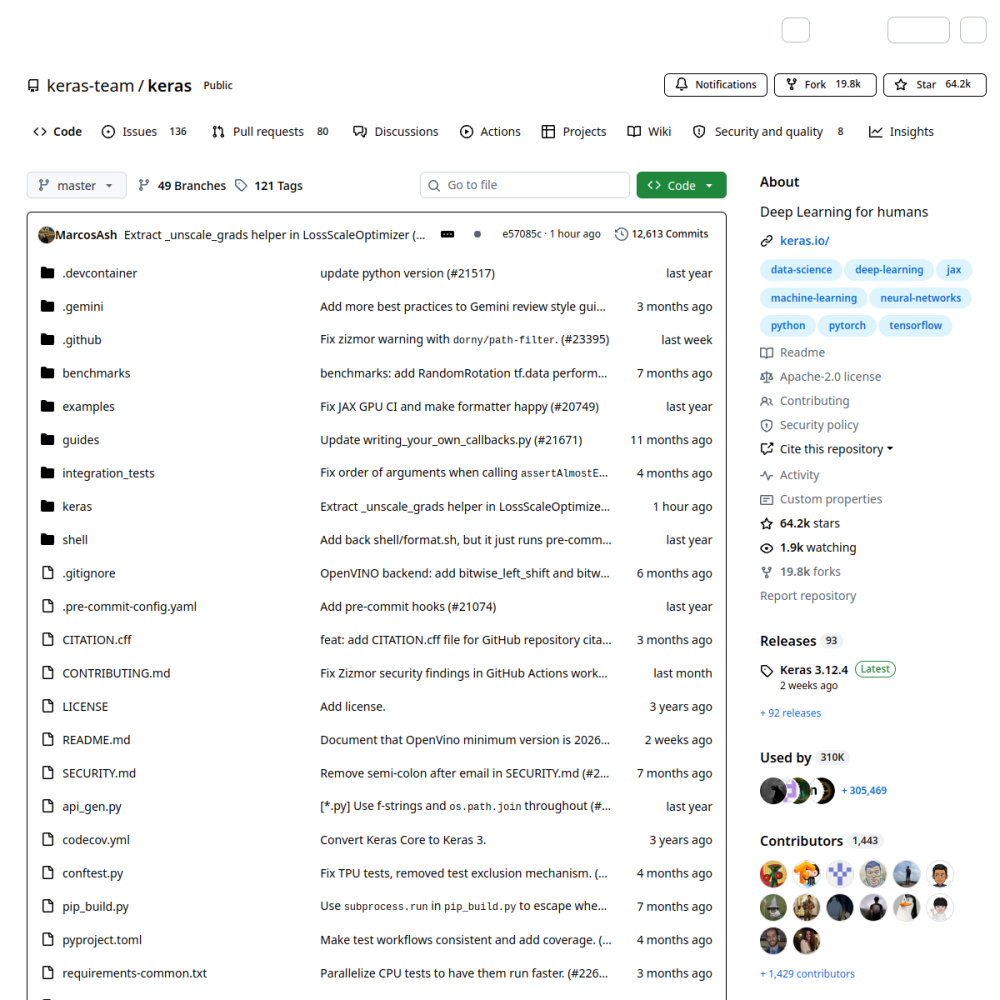
| Repository | keras-team/keras |
|---|---|
| GitHub Stars | ★ 64.2k |
| Forks | 19.8k forks |
| Primary Language | Python |
| License | Apache-2.0 |
| Technical Domain | OTHER |
$ git clone https://github.com/keras-team/keras.git && cd keras
Keras positions itself as a user-friendly interface for deep learning, emphasizing accessibility over low-level complexity. Originally designed to run on top of other engines, it has evolved into a standard high-level API that simplifies the construction of neural networks for developers and researchers alike.
The library supports multiple backends including TensorFlow, JAX, and PyTorch, allowing users to switch underlying engines without rewriting core model logic. Core capabilities include defining layers, compiling models, training with various optimizers, and evaluating performance through a consistent and intuitive Python API.
A primary highlight is the abstraction layer that reduces boilerplate code, making it ideal for rapid experimentation. However, this high level of abstraction may limit access to certain low-level optimizations compared to using the underlying frameworks directly. The project maintains a significant community presence, evidenced by its substantial star count on GitHub.
Typical applications range from academic research to production-grade machine learning systems. It serves as a foundational tool for teams needing to deploy deep learning models efficiently while maintaining code readability and maintainability across different hardware environments.
Keras was developed to address the significant complexity inherent in low-level deep learning frameworks. It positions itself as a user-friendly interface designed to prioritize accessibility over intricate engine management for developers. This approach democratizes access to advanced neural network capabilities.
Originally designed to run on top of other engines, it has evolved into a standard high-level API for constructing neural networks. This evolution allows developers and researchers to focus on model architecture rather than underlying computational details.
The library is primarily utilized for building and training neural network models across various technical domains. Its consistent Python API supports defining layers, compiling models, and evaluating performance with minimal boilerplate code.
Data science teams leverage Keras for rapid prototyping during experimental phases of machine learning projects. The abstraction layer significantly reduces setup time, enabling quick iteration on hypotheses before committing to production infrastructure.
Educational institutions frequently adopt the framework for machine learning courses due to its ease of use. Students can grasp core concepts without being hindered by the steep learning curve of lower-level frameworks.
Installation is straightforward for users with a Python environment configured on their system. Developers typically install the library using standard package managers to access the core functionality immediately. This ensures compatibility with existing data science workflows.
Once installed, users can define a simple neural network using the intuitive layer API. The process involves importing the library, constructing the model architecture, and compiling it with a chosen optimizer.
Training begins by feeding data into the compiled model through a consistent interface. This workflow remains stable regardless of whether TensorFlow, JAX, or PyTorch is selected as the underlying backend.
The project demonstrates strong production readiness with high ratings across functionality, documentation, and activity. Its multi-backend support allows teams to switch underlying engines without rewriting core model logic, enhancing flexibility in deployment.
However, the high level of abstraction may limit access to certain low-level optimizations compared to using the underlying frameworks directly. Teams requiring fine-grained control over hardware execution might find the simplified interface restrictive for specialized performance tuning.
Typical integration scenarios range from academic research to production-grade machine learning systems. Organizations often utilize Keras as a foundational tool for deploying deep learning models efficiently while maintaining code readability.
The substantial community presence, evidenced by over 64,000 stars on GitHub, suggests widespread adoption across various technical teams. While specific enterprise deployments vary, the framework is commonly found in environments prioritizing maintainability across different hardware configurations.
keras is an open-source AI project developed primarily in Python under the Apache-2.0 license. Keras is a high-level neural network library enabling rapid prototyping across TensorFlow, JAX, and PyTorch backends for machine learning practitioners.. Keras was developed to address the significant complexity inherent in low-level deep learning frameworks. It positions itself as a user-friendly interface designed to prioritize accessibility over intricate engine management for developers. This approach democratizes access to advanced neural network capabilities. Originally designed to run on top of other engines, it has evolved into a standard high-level API for constructing neural networks. This evolution allows developers and researchers to focus on model architecture rather than underlying computational details.
Installation is straightforward for users with a Python environment configured on their system. Developers typically install the library using standard package managers to access the core functionality immediately. This ensures compatibility with existing data science workflows. Once installed, users can define a simple neural network using the intuitive layer API. The process involves importing the library, constructing the model architecture, and compiling it with a chosen optimizer. Training begins by feeding data into the compiled model through a consistent interface. This workflow remains stable regardless of whether TensorFlow, JAX, or PyTorch is selected as the underlying backend.
keras is well-suited for Building and training neural network models, Rapid prototyping for data science projects, Educational purposes for machine learning courses. With an overall rating of 4.5/5, it offers strong community activity, reliable performance, and easy integration with existing AI pipelines.
The project demonstrates strong production readiness with high ratings across functionality, documentation, and activity. Its multi-backend support allows teams to switch underlying engines without rewriting core model logic, enhancing flexibility in deployment. However, the high level of abstraction may limit access to certain low-level optimizations compared to using the underlying frameworks directly. Teams requiring fine-grained control over hardware execution might find the simplified interface restrictive for specialized performance tuning.
Minimal tool for running large language models locally