headroom
Vendor: headroomlabs-ai
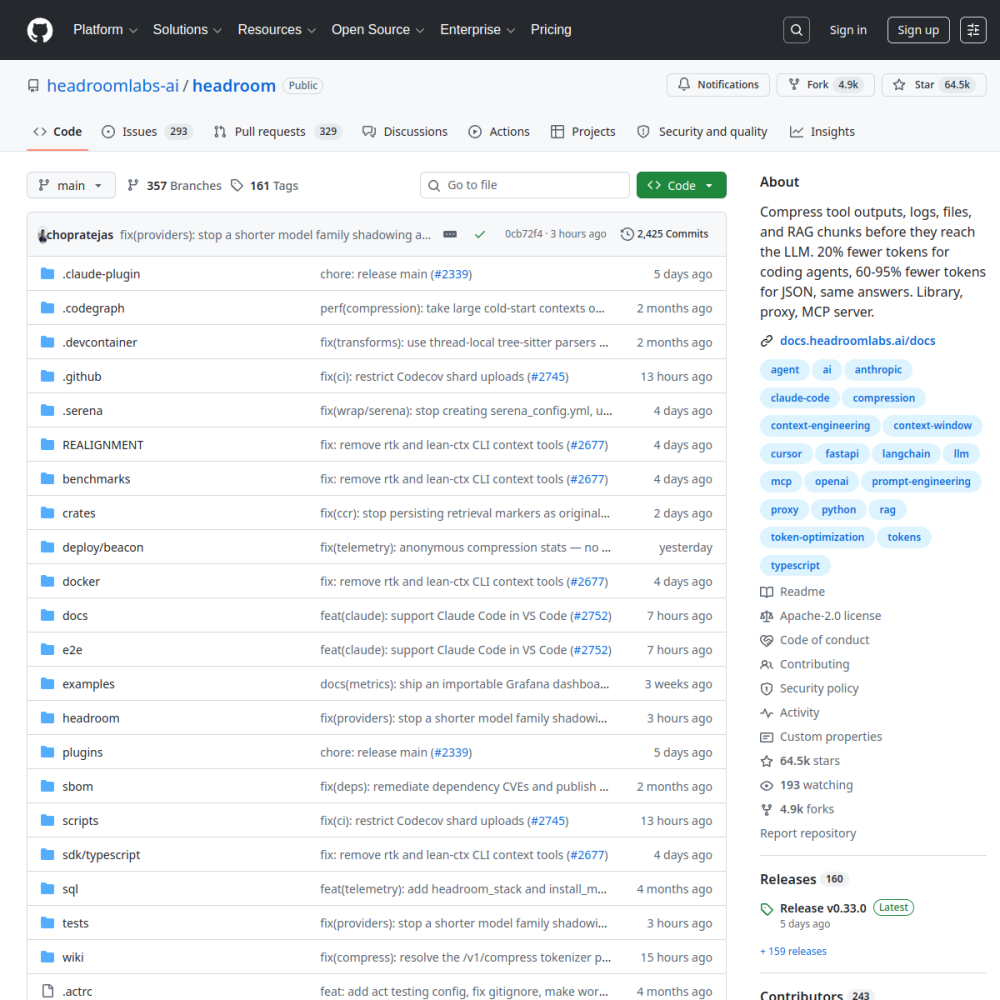
A Python library and proxy that compresses LLM inputs like logs and JSON to reduce token usage while maintaining answer quality.
Official Preview
Vendor: headroomlabs-ai
A Python library and proxy that compresses LLM inputs like logs and JSON to reduce token usage while maintaining answer quality.
| Repository | headroomlabs-ai/headroom |
|---|---|
| GitHub Stars | ★ 67.5k |
| Forks | 5.2k forks |
| Primary Language | Python |
| License | Apache-2.0 |
| Technical Domain | OTHER |
$ git clone https://github.com/headroomlabs-ai/headroom.git && cd headroom
Headroom positions itself as a critical optimization layer for Large Language Model applications, specifically targeting the reduction of token consumption without sacrificing output quality. By intervening before data reaches the model, it addresses the growing cost and latency issues associated with large context windows in modern AI workflows.
The project offers multiple integration points, functioning as a Python library, a proxy service, or an MCP server. Its core capability involves compressing diverse data types such as tool outputs, system logs, files, and Retrieval-Augmented Generation chunks. This flexibility allows developers to choose the implementation that best fits their existing infrastructure.
Performance claims suggest significant efficiency gains, with up to 20% fewer tokens for coding agents and between 60% to 95% reduction for JSON data. While the promise of maintaining answer accuracy is compelling, users should evaluate compatibility with their specific model providers and ensure that the compression logic aligns with their semantic requirements.
Ideal for teams managing expensive API calls or hitting context limits, this tool supports various ecosystems including LangChain, OpenAI, and Anthropic. It serves as a practical solution for scaling AI applications where token economy is a primary constraint.
Headroom is developed by Headroom Labs AI as a Python library and proxy designed to optimize Large Language Model inputs. It addresses the growing cost and latency issues associated with large context windows in modern AI workflows by intervening before data reaches the model.
The project positions itself as a critical optimization layer specifically targeting the reduction of token consumption without sacrificing output quality. By compressing diverse data types such as tool outputs, system logs, files, and Retrieval-Augmented Generation chunks, it aims to maintain answer accuracy while lowering API expenses.
Teams managing expensive API calls can utilize this tool to reduce costs for coding agent workflows. The compression logic targets specific data structures like logs and JSON, which often bloat context windows unnecessarily during automated development tasks.
Developers interacting with large JSON payloads in API interactions benefit from significant token reduction capabilities. The system claims efficiency gains of up to 60% to 95% for JSON data, making it suitable for applications handling heavy structured data.
Compressing RAG chunks to fit context windows is another primary application for retrieval-augmented generation systems. This allows developers to include more relevant information within the model's limits without exceeding token budgets or increasing latency.
Installation is handled via standard Python package managers once the repository is accessed. Users can import the library directly into their scripts to begin compressing inputs immediately without complex infrastructure changes.
For proxy deployment, the service can be started to intercept traffic between the application and the model provider. This allows for optimization without modifying the core application code and supports MCP server configurations.
Configuration requires selecting the compression strategy appropriate for the data type, such as logs or JSON. The system then processes the input before forwarding it to the LLM endpoint to apply the chosen optimization.
The project demonstrates strong production readiness with a high functionality rating of 4.5 out of 5 and active development status. Its flexibility across library, proxy, and MCP server deployment modes ensures compatibility with various existing infrastructures and model providers.
While the promise of maintaining answer accuracy is compelling, users should evaluate compatibility with their specific model providers. Ensuring that the compression logic aligns with semantic requirements is necessary before relying on it for critical production workflows, noting up to 20% savings for coding agents.
Typical integration scenarios involve ecosystems including LangChain, OpenAI, and Anthropic. The tool serves as a practical solution for scaling AI applications where token economy is a primary constraint within these frameworks.
While specific enterprise adoption names are not listed, the architecture supports common agent-based workflows. Teams utilizing coding agents or complex retrieval systems can expect to see reduced token usage when implementing this optimization layer.
headroom is an open-source AI project developed primarily in Python under the Apache-2.0 license. A Python library and proxy that compresses LLM inputs like logs and JSON to reduce token usage while maintaining answer quality.. Headroom is developed by Headroom Labs AI as a Python library and proxy designed to optimize Large Language Model inputs. It addresses the growing cost and latency issues associated with large context windows in modern AI workflows by intervening before data reaches the model. The project positions itself as a critical optimization layer specifically targeting the reduction of token consumption without sacrificing output quality. By compressing diverse data types such as tool outputs, system logs, files, and Retrieval-Augmented Generation chunks, it aims to maintain answer accuracy while lowering API expenses.
Installation is handled via standard Python package managers once the repository is accessed. Users can import the library directly into their scripts to begin compressing inputs immediately without complex infrastructure changes. For proxy deployment, the service can be started to intercept traffic between the application and the model provider. This allows for optimization without modifying the core application code and supports MCP server configurations. Configuration requires selecting the compression strategy appropriate for the data type, such as logs or JSON. The system then processes the input before forwarding it to the LLM endpoint to apply the chosen optimization.
headroom is well-suited for Reducing costs for coding agent workflows, Optimizing large JSON payloads in API interactions, Compressing RAG chunks to fit context windows. With an overall rating of 4.5/5, it offers strong community activity, reliable performance, and easy integration with existing AI pipelines.
The project demonstrates strong production readiness with a high functionality rating of 4.5 out of 5 and active development status. Its flexibility across library, proxy, and MCP server deployment modes ensures compatibility with various existing infrastructures and model providers. While the promise of maintaining answer accuracy is compelling, users should evaluate compatibility with their specific model providers. Ensuring that the compression logic aligns with semantic requirements is necessary before relying on it for critical production workflows, noting up to 20% savings for coding agents.
Minimal tool for running large language models locally