scikit-learn
Vendor: scikit-learn
Scikit-learn provides efficient tools for data analysis and machine learning in Python, built on NumPy, SciPy, and matplotlib.
Official Preview
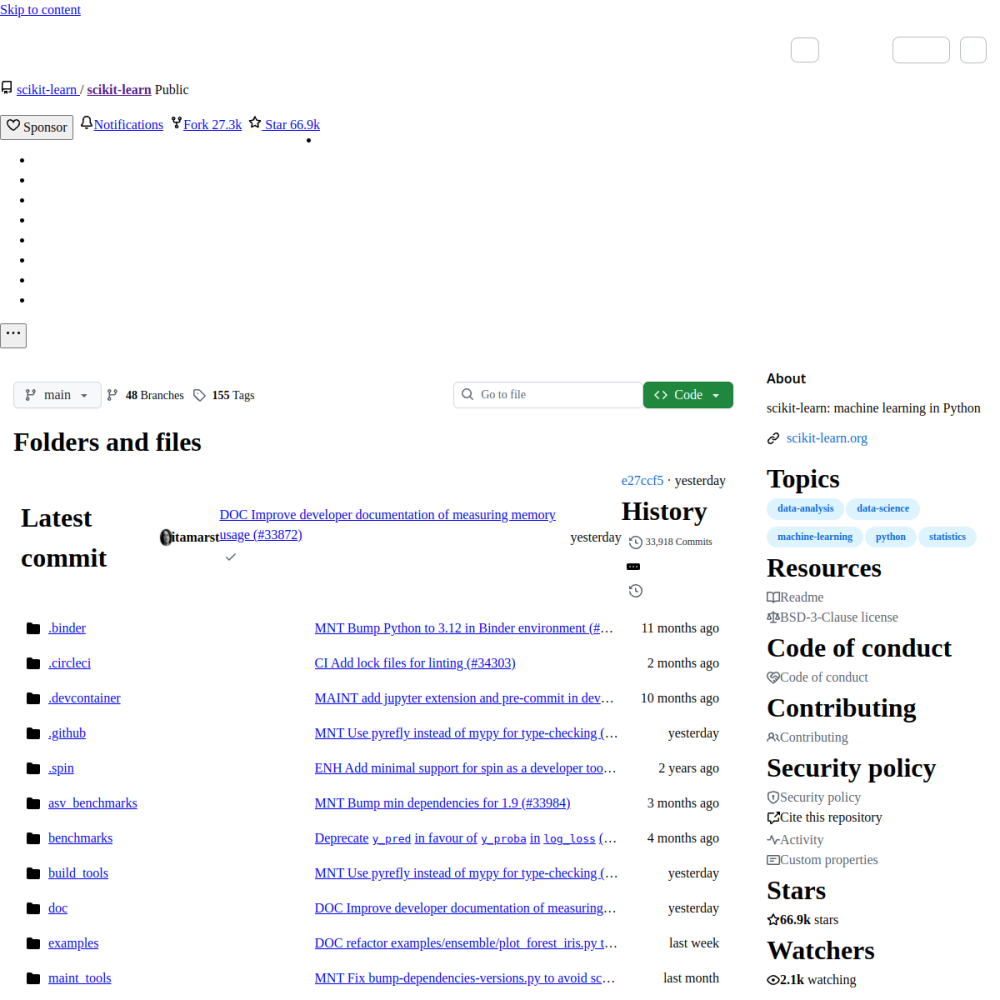
Vendor: scikit-learn
Scikit-learn provides efficient tools for data analysis and machine learning in Python, built on NumPy, SciPy, and matplotlib.
| Repository | scikit-learn/scikit-learn |
|---|---|
| GitHub Stars | ★ 67.1k |
| Forks | 27.3k forks |
| Primary Language | Python |
| License | BSD-3-Clause |
| Technical Domain | OTHER |
$ pip install scikit-learn
Scikit-learn stands as a foundational library within the Python data science ecosystem. It is designed to make machine learning accessible to researchers and developers by providing a consistent interface for various algorithms. The project leverages existing scientific computing libraries like NumPy and SciPy to ensure performance and compatibility.
The library covers a broad spectrum of machine learning tasks including classification, regression, clustering, and dimensionality reduction. It also includes utilities for model selection, preprocessing, and evaluation metrics. This comprehensive suite allows users to build complete pipelines without switching between different tools.
A key strength is its extensive documentation and community support, making it suitable for both beginners and experts. However, it is primarily focused on classical machine learning rather than deep learning, which is better handled by frameworks like TensorFlow or PyTorch. Performance on very large datasets may require optimization or distributed computing solutions.
Common applications include predictive modeling, natural language processing tasks, and image classification. Data scientists frequently utilize it for exploratory data analysis and prototyping models before deploying them into production environments. Its integration with the broader Python stack facilitates seamless workflow integration.
Scikit-learn emerged as a foundational library within the Python data science ecosystem to address the need for accessible machine learning tools. It was designed to provide researchers and developers with a consistent interface for various algorithms, reducing the friction of switching between different tools.
The project leverages existing scientific computing libraries like NumPy and SciPy to ensure performance and compatibility within the broader Python stack. This architectural choice allows the library to focus on efficient tools for data analysis and machine learning without reinventing lower-level computational infrastructure.
Data scientists frequently utilize the library for exploratory data analysis and prototyping models before deploying them into production environments. Common applications include predictive modeling for business analytics and natural language processing tasks where classical algorithms perform well.
Clustering for customer segmentation represents another typical use case, allowing users to group unlabeled data effectively. The library also supports feature selection and preprocessing pipelines, which are essential steps for preparing raw data before training models.
Target users range from beginners learning the basics of statistics to experts building complete pipelines without switching between different tools. Its integration with the broader Python stack facilitates seamless workflow integration for teams working on diverse data science projects.
Installation typically involves using the Python package manager to add the library to your environment. Users can install the package directly from the official repository or package indexes using the command pip install scikit-learn.
Once installed, developers can import the library to access its suite of algorithms for classification, regression, and clustering. A basic workflow involves loading data, preprocessing it using the provided utilities, and fitting a model to make predictions.
The consistent API design across different models means that switching between algorithms requires minimal code changes. This allows users to quickly experiment with different approaches during the initial prototyping phase.
The library demonstrates high production readiness for classical machine learning tasks, supported by extensive documentation and community support. Its high rating for functionality and ease of use indicates a stable API that is suitable for both beginners and experts.
However, the project is primarily focused on classical machine learning rather than deep learning, which is better handled by frameworks like TensorFlow or PyTorch. Performance on very large datasets may require optimization or distributed computing solutions, limiting its scope for massive-scale data processing without additional infrastructure.
While specific enterprise adoption metrics are not detailed in the project summary, the library is widely recognized within the data science community for its reliability. It is frequently utilized for exploratory data analysis and prototyping models before deploying them into production environments across various industries.
Typical integration scenarios involve combining scikit-learn with other Python data analysis tools to build complete pipelines. Its integration with the broader Python stack facilitates seamless workflow integration for teams working on predictive modeling and customer segmentation tasks.
scikit-learn is an open-source AI project developed primarily in Python under the BSD-3-Clause license. Scikit-learn provides efficient tools for data analysis and machine learning in Python, built on NumPy, SciPy, and matplotlib.. Scikit-learn emerged as a foundational library within the Python data science ecosystem to address the need for accessible machine learning tools. It was designed to provide researchers and developers with a consistent interface for various algorithms, reducing the friction of switching between different tools. The project leverages existing scientific computing libraries like NumPy and SciPy to ensure performance and compatibility within the broader Python stack. This architectural choice allows the library to focus on efficient tools for data analysis and machine learning without reinventing lower-level computational infrastructure.
Installation typically involves using the Python package manager to add the library to your environment. Users can install the package directly from the official repository or package indexes using the command pip install scikit-learn. Once installed, developers can import the library to access its suite of algorithms for classification, regression, and clustering. A basic workflow involves loading data, preprocessing it using the provided utilities, and fitting a model to make predictions. The consistent API design across different models means that switching between algorithms requires minimal code changes. This allows users to quickly experiment with different approaches during the initial prototyping phase.
scikit-learn is well-suited for Predictive modeling for business analytics, Clustering for customer segmentation, Feature selection and preprocessing pipelines. With an overall rating of 4.8/5, it offers strong community activity, reliable performance, and easy integration with existing AI pipelines.
The library demonstrates high production readiness for classical machine learning tasks, supported by extensive documentation and community support. Its high rating for functionality and ease of use indicates a stable API that is suitable for both beginners and experts. However, the project is primarily focused on classical machine learning rather than deep learning, which is better handled by frameworks like TensorFlow or PyTorch. Performance on very large datasets may require optimization or distributed computing solutions, limiting its scope for massive-scale data processing without additional infrastructure.
Minimal tool for running large language models locally