annotated_deep_learning_paper_implementations
Vendor: labmlai
This repository provides annotated Python implementations of deep learning papers, featuring detailed explanations alongside code for transformers, GANs, and optimizers.
Official Preview
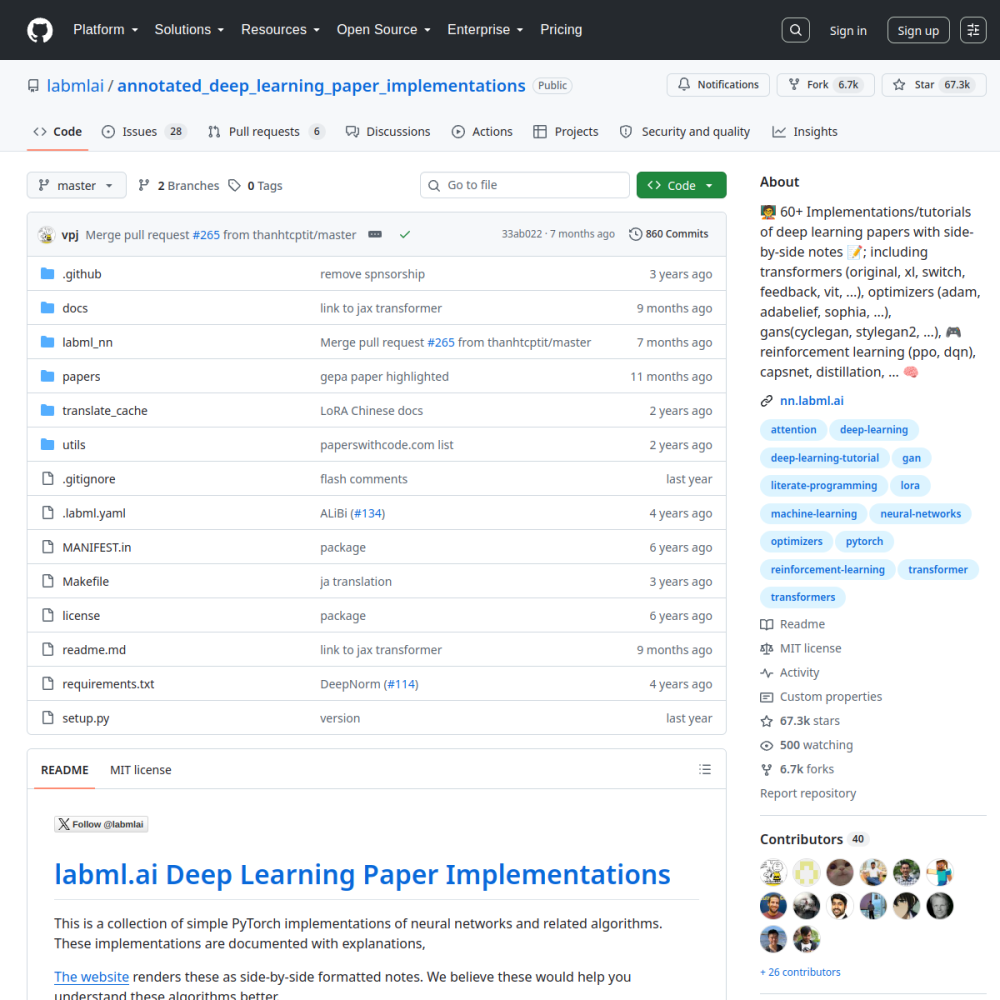
Vendor: labmlai
This repository provides annotated Python implementations of deep learning papers, featuring detailed explanations alongside code for transformers, GANs, and optimizers.
| Repository | labmlai/annotated_deep_learning_paper_implementations |
|---|---|
| GitHub Stars | ★ 67.3k |
| Forks | 6.8k forks |
| Primary Language | Python |
| License | MIT |
| Technical Domain | OTHER |
$ git clone https://github.com/labmlai/annotated_deep_learning_paper_implementations.git && cd annotated_deep_learning_paper_implementations
This repository serves as an educational resource for researchers and engineers seeking to understand the practical implementation of deep learning theories. It bridges the gap between academic publications and executable code by providing detailed annotations directly within the source files. The project is maintained by labmlai and focuses on clarity alongside functional correctness.
The collection covers a wide spectrum of modern deep learning architectures, including various transformer models, generative adversarial networks, and reinforcement learning algorithms. Each implementation is designed to be readable, allowing users to trace the logic of complex papers step-by-step. The use of Python ensures compatibility with the broader machine learning ecosystem.
A key strength of this project is its literate programming approach, where explanatory text accompanies the code blocks. This makes it particularly valuable for learning purposes rather than just production deployment. However, the complexity of the underlying algorithms may require a foundational understanding of deep learning concepts to fully grasp the nuances presented.
Typical users include students studying advanced neural network architectures and developers looking for reference implementations of specific optimizers or attention mechanisms. The repository acts as a bridge for translating mathematical formulations into working software components. It supports those who wish to modify or extend existing models based on a solid understanding of their internals.
This repository was created by labmlai to address the significant disconnect between academic deep learning publications and executable code. It aims to provide detailed annotations directly within the source files to clarify complex implementations for researchers and engineers seeking practical understanding.
The project utilizes a literate programming approach where explanatory text accompanies code blocks throughout the repository. This design choice prioritizes clarity and educational value over production optimization, helping users trace the logic of complex papers step-by-step while covering topics like LoRA and transformers.
Students studying advanced neural network architectures find this resource valuable for understanding the internals of models like transformers and GANs. The side-by-side explanations allow learners to connect mathematical formulations directly to PyTorch code without guessing the implementation details.
Developers looking for reference implementations of specific optimizers or attention mechanisms can use this repository as a reliable guide for their own work. It supports those who wish to modify or extend existing models based on a solid understanding of their internals.
The collection covers a wide spectrum of modern deep learning architectures, including reinforcement learning algorithms and generative adversarial networks. Users typically engage with the code to bridge the gap between reading a paper and writing functional software components.
Users begin by cloning the repository and installing the necessary Python dependencies required for the PyTorch ecosystem. The project relies on standard machine learning libraries, ensuring compatibility with the broader development environment and existing toolchains.
Once installed, users can navigate through the directory structure to find specific paper implementations organized by topic. Each module is designed to be readable independently, allowing for direct inspection of the code and annotations within the source files.
Running the scripts typically involves executing the Python files associated with the desired architecture or algorithm. The code is structured to facilitate experimentation and modification without extensive configuration overhead or complex setup procedures.
The project scores highly on documentation and functionality, making it a strong educational tool rather than a production library. The literate programming style ensures that the code is understandable, though it may not be optimized for deployment performance or speed.
A key limitation is that the complexity of the underlying algorithms requires a foundational understanding of deep learning concepts. While the code is functional, users should expect to invest time in grasping the nuances presented in the annotations.
While specific enterprise adoption is not publicly documented, the repository serves as a common reference point for engineering teams exploring transformer architectures. It is frequently utilized in academic settings and research groups to validate theoretical concepts against working code.
Typical integration scenarios involve developers studying the code to implement custom attention mechanisms or optimizers in their own projects. The MIT license allows for flexible usage, supporting both internal research and educational curriculum development without restriction.
annotated_deep_learning_paper_implementations is an open-source AI project developed primarily in Python under the MIT license. This repository provides annotated Python implementations of deep learning papers, featuring detailed explanations alongside code for transformers, GANs, and optimizers.. This repository was created by labmlai to address the significant disconnect between academic deep learning publications and executable code. It aims to provide detailed annotations directly within the source files to clarify complex implementations for researchers and engineers seeking practical understanding. The project utilizes a literate programming approach where explanatory text accompanies code blocks throughout the repository. This design choice prioritizes clarity and educational value over production optimization, helping users trace the logic of complex papers step-by-step while covering topics like LoRA and transformers.
Users begin by cloning the repository and installing the necessary Python dependencies required for the PyTorch ecosystem. The project relies on standard machine learning libraries, ensuring compatibility with the broader development environment and existing toolchains. Once installed, users can navigate through the directory structure to find specific paper implementations organized by topic. Each module is designed to be readable independently, allowing for direct inspection of the code and annotations within the source files. Running the scripts typically involves executing the Python files associated with the desired architecture or algorithm. The code is structured to facilitate experimentation and modification without extensive configuration overhead or complex setup procedures.
annotated_deep_learning_paper_implementations is well-suited for Learning specific paper architectures, Reference for implementing optimizers, Educational resource for deep learning concepts. With an overall rating of 4.5/5, it offers strong community activity, reliable performance, and easy integration with existing AI pipelines.
The project scores highly on documentation and functionality, making it a strong educational tool rather than a production library. The literate programming style ensures that the code is understandable, though it may not be optimized for deployment performance or speed. A key limitation is that the complexity of the underlying algorithms requires a foundational understanding of deep learning concepts. While the code is functional, users should expect to invest time in grasping the nuances presented in the annotations.
Minimal tool for running large language models locally