awesome-scalability
Vendor: binhnguyennus
A curated collection of resources focused on scalable, reliable, and performant large-scale system design patterns for developers and architects.
Official Preview
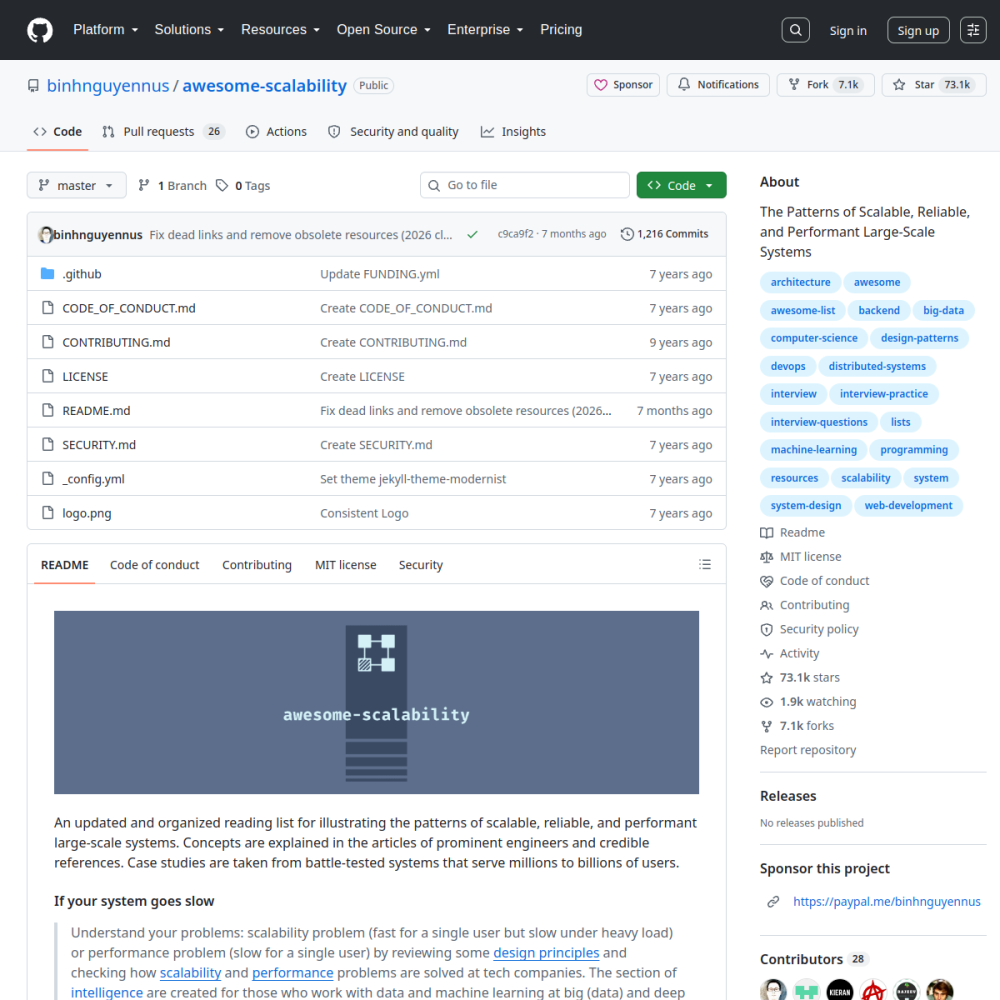
Vendor: binhnguyennus
A curated collection of resources focused on scalable, reliable, and performant large-scale system design patterns for developers and architects.
| Repository | binhnguyennus/awesome-scalability |
|---|---|
| GitHub Stars | ★ 73.5k |
| Forks | 7.1k forks |
| Primary Language | N/A |
| License | MIT |
| Technical Domain | OTHER |
$ git clone https://github.com/binhnguyennus/awesome-scalability.git && cd awesome-scalability
This repository serves as a comprehensive knowledge base for engineers seeking to understand the principles behind large-scale system architecture. With over 73,000 stars, it stands as a community-validated hub for topics ranging from distributed systems to backend development.
The core value lies in its curated aggregation of external resources, including articles, talks, and books. It organizes complex subjects like scalability, reliability, and performance into accessible categories, making it easier for practitioners to navigate the vast landscape of system design literature.
While the collection is extensive, it functions primarily as a directory rather than an educational course. Users must follow external links to consume the content, which means the repository relies on the availability of third-party resources. However, the breadth of coverage across big data, machine learning, and web development ensures relevance for various technical roles.
Ideal for both seasoned architects and students, this project supports continuous learning and professional development. It is particularly useful for those preparing for technical interviews or looking to deepen their understanding of modern infrastructure patterns without starting from scratch.
The awesome-scalability repository was established by binhnguyennus as a centralized hub for engineers navigating complex infrastructure challenges in modern technology stacks. It addresses the significant difficulty of finding reliable information on large-scale system design by aggregating scattered knowledge into a single accessible location under an MIT license.
Inspired by the critical need for structured learning in distributed systems, the project compiles articles, talks, and books covering backend development, big data, and machine learning. This approach solves the problem of information overload by organizing vast technical literature into categorized resources for developers and architects seeking to improve system reliability.
Primary users include software engineers preparing for technical interviews where system design questions are common and require deep conceptual understanding. The curated list provides a structured path to study scalability patterns without searching through unverified sources independently or wasting time on low-quality content.
Architects and senior developers utilize the repository to research large-scale architecture patterns relevant to backend development and big data processing workflows. It serves as a comprehensive reference guide for understanding reliability and performance optimization in production environments where uptime is critical.
Students and junior developers benefit from the broad coverage across machine learning and web development topics that span various technical roles. The resource supports continuous professional development by offering entry points into complex computer science concepts without requiring formal university enrollment.
Accessing the project requires no installation or local environment setup since it functions primarily as a documentation repository hosted on GitHub. Users can visit the GitHub URL directly to browse the categorized list of external resources without configuring dependencies or managing version control locally.
To begin, navigate to the main README file which organizes topics such as distributed systems, design patterns, and devops practices. Clicking on specific links directs users to the original articles, videos, or books maintained by third parties outside the repository.
There are no commands to execute locally, as the value lies in reading the curated content rather than running executable software. Users should ensure they have stable internet access to follow the external links provided within the list effectively.
The project scores highly on functionality and ease of use, reflecting its effectiveness as a knowledge base with an overall rating of 4.5 out of 5. Its strength lies in the extensive library of system design resources validated by a large community following of over 73,000 stars.
A key limitation is that it functions primarily as a directory rather than an educational course with interactive exercises. Users must rely on the continued availability of third-party resources, which may change or become inaccessible over time without notice.
While specific company adoption is not publicly documented, the repository is widely referenced in technical interview preparation communities globally. Engineers often use it as a foundational resource when designing new infrastructure components or studying for advanced certification.
Typical integration scenarios involve individual study plans for mastering distributed systems concepts and scalable architecture principles. Teams may reference the curated topics during internal knowledge sharing sessions to align on scalability standards without starting from scratch.
awesome-scalability is an open-source AI project developed primarily in N/A under the MIT license. A curated collection of resources focused on scalable, reliable, and performant large-scale system design patterns for developers and architects.. The awesome-scalability repository was established by binhnguyennus as a centralized hub for engineers navigating complex infrastructure challenges in modern technology stacks. It addresses the significant difficulty of finding reliable information on large-scale system design by aggregating scattered knowledge into a single accessible location under an MIT license. Inspired by the critical need for structured learning in distributed systems, the project compiles articles, talks, and books covering backend development, big data, and machine learning. This approach solves the problem of information overload by organizing vast technical literature into categorized resources for developers and architects seeking to improve system reliability.
Accessing the project requires no installation or local environment setup since it functions primarily as a documentation repository hosted on GitHub. Users can visit the GitHub URL directly to browse the categorized list of external resources without configuring dependencies or managing version control locally. To begin, navigate to the main README file which organizes topics such as distributed systems, design patterns, and devops practices. Clicking on specific links directs users to the original articles, videos, or books maintained by third parties outside the repository. There are no commands to execute locally, as the value lies in reading the curated content rather than running executable software. Users should ensure they have stable internet access to follow the external links provided within the list effectively.
awesome-scalability is well-suited for Preparing for system design interviews, Researching large-scale architecture patterns, Learning distributed systems concepts. With an overall rating of 4.5/5, it offers strong community activity, reliable performance, and easy integration with existing AI pipelines.
The project scores highly on functionality and ease of use, reflecting its effectiveness as a knowledge base with an overall rating of 4.5 out of 5. Its strength lies in the extensive library of system design resources validated by a large community following of over 73,000 stars. A key limitation is that it functions primarily as a directory rather than an educational course with interactive exercises. Users must rely on the continued availability of third-party resources, which may change or become inaccessible over time without notice.
Minimal tool for running large language models locally