CrewAI
Vendor: crewAIInc
Role-playing multi-agent orchestration framework
Official Preview
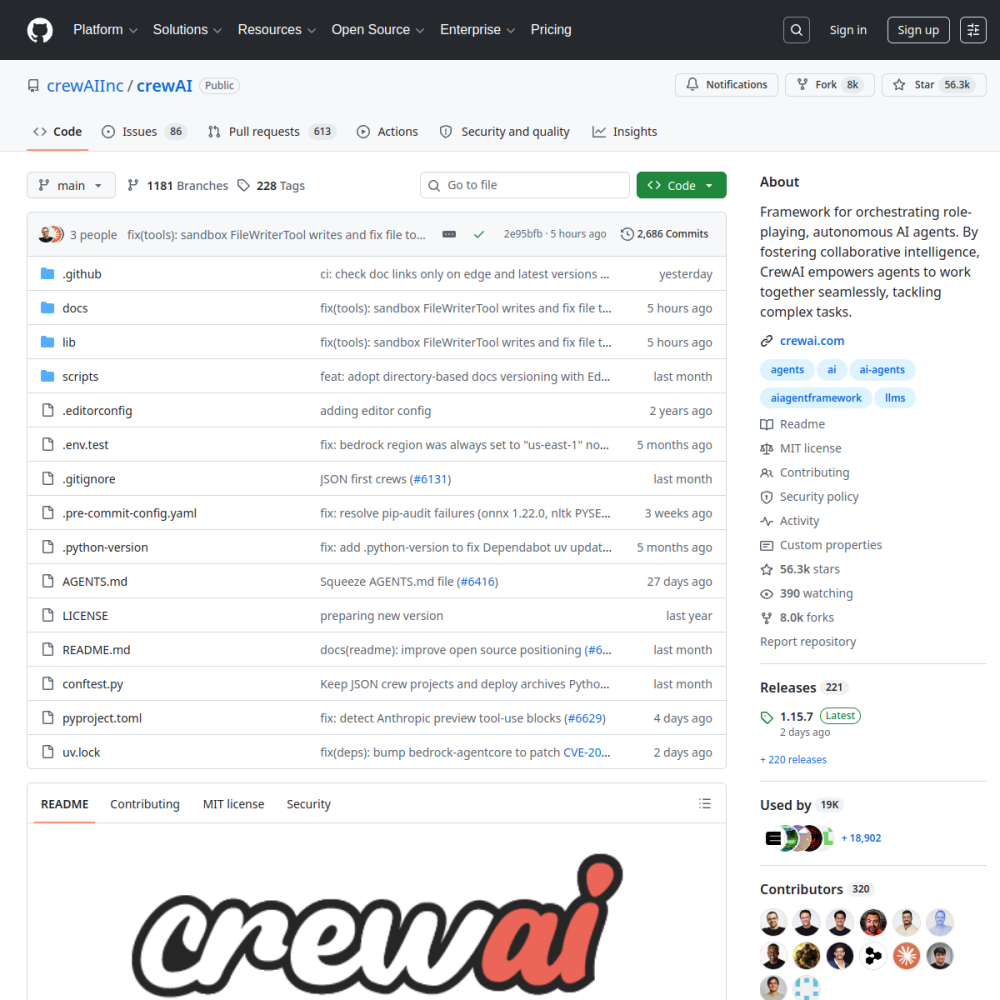
Vendor: crewAIInc
Role-playing multi-agent orchestration framework
| Repository | crewAIInc/crewAI |
|---|---|
| GitHub Stars | ★ 57.6k |
| Forks | 8.2k forks |
| Primary Language | Python |
| License | MIT |
| Technical Domain | AGENTS |
$ git clone https://github.com/crewAIInc/crewAI.git && cd crewAI
CrewAI's core idea is role-playing plus task division: it models multi-agent collaboration as a Crew where each Agent has a role, goal, and backstory, connected by Tasks. The flow is intuitive and the cognitive load is low. Sitting between LangGraph (lower-level) and AutoGen (research-leaning), CrewAI occupies the easy-onboarding niche.
Core capabilities include the Agent/Task/Crew three-layer abstraction, sequential and hierarchical processes, tool calling, memory and caching, interop with the LangChain tool ecosystem, and a visual orchestration layer in the enterprise CrewAI+ edition. After 1.x, the internal execution engine was significantly rewritten, improving performance and observability.
The highlight is an API design close to natural-language intuition, so non-engineers can quickly build multi-agent demos. The downside is weaker debugging and predictability under complex flows, opaque message passing between agents, and a widening feature gap between the enterprise and open-source editions.
Use cases: content production pipelines, research-assistant style multi-agent setups, teaching entry to multi-agent orchestration. For fine-grained state control, switch to LangGraph.
CrewAI emerges from the need to simplify multi-agent collaboration without sacrificing structural clarity within the LLM landscape. The framework models collaboration as a Crew where each Agent possesses a defined role, goal, and backstory, connected through specific Tasks.
This approach addresses the cognitive load often associated with building complex LLM-driven systems. By positioning itself between lower-level tools like LangGraph and research-leaning frameworks like AutoGen, CrewAI targets the easy-onboarding niche for developers seeking intuitive orchestration.
Content production pipelines benefit significantly from the framework's hierarchical process orchestration capabilities. Teams can assign specific roles to agents for drafting, editing, and finalizing content, leveraging the natural-language intuition of the API to streamline workflows.
Research-assistant style multi-agent setups are another primary application area for this technology. Users can configure agents to gather information, analyze data, and synthesize findings, making it suitable for exploratory tasks where rigid state control is less critical.
The framework also serves as a teaching entry point for multi-agent orchestration concepts. Its low cognitive load allows educators and new developers to grasp core concepts quickly before potentially migrating to more granular tools for complex state management. Non-engineers can quickly build multi-agent demos due to the API design being close to natural-language intuition.
As a Python-based framework, setup begins with standard environment preparation within the developer's local workspace. Developers typically install the package via package managers compatible with the Python ecosystem to access the core orchestration libraries.
Once installed, users define Agents and Tasks using the provided abstraction layers. The workflow involves configuring the Crew object to manage the execution flow, allowing for immediate testing of sequential or hierarchical processes without complex boilerplate.
Practicality is high for rapid prototyping and demo generation, supported by an API design close to natural language intuition. The recent 1.x internal execution engine rewrite has improved performance and observability, making it viable for lighter production workloads.
However, limitations exist regarding debugging and predictability under complex flows. Message passing between agents can be opaque, and there is a widening feature gap between the enterprise CrewAI+ edition and the open-source version, which may affect long-term scalability for some teams. The overall functionality and documentation ratings stand at 4.0 out of 5, reflecting solid but not perfect support for complex enterprise needs.
Integration scenarios often involve leveraging the LangChain tool ecosystem for extended functionality. This interoperability allows existing LangChain users to adopt CrewAI's orchestration layer without abandoning their current tooling stack.
While specific enterprise adoption metrics are not publicly detailed, the framework is positioned for scenarios requiring role-based collaboration. Teams looking for visual orchestration layers may consider the enterprise edition, though the open-source version remains the primary focus for community-driven projects.
CrewAI is an open-source AI project developed primarily in Python under the MIT license. Role-playing multi-agent orchestration framework. CrewAI emerges from the need to simplify multi-agent collaboration without sacrificing structural clarity within the LLM landscape. The framework models collaboration as a Crew where each Agent possesses a defined role, goal, and backstory, connected through specific Tasks. This approach addresses the cognitive load often associated with building complex LLM-driven systems. By positioning itself between lower-level tools like LangGraph and research-leaning frameworks like AutoGen, CrewAI targets the easy-onboarding niche for developers seeking intuitive orchestration.
As a Python-based framework, setup begins with standard environment preparation within the developer's local workspace. Developers typically install the package via package managers compatible with the Python ecosystem to access the core orchestration libraries. Once installed, users define Agents and Tasks using the provided abstraction layers. The workflow involves configuring the Crew object to manage the execution flow, allowing for immediate testing of sequential or hierarchical processes without complex boilerplate.
CrewAI is well-suited for Content production pipelines, Research-assistant multi-agent, Multi-agent teaching entry. With an overall rating of 4.0/5, it offers strong community activity, reliable performance, and easy integration with existing AI pipelines.
Practicality is high for rapid prototyping and demo generation, supported by an API design close to natural language intuition. The recent 1.x internal execution engine rewrite has improved performance and observability, making it viable for lighter production workloads. However, limitations exist regarding debugging and predictability under complex flows. Message passing between agents can be opaque, and there is a widening feature gap between the enterprise CrewAI+ edition and the open-source version, which may affect long-term scalability for some teams. The overall functionality and documentation ratings stand at 4.0 out of 5, reflecting solid but not perfect support for complex enterprise needs.
Minimal tool for running large language models locally