LlamaFactory
Vendor: hiyouga
LlamaFactory is a unified framework for efficient fine-tuning of over 100 large language and vision models, supporting various training methods.
Official Preview
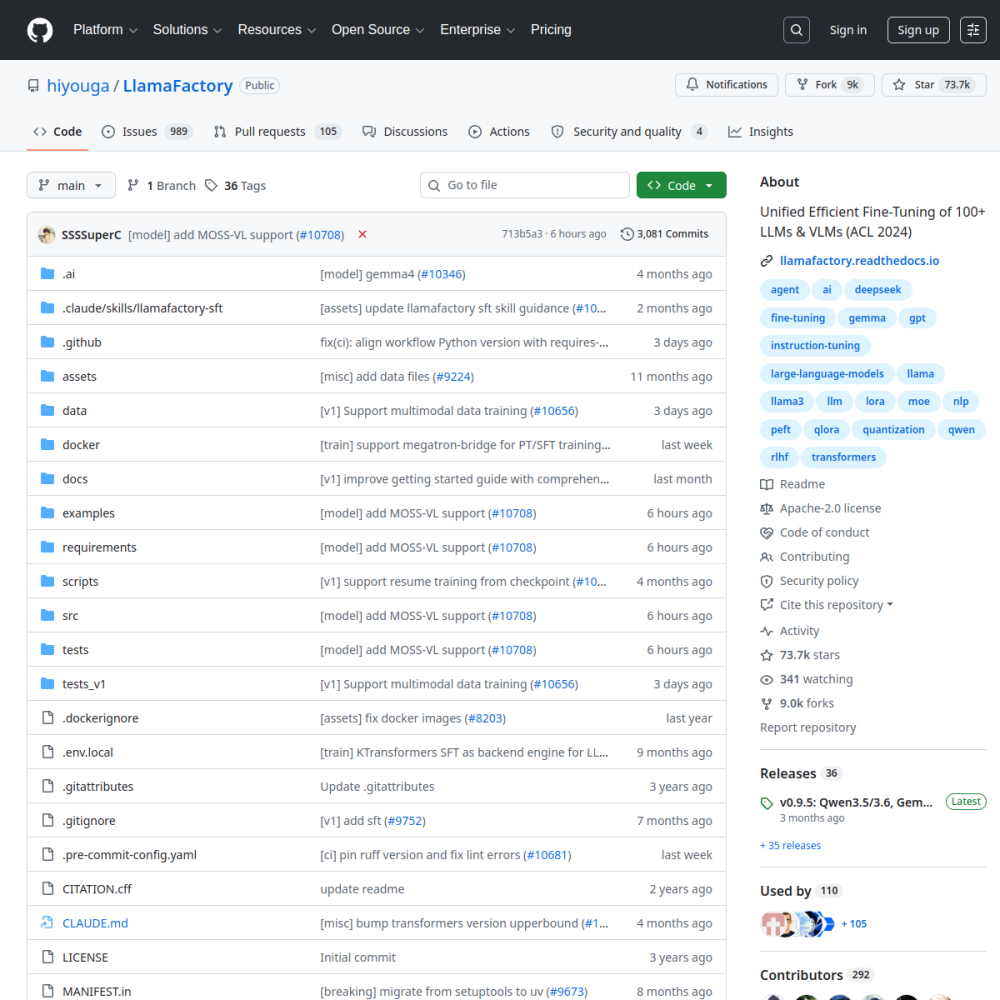
Vendor: hiyouga
LlamaFactory is a unified framework for efficient fine-tuning of over 100 large language and vision models, supporting various training methods.
| Repository | hiyouga/LlamaFactory |
|---|---|
| GitHub Stars | ★ 74.3k |
| Forks | 9.1k forks |
| Primary Language | Python |
| License | Apache-2.0 |
| Technical Domain | OTHER |
$ git clone https://github.com/hiyouga/LlamaFactory.git && cd LlamaFactory
LlamaFactory positions itself as a comprehensive toolkit designed to simplify the fine-tuning process for a wide array of large language models and vision-language models. Recognized by its publication at ACL 2024, the project aims to lower the barrier to entry for researchers and developers looking to adapt pre-trained models to specific tasks without managing complex infrastructure from scratch.
The framework supports efficient training techniques such as LoRA, QLoRA, and full fine-tuning across more than 100 model architectures. It integrates seamlessly with popular libraries like Transformers and PEFT, offering a unified interface that handles diverse model types including Llama, Qwen, and DeepSeek variants. This versatility allows users to switch between models and training strategies with minimal code changes.
A key strength is its support for reinforcement learning from human feedback and quantization, enabling resource-constrained environments to train large models effectively. However, users should note that while the abstraction layer simplifies setup, advanced customization might require deeper understanding of the underlying Hugging Face ecosystem. The project's rapid growth indicates strong community interest, though keeping pace with the latest model releases can sometimes lag slightly behind official releases.
Typical applications include adapting general-purpose models for domain-specific instruction tuning, optimizing models for deployment on edge devices via quantization, and conducting experiments with multi-modal vision-language systems. It serves both academic research and production pipelines where standardized training workflows are essential.
LlamaFactory was developed to address the complexity involved in fine-tuning large language and vision models across different architectures. Created by hiyouga, the project emerged from the need to standardize training workflows that previously required extensive infrastructure management and custom coding for each model type.
Recognized through its publication at ACL 2024, the framework aims to lower the barrier to entry for researchers and developers. It consolidates support for over 100 model architectures into a single interface, allowing users to adapt pre-trained models without building complex pipelines from scratch.
Primary use cases involve adapting general-purpose models for domain-specific instruction tuning within enterprise applications. Organizations seeking to align open-source models like Llama or Qwen with proprietary data can utilize the framework to create specialized assistants without training from scratch.
Developers working in resource-constrained environments benefit from the built-in quantization techniques. These features enable the optimization of large models for deployment on edge devices or limited GPU setups using methods like QLoRA.
Academic researchers and experimental teams also utilize the toolkit for conducting experiments on multi-modal vision-language systems. The unified interface supports various training methods, including RLHF, making it suitable for exploring new model behaviors across different architectures.
Installation begins with cloning the repository from GitHub or installing the package in a Python environment. The project relies on standard dependencies such as Transformers and PEFT, ensuring compatibility with existing Hugging Face ecosystems.
Users can initiate fine-tuning by configuring a file that specifies the model architecture, dataset, and training strategy. This configuration-driven approach allows for quick iteration between different models like DeepSeek or Gemma without modifying core code.
Once configured, the training process launches through the provided interface. The framework handles the underlying complexity of loading weights and applying parameter-efficient techniques like LoRA automatically during execution.
The project demonstrates high production readiness with a functionality rating of 4.7 and activity score of 4.9. Its abstraction layer simplifies setup significantly, making it practical for standardized training workflows in both academic research and production pipelines.
Limitations exist for users requiring deep customization beyond the provided interface. Advanced tuning might require a deeper understanding of the underlying Hugging Face ecosystem, and keeping pace with the very latest model releases can sometimes lag slightly behind official updates.
While specific enterprise adoption lists are not publicly detailed, typical integration scenarios involve organizations building internal knowledge bases or customer support agents. These deployments often leverage the framework's ability to fine-tune models on private datasets while maintaining efficiency through quantization.
Research institutions frequently integrate LlamaFactory into their experimental pipelines for benchmarking different fine-tuning strategies. The support for RLHF and multi-modal architectures allows these teams to validate new training methodologies across a wide range of supported model families.
LlamaFactory is an open-source AI project developed primarily in Python under the Apache-2.0 license. LlamaFactory is a unified framework for efficient fine-tuning of over 100 large language and vision models, supporting various training methods.. LlamaFactory was developed to address the complexity involved in fine-tuning large language and vision models across different architectures. Created by hiyouga, the project emerged from the need to standardize training workflows that previously required extensive infrastructure management and custom coding for each model type. Recognized through its publication at ACL 2024, the framework aims to lower the barrier to entry for researchers and developers. It consolidates support for over 100 model architectures into a single interface, allowing users to adapt pre-trained models without building complex pipelines from scratch.
Installation begins with cloning the repository from GitHub or installing the package in a Python environment. The project relies on standard dependencies such as Transformers and PEFT, ensuring compatibility with existing Hugging Face ecosystems. Users can initiate fine-tuning by configuring a file that specifies the model architecture, dataset, and training strategy. This configuration-driven approach allows for quick iteration between different models like DeepSeek or Gemma without modifying core code. Once configured, the training process launches through the provided interface. The framework handles the underlying complexity of loading weights and applying parameter-efficient techniques like LoRA automatically during execution.
LlamaFactory is well-suited for Domain-specific instruction tuning for enterprise applications, Resource-efficient model optimization using quantization techniques, Research experiments on multi-modal vision-language architectures. With an overall rating of 4.8/5, it offers strong community activity, reliable performance, and easy integration with existing AI pipelines.
The project demonstrates high production readiness with a functionality rating of 4.7 and activity score of 4.9. Its abstraction layer simplifies setup significantly, making it practical for standardized training workflows in both academic research and production pipelines. Limitations exist for users requiring deep customization beyond the provided interface. Advanced tuning might require a deeper understanding of the underlying Hugging Face ecosystem, and keeping pace with the very latest model releases can sometimes lag slightly behind official updates.
Minimal tool for running large language models locally