tesseract
Vendor: tesseract-ocr
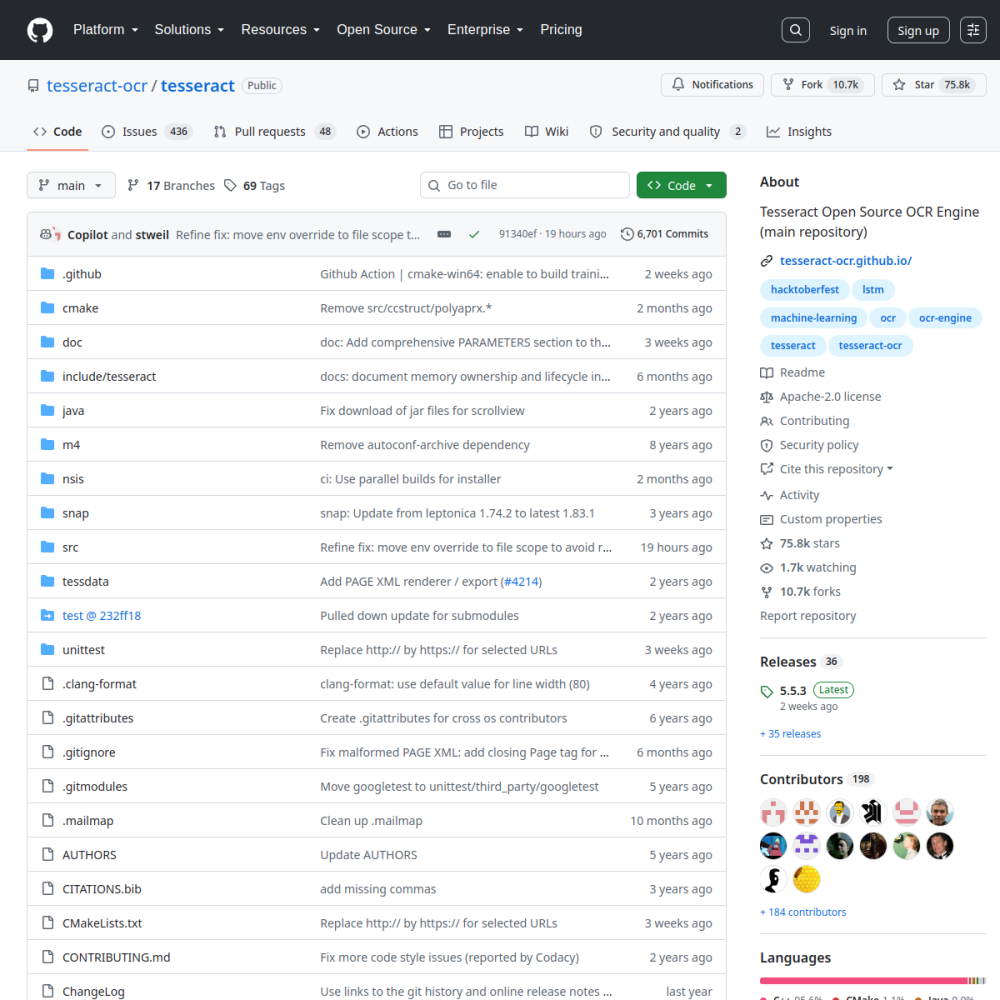
Tesseract is a widely used open-source OCR engine written in C++ that supports multiple languages and machine learning models.
Official Preview
Vendor: tesseract-ocr
Tesseract is a widely used open-source OCR engine written in C++ that supports multiple languages and machine learning models.
| Repository | tesseract-ocr/tesseract |
|---|---|
| GitHub Stars | ★ 76.2k |
| Forks | 10.8k forks |
| Primary Language | C++ |
| License | Apache-2.0 |
| Technical Domain | OTHER |
$ git clone https://github.com/tesseract-ocr/tesseract.git && cd tesseract
Tesseract stands as one of the most recognized open-source optical character recognition engines available today. Originally developed by Hewlett-Packard, it is now maintained by Google and serves as a foundational tool for developers needing text extraction capabilities. Its large star count on GitHub reflects its widespread adoption and community trust within the software development ecosystem.
The engine is primarily written in C++ and offers support for over 100 languages. It utilizes LSTM neural networks for improved accuracy in recognizing printed text. The software is designed to be integrated into various applications, providing a robust API for extracting text from images and PDF files.
While Tesseract provides strong performance for standard printed text, it may require preprocessing for complex layouts or handwritten notes. The project encourages community contributions, as indicated by its Hacktoberfest topic, allowing users to improve training data and engine functionality. However, achieving high accuracy often depends on the quality of the input image and the specific language data used.
Developers frequently employ Tesseract in document digitization projects, accessibility tools for the visually impaired, and automated data entry systems. Its open-source nature allows for customization without licensing fees, making it suitable for both commercial and personal projects. The engine continues to evolve with updates to its machine learning models to handle diverse text scenarios.
Tesseract began as an open-source optical character recognition engine originally developed by Hewlett-Packard to solve the problem of converting images into machine-readable text. It addresses the fundamental challenge of extracting data from scanned documents and images for digital processing.
The project is now maintained by Google and serves as a foundational tool for developers requiring text extraction capabilities. Its transition to modern machine learning models, specifically LSTM neural networks, marks a significant evolution from its earlier iterations.
Developers frequently employ Tesseract in document digitization projects to convert scanned books and printed materials into editable text. This capability is essential for archival purposes and creating searchable digital libraries from physical collections.
Automated data entry systems utilize the engine to extract information from forms and invoices, reducing manual input errors in enterprise workflows. The software provides a robust API for extracting text from images and PDF files, streamlining integration into existing applications.
Accessibility tools for visually impaired users rely on this technology to read printed content aloud through screen readers. By integrating Tesseract, applications can bridge the gap between physical documents and digital accessibility standards.
Since the engine is primarily written in C++, developers typically install it via system package managers or compile it from the source code. The project is licensed under Apache-2.0, allowing free usage in commercial and personal projects without licensing fees.
Integration involves linking the library to your application to access the robust API for text extraction. Users must ensure the specific language data files are available to achieve accurate recognition results for their target content.
Achieving high accuracy often depends on the quality of the input image and the specific language data used. Preprocessing steps may be necessary before running the engine to ensure optimal performance on complex documents.
Tesseract demonstrates strong production readiness with a functionality rating of 4.5 out of 5. It supports over 100 languages and utilizes LSTM neural networks for improved accuracy in recognizing printed text.
While the engine provides strong performance for standard printed text, it may require preprocessing for complex layouts or handwritten notes. The ease of use rating of 3.5 suggests that achieving high accuracy often depends on input image quality and configuration.
The project encourages community contributions, as indicated by its Hacktoberfest topic, allowing users to improve training data and engine functionality. This open-source nature fosters a large community support with extensive GitHub adoption.
Developers frequently employ Tesseract in document digitization projects, accessibility tools for the visually impaired, and automated data entry systems. Its widespread adoption reflects community trust within the software development ecosystem, though specific corporate usage varies.
tesseract is an open-source AI project developed primarily in C++ under the Apache-2.0 license. Tesseract is a widely used open-source OCR engine written in C++ that supports multiple languages and machine learning models.. Tesseract began as an open-source optical character recognition engine originally developed by Hewlett-Packard to solve the problem of converting images into machine-readable text. It addresses the fundamental challenge of extracting data from scanned documents and images for digital processing. The project is now maintained by Google and serves as a foundational tool for developers requiring text extraction capabilities. Its transition to modern machine learning models, specifically LSTM neural networks, marks a significant evolution from its earlier iterations.
Since the engine is primarily written in C++, developers typically install it via system package managers or compile it from the source code. The project is licensed under Apache-2.0, allowing free usage in commercial and personal projects without licensing fees. Integration involves linking the library to your application to access the robust API for text extraction. Users must ensure the specific language data files are available to achieve accurate recognition results for their target content. Achieving high accuracy often depends on the quality of the input image and the specific language data used. Preprocessing steps may be necessary before running the engine to ensure optimal performance on complex documents.
tesseract is well-suited for Digitizing printed documents and books, Extracting text from images for data entry, Building accessibility tools for visually impaired users. With an overall rating of 4.5/5, it offers strong community activity, reliable performance, and easy integration with existing AI pipelines.
Tesseract demonstrates strong production readiness with a functionality rating of 4.5 out of 5. It supports over 100 languages and utilizes LSTM neural networks for improved accuracy in recognizing printed text. While the engine provides strong performance for standard printed text, it may require preprocessing for complex layouts or handwritten notes. The ease of use rating of 3.5 suggests that achieving high accuracy often depends on input image quality and configuration.
Minimal tool for running large language models locally