Prompt-Engineering-Guide
Vendor: dair-ai
A comprehensive collection of guides, papers, and resources focused on prompt engineering, context engineering, RAG, and AI agents for developers.
Official Preview
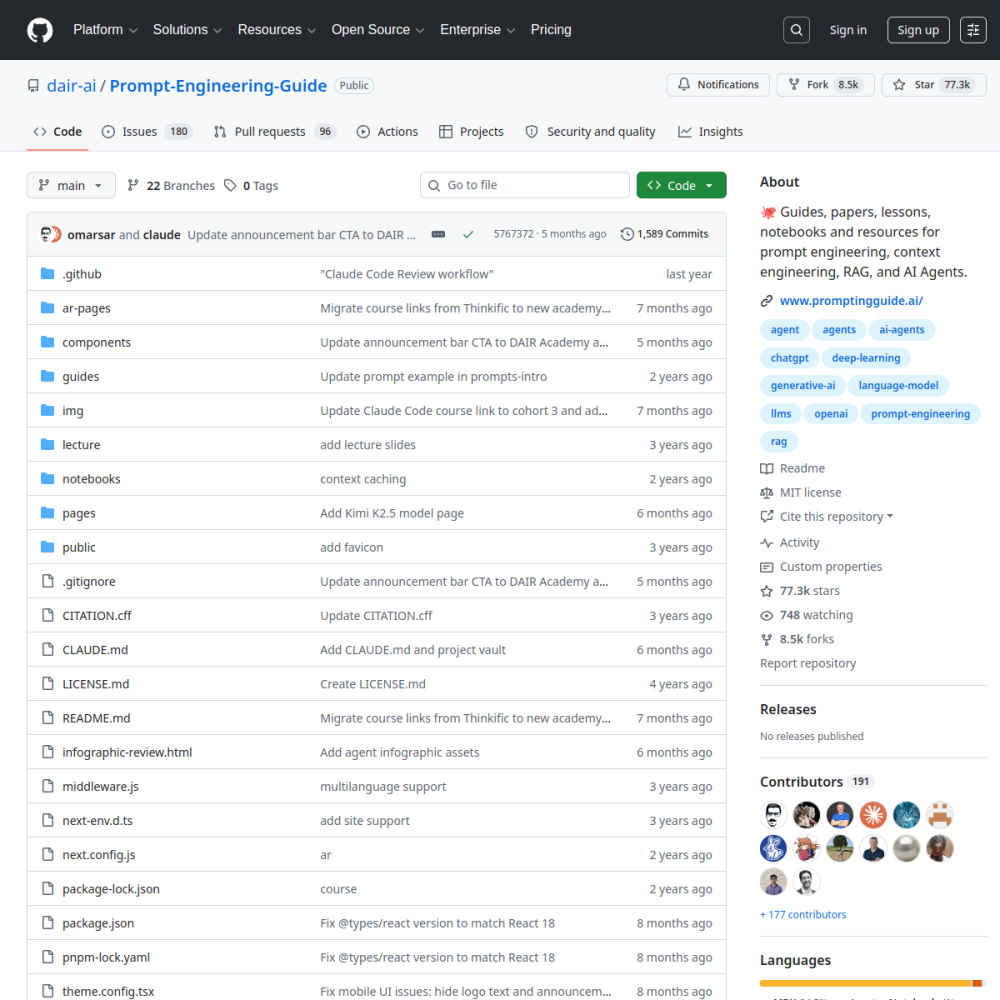
Vendor: dair-ai
A comprehensive collection of guides, papers, and resources focused on prompt engineering, context engineering, RAG, and AI agents for developers.
| Repository | dair-ai/Prompt-Engineering-Guide |
|---|---|
| GitHub Stars | ★ 77.8k |
| Forks | 8.5k forks |
| Primary Language | MDX |
| License | MIT |
| Technical Domain | OTHER |
$ git clone https://github.com/dair-ai/Prompt-Engineering-Guide.git && cd Prompt-Engineering-Guide
This repository serves as a central hub for individuals seeking to master the nuances of interacting with large language models. Positioned as a curated knowledge base, it aggregates diverse materials ranging from academic papers to practical notebooks, aiming to bridge the gap between theoretical research and applied implementation in the generative AI space.
The core capabilities revolve around structured learning paths for prompt engineering, context engineering, and retrieval-augmented generation. By organizing resources into specific topics like AI agents and deep learning, the project enables users to navigate complex concepts systematically. The inclusion of MDX suggests a focus on readable, structured documentation that can be easily integrated into modern development workflows.
A significant highlight is the breadth of coverage, extending beyond basic prompting to include advanced topics like RAG and autonomous agents. However, as a curated list rather than a software library, its utility depends heavily on the external resources linked within. Users must verify the currency of linked papers and notebooks, as the rapid evolution of LLMs can render specific techniques obsolete quickly.
This resource is particularly valuable for developers building AI-powered applications who need to optimize model outputs without fine-tuning. It also supports researchers looking for a consolidated bibliography on emerging techniques. Additionally, educators can utilize the structured lessons to design curricula focused on practical AI interaction strategies.
The Prompt-Engineering-Guide repository was created by Dair-AI to address the rapid evolution of large language model interactions. It serves as a centralized hub for developers and researchers navigating the complexities of generative AI under an MIT license. Topics include chatgpt, openai, and deep learning.
The project aggregates academic papers, practical notebooks, and guides to bridge the gap between theoretical research and applied implementation. By organizing resources into specific topics like AI agents and deep learning, it enables systematic navigation of complex concepts.
Developers building AI-powered applications utilize this resource to optimize model outputs without requiring fine-tuning. The structured lessons support the implementation of retrieval-augmented generation systems and advanced prompting techniques for production environments. This helps reduce latency and improve response quality.
Researchers benefit from a consolidated bibliography on emerging techniques within the generative AI space. The collection supports those investigating autonomous AI agent architectures and context engineering strategies for academic study. It provides a foundation for further experimentation.
Educators can leverage the organized materials to design curricula focused on practical AI interaction strategies. This makes the repository suitable for academic settings where structured learning paths are required for students. It simplifies the onboarding process for new learners.
Users can access the repository directly via the provided GitHub URL or clone it locally for offline review. The project uses MDX for documentation, ensuring readable structured content within modern development workflows. The MIT license allows for broad distribution and modification.
No specific software installation is required to read the guides, as the content is primarily text-based. Developers typically begin by navigating the topic directories to find relevant papers or notebooks matching their current project needs. This facilitates quick discovery of relevant information.
For those integrating specific examples, users may need to set up their own local environment to run linked notebooks. This ensures compatibility with the specific large language model APIs referenced in the documentation. External dependencies may vary by example.
The project holds a high overall rating of 4.5 out of 5, reflecting strong documentation quality and activity levels. Its strength lies in the breadth of coverage, extending beyond basic prompting to include advanced topics like RAG and autonomous agents. Documentation and activity scores are specifically high.
As a curated list rather than a software library, utility depends heavily on the external resources linked within. Users must verify the currency of linked papers and notebooks, as the rapid evolution of LLMs can render specific techniques obsolete quickly. Regular updates are necessary to maintain relevance.
While specific enterprise adoption metrics are not publicly detailed, the repository is widely referenced in developer communities focused on generative AI. It serves as a common starting point for teams exploring OpenAI and other large language model integrations. Many teams cite it as a reference.
Typical integration scenarios involve using the guides to inform the architecture of internal AI tools or educational platforms. Organizations may adopt the structured learning paths to upskill engineering teams on context engineering and agent-based workflows. This supports scalable AI adoption strategies.
Prompt-Engineering-Guide is an open-source AI project developed primarily in MDX under the MIT license. A comprehensive collection of guides, papers, and resources focused on prompt engineering, context engineering, RAG, and AI agents for developers.. The Prompt-Engineering-Guide repository was created by Dair-AI to address the rapid evolution of large language model interactions. It serves as a centralized hub for developers and researchers navigating the complexities of generative AI under an MIT license. Topics include chatgpt, openai, and deep learning. The project aggregates academic papers, practical notebooks, and guides to bridge the gap between theoretical research and applied implementation. By organizing resources into specific topics like AI agents and deep learning, it enables systematic navigation of complex concepts.
Users can access the repository directly via the provided GitHub URL or clone it locally for offline review. The project uses MDX for documentation, ensuring readable structured content within modern development workflows. The MIT license allows for broad distribution and modification. No specific software installation is required to read the guides, as the content is primarily text-based. Developers typically begin by navigating the topic directories to find relevant papers or notebooks matching their current project needs. This facilitates quick discovery of relevant information. For those integrating specific examples, users may need to set up their own local environment to run linked notebooks. This ensures compatibility with the specific large language model APIs referenced in the documentation. External dependencies may vary by example.
Prompt-Engineering-Guide is well-suited for Learning advanced prompting techniques for LLMs, Implementing retrieval-augmented generation systems, Researching autonomous AI agent architectures. With an overall rating of 4.5/5, it offers strong community activity, reliable performance, and easy integration with existing AI pipelines.
The project holds a high overall rating of 4.5 out of 5, reflecting strong documentation quality and activity levels. Its strength lies in the breadth of coverage, extending beyond basic prompting to include advanced topics like RAG and autonomous agents. Documentation and activity scores are specifically high. As a curated list rather than a software library, utility depends heavily on the external resources linked within. Users must verify the currency of linked papers and notebooks, as the rapid evolution of LLMs can render specific techniques obsolete quickly. Regular updates are necessary to maintain relevance.
Minimal tool for running large language models locally