d2l-zh
Vendor: d2l-ai
A Chinese-language deep learning textbook with runnable code used by hundreds of universities worldwide for teaching machine learning concepts.
Official Preview
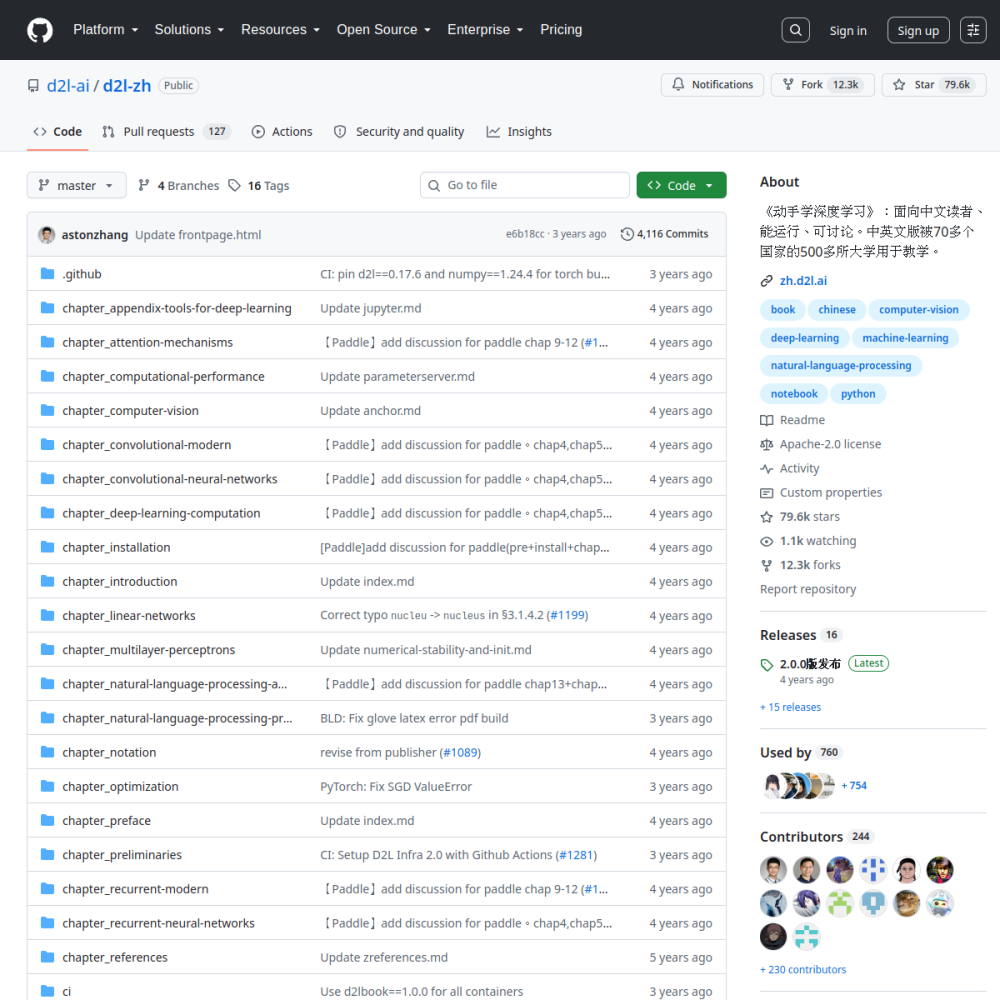
Vendor: d2l-ai
A Chinese-language deep learning textbook with runnable code used by hundreds of universities worldwide for teaching machine learning concepts.
| Repository | d2l-ai/d2l-zh |
|---|---|
| GitHub Stars | ★ 79.9k |
| Forks | 12.3k forks |
| Primary Language | Python |
| License | Apache-2.0 |
| Technical Domain | OTHER |
$ git clone https://github.com/d2l-ai/d2l-zh.git && cd d2l-zh
This repository hosts the Chinese edition of the Dive into Deep Learning textbook, specifically tailored for Chinese-speaking learners seeking to understand machine learning fundamentals. It positions itself as an interactive educational resource that combines theoretical explanations with practical coding exercises.
The core capability lies in its runnable code structure, allowing users to execute deep learning models directly within the provided notebooks. Topics covered include computer vision, natural language processing, and general machine learning principles, all implemented using Python.
Adoption metrics indicate widespread usage, with the material being employed for teaching at over 500 universities across more than 70 countries. The substantial star count on GitHub reflects its status as a widely recognized reference in the academic and technical community.
While excellent for education, the project is primarily designed for learning rather than production-ready software development. Users should expect content focused on pedagogical clarity rather than enterprise-grade optimization or support.
The d2l-zh repository hosts the Chinese edition of the Dive into Deep Learning textbook, created by the d2l-ai team. It addresses the language barrier faced by Chinese-speaking learners seeking to understand machine learning fundamentals.
The project positions itself as an interactive educational resource that combines theoretical explanations with practical coding exercises. By integrating runnable code directly into the textbook content, it allows users to execute deep learning models immediately. This approach bridges the gap between abstract concepts and hands-on implementation using Python.
University courses teaching deep learning fundamentals utilize this material as a primary textbook. Instructors benefit from the structured progression of topics covering computer vision, natural language processing, and general machine learning principles. The content supports both introductory and advanced levels of study.
Self-study for Chinese-speaking developers learning AI provides a comprehensive pathway without relying on external translations. Learners can follow along with the provided notebooks to reinforce theoretical knowledge through immediate practice.
It serves as a reference for implementing computer vision models and understanding neural network architectures. The Python-based implementation ensures compatibility with standard deep learning frameworks used in the industry.
Users can begin by cloning the repository from GitHub to access the full collection of notebooks and text. The project is built on Python, requiring a standard environment capable of running Jupyter notebooks.
Once cloned, learners can open the notebook files directly to execute the deep learning models included in the chapters. This immediate execution capability allows for testing code snippets without additional configuration overhead.
The Apache-2.0 license permits free usage and modification for educational purposes. Accessing the content online is also an option for those who prefer not to manage local dependencies.
The project scores highly on documentation and ease of use, reflecting its focus on pedagogical clarity. Functionality is strong for learning purposes, with comprehensive coverage of deep learning topics implemented in Python. Overall ratings indicate a strong reception within the community for educational utility.
However, the project is primarily designed for learning rather than production-ready software development. Users should expect content focused on explanation rather than enterprise-grade optimization or support.
Adoption metrics indicate widespread usage, with the material being employed for teaching at over 500 universities across more than 70 countries. This global reach highlights its status as a widely recognized reference in the academic community.
Typical integration scenarios include curriculum development for computer science departments and training programs for AI specialists. The substantial star count on GitHub reflects its recognition within the technical community.
d2l-zh is an open-source AI project developed primarily in Python under the Apache-2.0 license. A Chinese-language deep learning textbook with runnable code used by hundreds of universities worldwide for teaching machine learning concepts.. The d2l-zh repository hosts the Chinese edition of the Dive into Deep Learning textbook, created by the d2l-ai team. It addresses the language barrier faced by Chinese-speaking learners seeking to understand machine learning fundamentals. The project positions itself as an interactive educational resource that combines theoretical explanations with practical coding exercises. By integrating runnable code directly into the textbook content, it allows users to execute deep learning models immediately. This approach bridges the gap between abstract concepts and hands-on implementation using Python.
Users can begin by cloning the repository from GitHub to access the full collection of notebooks and text. The project is built on Python, requiring a standard environment capable of running Jupyter notebooks. Once cloned, learners can open the notebook files directly to execute the deep learning models included in the chapters. This immediate execution capability allows for testing code snippets without additional configuration overhead. The Apache-2.0 license permits free usage and modification for educational purposes. Accessing the content online is also an option for those who prefer not to manage local dependencies.
d2l-zh is well-suited for University courses teaching deep learning fundamentals, Self-study for Chinese-speaking developers learning AI, Reference for implementing computer vision models. With an overall rating of 4.8/5, it offers strong community activity, reliable performance, and easy integration with existing AI pipelines.
The project scores highly on documentation and ease of use, reflecting its focus on pedagogical clarity. Functionality is strong for learning purposes, with comprehensive coverage of deep learning topics implemented in Python. Overall ratings indicate a strong reception within the community for educational utility. However, the project is primarily designed for learning rather than production-ready software development. Users should expect content focused on explanation rather than enterprise-grade optimization or support.
Minimal tool for running large language models locally