deer-flow
Vendor: bytedance
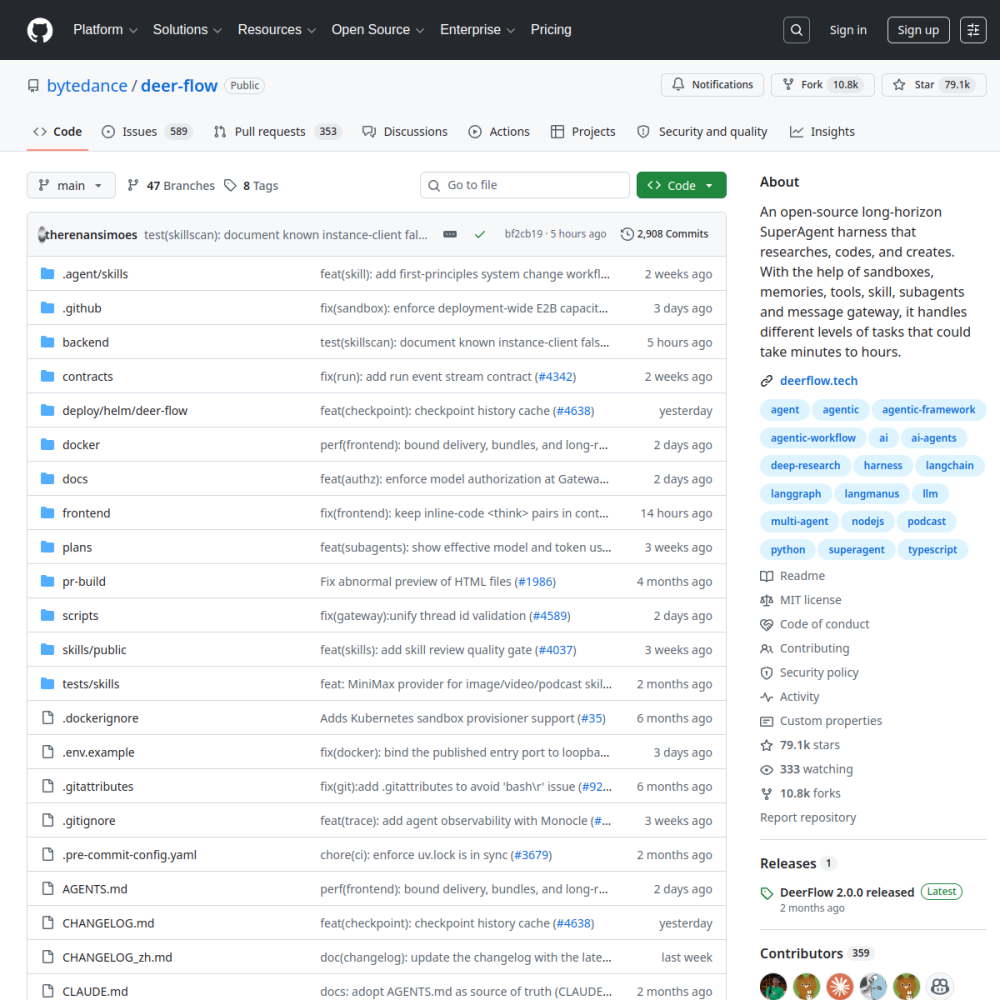
Deer-flow is an open-source SuperAgent harness enabling long-horizon tasks through sandboxes, memories, and subagents for researching, coding, and creating.
Official Preview
Vendor: bytedance
Deer-flow is an open-source SuperAgent harness enabling long-horizon tasks through sandboxes, memories, and subagents for researching, coding, and creating.
| Repository | bytedance/deer-flow |
|---|---|
| GitHub Stars | ★ 80.8k |
| Forks | 11.1k forks |
| Primary Language | Python |
| License | MIT |
| Technical Domain | OTHER |
$ git clone https://github.com/bytedance/deer-flow.git && cd deer-flow
Deer-flow positions itself as a robust framework for managing complex, long-horizon autonomous tasks. Developed by ByteDance, this open-source project serves as a SuperAgent harness designed to orchestrate workflows that extend from minutes to hours, distinguishing it from simpler single-shot agent implementations.
The system integrates several advanced components to achieve its goals, including sandboxes for safe execution, memory systems for context retention, and a message gateway for communication. It supports a multi-agent architecture where subagents can collaborate, leveraging tools and skills to handle diverse objectives. The technology stack appears diverse, incorporating Python, Node.js, and TypeScript alongside integrations with LangChain and LangGraph.
Key strengths lie in its ability to manage extended operations and its modular design featuring skills and subagents. However, the complexity of coordinating sandboxes, memories, and multiple agents may present a steep learning curve for developers unfamiliar with agentic workflows. The project aims to bridge the gap between simple script execution and sustained autonomous operation.
Typical applications include deep research tasks requiring information synthesis over time, automated software development cycles, and content creation workflows. By utilizing its harness capabilities, users can deploy agents that persist beyond immediate interactions, making it suitable for projects requiring sustained attention and multi-step reasoning.
Deer-flow is an open-source SuperAgent harness developed by ByteDance to address the limitations of single-shot agent implementations. It focuses on managing complex, long-horizon autonomous tasks that extend from minutes to hours rather than immediate responses.
The system integrates sandboxes for safe execution, memory systems for context retention, and a message gateway for communication. This architecture allows subagents to collaborate using tools and skills, bridging the gap between simple script execution and sustained autonomous operation.
Typical applications include deep research tasks requiring information synthesis over time and automated software development cycles. Users deploy agents that persist beyond immediate interactions, making it suitable for projects requiring sustained attention and multi-step reasoning.
The framework supports complex content creation pipelines where multiple steps depend on previous outputs. Developers can leverage the multi-agent architecture to handle diverse objectives without manual intervention between stages.
Target users include engineers building agentic workflows who need robust orchestration capabilities.
The technology stack incorporates Python, Node.js, and TypeScript alongside integrations with LangChain and LangGraph. Developers should ensure their environment supports these languages to leverage the full capabilities of the harness.
Setup involves configuring the multi-agent architecture where subagents can collaborate within the defined sandbox. Users need to define the skills and tools available to the agents to ensure safe execution.
Initial deployment requires establishing the memory systems and message gateway for communication. Once configured, the system can orchestrate workflows that extend beyond immediate interactions.
Deer-flow demonstrates strong functionality and activity ratings, indicating a robust framework for managing extended operations. The modular design featuring skills and subagents allows for flexible workflow construction.
However, the complexity of coordinating sandboxes, memories, and multiple agents may present a steep learning curve. Developers unfamiliar with agentic workflows might find the ease of use rating lower compared to simpler tools.
Developed by ByteDance, the project is positioned for use in managing complex autonomous tasks within large-scale environments. It serves as a foundation for building systems that require sustained attention and multi-step reasoning.
Typical integration scenarios include automated deep research workflows and long-term software coding assistance. Organizations seeking to bridge the gap between simple script execution and sustained autonomous operation may find this harness suitable.
deer-flow is an open-source AI project developed primarily in Python under the MIT license. Deer-flow is an open-source SuperAgent harness enabling long-horizon tasks through sandboxes, memories, and subagents for researching, coding, and creating.. Deer-flow is an open-source SuperAgent harness developed by ByteDance to address the limitations of single-shot agent implementations. It focuses on managing complex, long-horizon autonomous tasks that extend from minutes to hours rather than immediate responses. The system integrates sandboxes for safe execution, memory systems for context retention, and a message gateway for communication. This architecture allows subagents to collaborate using tools and skills, bridging the gap between simple script execution and sustained autonomous operation.
The technology stack incorporates Python, Node.js, and TypeScript alongside integrations with LangChain and LangGraph. Developers should ensure their environment supports these languages to leverage the full capabilities of the harness. Setup involves configuring the multi-agent architecture where subagents can collaborate within the defined sandbox. Users need to define the skills and tools available to the agents to ensure safe execution. Initial deployment requires establishing the memory systems and message gateway for communication. Once configured, the system can orchestrate workflows that extend beyond immediate interactions.
deer-flow is well-suited for Automated deep research workflows, Long-term software coding assistance, Complex content creation pipelines. With an overall rating of 4.2/5, it offers strong community activity, reliable performance, and easy integration with existing AI pipelines.
Deer-flow demonstrates strong functionality and activity ratings, indicating a robust framework for managing extended operations. The modular design featuring skills and subagents allows for flexible workflow construction. However, the complexity of coordinating sandboxes, memories, and multiple agents may present a steep learning curve. Developers unfamiliar with agentic workflows might find the ease of use rating lower compared to simpler tools.
Minimal tool for running large language models locally