ML-For-Beginners
Vendor: microsoft
A comprehensive twelve-week curriculum designed to teach machine learning fundamentals through lessons, quizzes, and Jupyter notebooks for beginners.
Official Preview
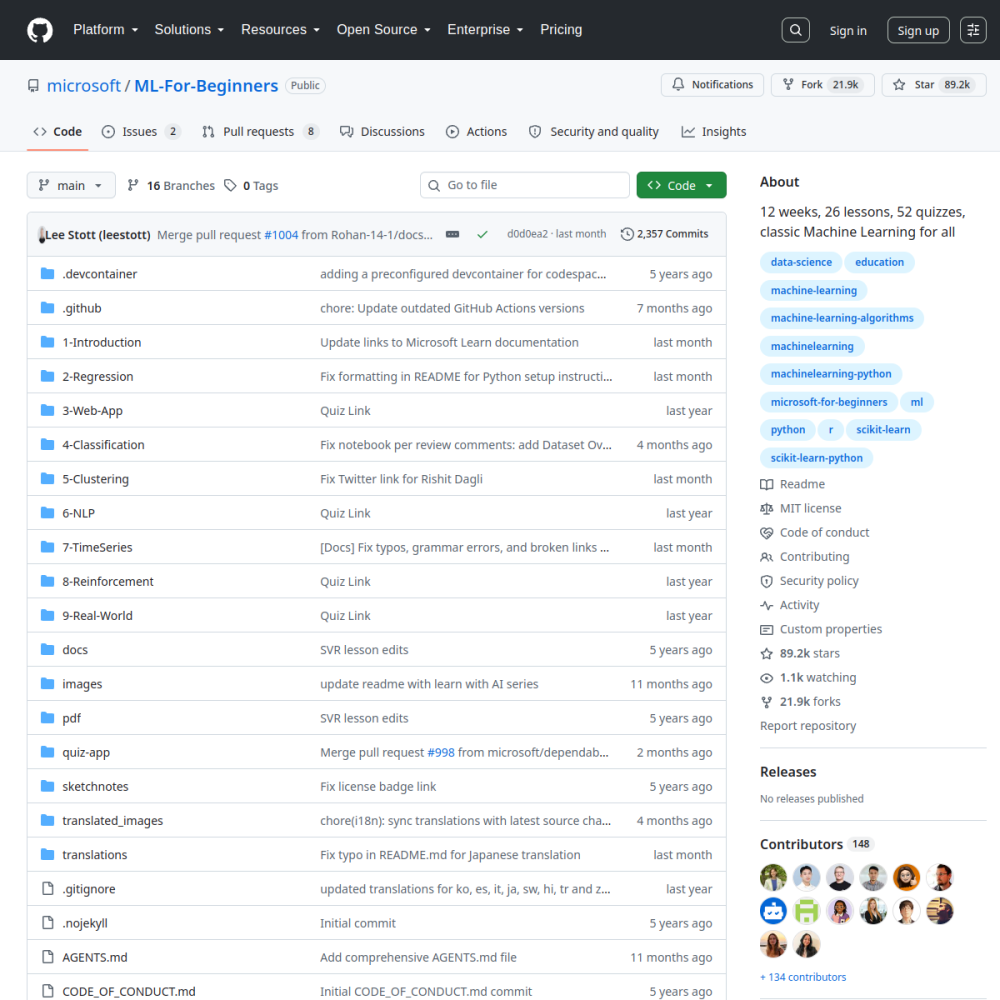
Vendor: microsoft
A comprehensive twelve-week curriculum designed to teach machine learning fundamentals through lessons, quizzes, and Jupyter notebooks for beginners.
| Repository | microsoft/ML-For-Beginners |
|---|---|
| GitHub Stars | ★ 89.8k |
| Forks | 22.1k forks |
| Primary Language | Jupyter Notebook |
| License | MIT |
| Technical Domain | OTHER |
$ git clone https://github.com/microsoft/ML-For-Beginners
This repository serves as a structured educational curriculum developed by Microsoft to introduce newcomers to the field of machine learning. It is designed as a self-paced course that spans twelve weeks, providing a systematic approach to understanding core concepts without requiring prior expertise in advanced mathematics or programming.
The core structure consists of twenty-six lessons accompanied by fifty-two quizzes to reinforce learning outcomes. Each module utilizes Jupyter Notebooks, allowing learners to interact directly with code and data while following the instructional material. This hands-on approach ensures that theoretical knowledge is immediately applied to practical scenarios using Python and related libraries.
While the project excels at accessibility and breadth, it focuses primarily on classic machine learning algorithms rather than deep learning or modern neural network architectures. This makes it an ideal starting point for foundational knowledge, though advanced practitioners may find the content introductory. The extensive star count indicates strong community adoption and validation of the teaching methodology.
The curriculum is best suited for individuals seeking a formal introduction to data science and machine learning principles. It provides a clear roadmap for students, career changers, and professionals looking to upskill in AI technologies. By breaking down complex topics into manageable weekly segments, it reduces the barrier to entry for those new to the domain.
Microsoft created this repository to address the high barrier to entry often faced by newcomers in the machine learning domain. The project functions as a structured educational curriculum designed to teach fundamentals without requiring prior expertise in advanced mathematics or programming.
The inspiration behind the project is to provide a systematic approach to understanding core concepts through a self-paced course spanning twelve weeks. By breaking down complex topics into manageable weekly segments, the creators aim to reduce the intimidation factor for those new to the field.
Individuals seeking a formal introduction to data science and machine learning principles can utilize this repository for self-paced learning. It provides a clear roadmap for students, career changers, and professionals looking to upskill in AI technologies without formal classroom attendance.
Educators and institutions may adopt the curriculum as a foundation for data science courses due to its organized lesson structure. The integrated quizzes serve as a mechanism for skill assessment, allowing learners to verify their understanding of specific modules.
The content is particularly effective for those needing to grasp classic machine learning algorithms before moving on to more complex topics. It supports a hands-on approach where theoretical knowledge is immediately applied to practical scenarios using Python and related libraries.
Users begin by cloning the repository from GitHub using a command like git clone https://github.com/microsoft/ML-For-Beginners to access the full collection locally. This ensures all instructional material and code examples are available offline for interactive study sessions.
Since the project relies on Jupyter Notebooks, learners must have a compatible environment such as Python and Jupyter installed on their machine. Opening the provided notebook files allows users to execute code directly while following the instructional material.
The curriculum is organized into weekly segments, so users should start with the first week module to follow the intended learning progression. Each module utilizes Jupyter Notebooks to facilitate direct interaction with code and data during the learning process.
The project scores highly on functionality and ease of use, making it a reliable resource for foundational education. Its strength lies in accessibility and breadth, ensuring that theoretical knowledge is immediately applied to practical scenarios using Python and related libraries.
However, the curriculum focuses primarily on classic machine learning algorithms rather than deep learning or modern neural network architectures. Advanced practitioners may find the content introductory, limiting its utility for those already experienced in modern AI model development.
While specific corporate adoption metrics are not detailed, the extensive star count indicates strong community validation of the teaching methodology. This suggests the material is widely recognized within the open-source community as a credible starting point for machine learning education.
Typical integration scenarios include using the repository as a syllabus for introductory university courses or corporate training workshops. Organizations looking to upskill employees in basic AI concepts may reference this material to establish a common baseline of knowledge.
ML-For-Beginners is an open-source AI project developed primarily in Jupyter Notebook under the MIT license. A comprehensive twelve-week curriculum designed to teach machine learning fundamentals through lessons, quizzes, and Jupyter notebooks for beginners.. Microsoft created this repository to address the high barrier to entry often faced by newcomers in the machine learning domain. The project functions as a structured educational curriculum designed to teach fundamentals without requiring prior expertise in advanced mathematics or programming. The inspiration behind the project is to provide a systematic approach to understanding core concepts through a self-paced course spanning twelve weeks. By breaking down complex topics into manageable weekly segments, the creators aim to reduce the intimidation factor for those new to the field.
Users begin by cloning the repository from GitHub using a command like git clone https://github.com/microsoft/ML-For-Beginners to access the full collection locally. This ensures all instructional material and code examples are available offline for interactive study sessions. Since the project relies on Jupyter Notebooks, learners must have a compatible environment such as Python and Jupyter installed on their machine. Opening the provided notebook files allows users to execute code directly while following the instructional material. The curriculum is organized into weekly segments, so users should start with the first week module to follow the intended learning progression. Each module utilizes Jupyter Notebooks to facilitate direct interaction with code and data during the learning process.
ML-For-Beginners is well-suited for Self-paced learning for ML newcomers, Classroom curriculum for data science courses, Skill assessment via integrated quizzes. With an overall rating of 4.5/5, it offers strong community activity, reliable performance, and easy integration with existing AI pipelines.
The project scores highly on functionality and ease of use, making it a reliable resource for foundational education. Its strength lies in accessibility and breadth, ensuring that theoretical knowledge is immediately applied to practical scenarios using Python and related libraries. However, the curriculum focuses primarily on classic machine learning algorithms rather than deep learning or modern neural network architectures. Advanced practitioners may find the content introductory, limiting its utility for those already experienced in modern AI model development.
Minimal tool for running large language models locally