Official Preview
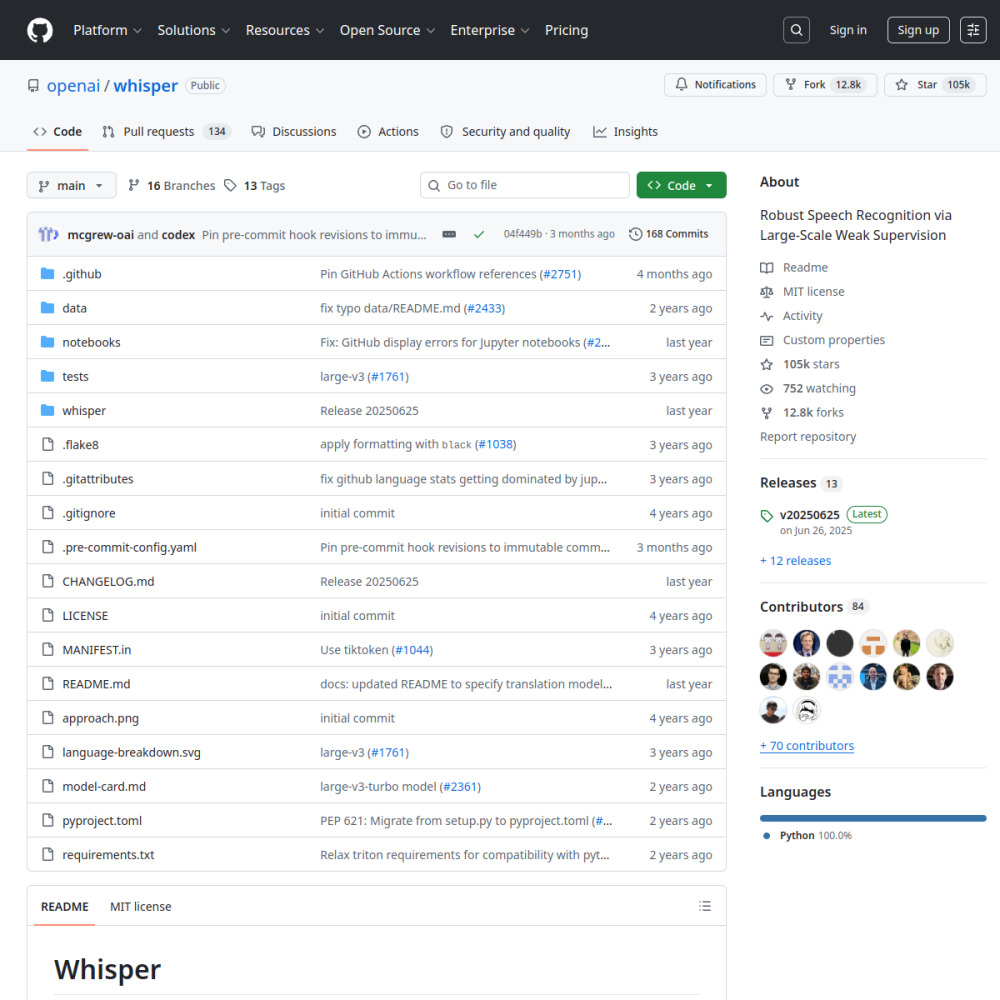
| Repository | openai/whisper |
|---|---|
| GitHub Stars | ★ 107.9k |
| Forks | 13.1k forks |
| Primary Language | Python |
| License | MIT |
| Technical Domain | MULTIMODAL |
$ git clone https://github.com/openai/whisper.git && cd whisper
Whisper is the multilingual speech recognition model open-sourced by OpenAI in 2022, trained on 680,000 hours of multilingual data. It remains a strong baseline for open-source ASR, with robustness to accents, noise, and reverberation that exceeds most peers from the same era.
Core capabilities include multilingual speech-to-text, language identification, spoken translation (X to English), timestamp alignment, and model sizes from tiny to large. The community has spawned faster-whisper (CTranslate2 acceleration), whisper.cpp (C++ inference), and whisperX (word-level timestamps and speaker diarization).
The highlight is that model quality and language coverage remain competitive in open source, with a rich ecosystem of derived projects. The downside is that the official repo updates slowly (no release in two years), long audio needs manual segmentation to avoid hallucinations, and punctuation and timestamps are unstable on fast models.
Use cases: video subtitle generation, meeting and podcast transcription, low-cost multilingual ASR services. For word-level precision or speaker diarization, go straight to whisperX.
Whisper is a multilingual speech recognition model open-sourced by OpenAI in 2022. It was trained on 680,000 hours of multilingual and multitask supervised data collected from the web.
The project addresses the need for robust automatic speech recognition that handles diverse accents, background noise, and reverberation better than previous open-source baselines. It serves as a foundational transformer-based architecture for converting audio to text across many languages.
Content creators frequently use Whisper for automatic video subtitle generation due to its strong language coverage and translation capabilities. It supports spoken translation from various languages directly into English, simplifying localization workflows.
Professional users rely on the model for meeting and podcast transcription where accuracy across different speakers and audio qualities is critical. The ability to output timestamps allows for easy synchronization with video or audio tracks during post-production.
Developers building low-cost multilingual ASR services often integrate Whisper as a baseline to avoid expensive proprietary API costs. It provides a self-hosted option for organizations requiring data privacy while maintaining competitive recognition quality.
Users install the Python package to access the command-line interface provided by the repository. The standard installation process prepares the environment for local inference without requiring external API keys.
Running the tool involves specifying an audio file and choosing a model size ranging from tiny to large. The system handles weight downloads automatically during the initial run, outputting results in formats like JSON or SRT.
For production environments, users often configure GPU acceleration to reduce inference time significantly. This setup ensures that the processing speed meets the demands of real-time or batch transcription tasks.
The model offers strong functionality with a 4.5 rating, supported by extensive documentation and ease of use. It remains a competitive baseline for open-source ASR with robustness to accents and noise that exceeds many peers from its era.
However, production deployment requires attention to limitations such as slow official repository updates and the need for manual segmentation of long audio files. Punctuation and timestamps can be unstable on smaller model sizes, and hallucinations may occur without proper chunking strategies.
The project has spawned a rich ecosystem of derived tools including faster-whisper for CTranslate2 acceleration and whisper.cpp for C++ inference. These adaptations allow integration into environments where Python dependencies are restricted or latency is critical.
Advanced workflows often utilize whisperX for word-level timestamps and speaker diarization when standard output is insufficient. While specific enterprise adoption is not publicly detailed, the model serves as a common backend for independent transcription services and media processing pipelines.
Whisper is an open-source AI project developed primarily in Python under the MIT license. OpenAI's open-source speech recognition model. Whisper is a multilingual speech recognition model open-sourced by OpenAI in 2022. It was trained on 680,000 hours of multilingual and multitask supervised data collected from the web. The project addresses the need for robust automatic speech recognition that handles diverse accents, background noise, and reverberation better than previous open-source baselines. It serves as a foundational transformer-based architecture for converting audio to text across many languages.
Users install the Python package to access the command-line interface provided by the repository. The standard installation process prepares the environment for local inference without requiring external API keys. Running the tool involves specifying an audio file and choosing a model size ranging from tiny to large. The system handles weight downloads automatically during the initial run, outputting results in formats like JSON or SRT. For production environments, users often configure GPU acceleration to reduce inference time significantly. This setup ensures that the processing speed meets the demands of real-time or batch transcription tasks.
Whisper is well-suited for Automatic video subtitles, Meeting and podcast transcription, Multilingual ASR services. With an overall rating of 4.5/5, it offers strong community activity, reliable performance, and easy integration with existing AI pipelines.
The model offers strong functionality with a 4.5 rating, supported by extensive documentation and ease of use. It remains a competitive baseline for open-source ASR with robustness to accents and noise that exceeds many peers from its era. However, production deployment requires attention to limitations such as slow official repository updates and the need for manual segmentation of long audio files. Punctuation and timestamps can be unstable on smaller model sizes, and hallucinations may occur without proper chunking strategies.
Minimal tool for running large language models locally