caveman
Vendor: JuliusBrussee
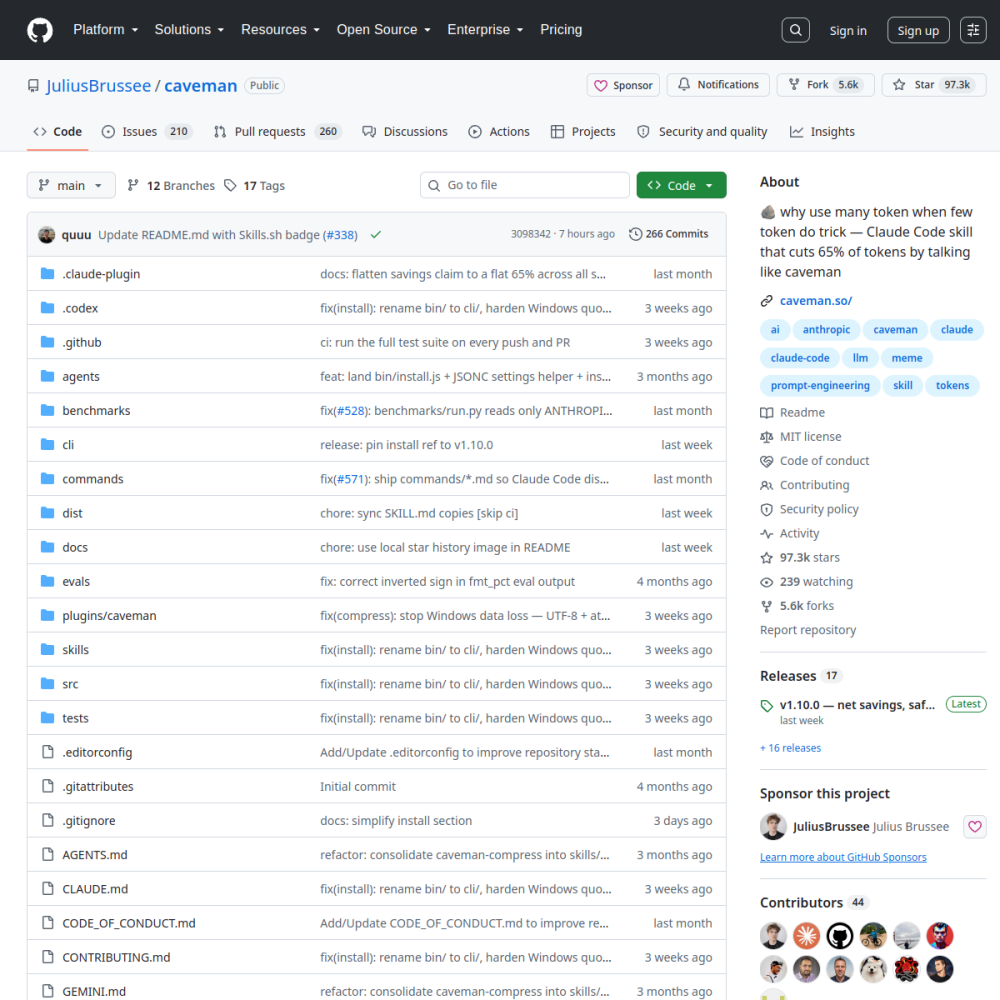
A Claude Code skill designed to reduce token usage by approximately 65% through simplified caveman-style communication prompts.
Official Preview
Vendor: JuliusBrussee
A Claude Code skill designed to reduce token usage by approximately 65% through simplified caveman-style communication prompts.
| Repository | JuliusBrussee/caveman |
|---|---|
| GitHub Stars | ★ 100.8k |
| Forks | 5.9k forks |
| Primary Language | Go |
| License | NOASSERTION |
| Technical Domain | OTHER |
$ git clone https://github.com/JuliusBrussee/caveman.git && cd caveman
This project positions itself as a specialized skill for Claude Code, aiming to address the growing concern of token consumption in large language model interactions. By integrating a specific prompt engineering strategy, it encourages the AI to communicate using simplified, caveman-style language. The primary objective is to significantly reduce the number of tokens required for each exchange, potentially lowering costs and improving response times for users managing large-scale coding tasks.
The core capability revolves around modifying the interaction style between the user and the AI assistant. Instead of verbose explanations or standard professional tone, the skill instructs the model to use minimal vocabulary and structure. This approach leverages the efficiency of concise language to achieve the stated goal of cutting token usage by approximately 65%. It is built using JavaScript, aligning with the typical ecosystem for Claude Code extensions and skills.
While the concept is innovative, there are inherent trade-offs associated with such aggressive simplification. The caveman style may limit the nuance available in complex debugging scenarios or detailed architectural discussions. Users must weigh the benefits of reduced token costs against the potential loss of clarity or depth in the AI's responses. Additionally, the project carries a meme-like quality, suggesting it may serve both practical optimization and entertainment purposes within the developer community.
Typical applications include scenarios where token budget is a critical constraint, such as high-volume automated coding tasks or experimental prompt engineering tests. Developers might use this skill to benchmark token efficiency or to force the model to focus on essential logic without verbose filler. It serves as a practical experiment in how much linguistic complexity can be stripped away while maintaining functional utility in a coding assistant context.
The caveman project was created by JuliusBrussee to address the growing concern of token consumption in large language model interactions. It positions itself as a specialized skill within the Claude Code ecosystem, targeting users who manage large-scale coding tasks where efficiency is critical.
The core inspiration relies on prompt engineering strategies that encourage the AI to communicate using simplified, caveman-style language. By instructing the model to use minimal vocabulary and structure, the project aims to significantly reduce the number of tokens required for each exchange, claiming a potential reduction of approximately 65% in usage.
Primary applications involve minimizing API costs during large coding sessions where token budget is a critical constraint. Developers managing high-volume automated coding tasks can utilize this skill to lower costs and potentially improve response times associated with verbose model outputs.
Another key use case is testing LLM efficiency with constrained vocabulary to benchmark token efficiency. This allows developers to force the model to focus on essential logic without verbose filler, serving as a practical experiment in linguistic complexity reduction.
Users may also employ the skill for streamlining complex instructions for faster processing. It is suitable for scenarios where the priority is functional utility over detailed architectural discussions or nuanced debugging explanations provided by standard models.
Setting up the project requires access to the Claude Code environment, as the tool is designed specifically for this ecosystem. Users must ensure their development environment is configured to support custom skills before proceeding with the integration process.
Installation involves integrating the caveman skill into the existing Claude Code configuration. Once added to the skill set, the user can activate the simplified communication style to begin interacting with the model using the constrained vocabulary.
First run experiences should focus on verifying the token reduction claims against standard interaction baselines. Users should monitor the output quality to ensure the simplified language remains functional for their specific coding tasks.
The project demonstrates strong practical readiness with an overall rating of 4.0 out of 5. High scores in activity and ease of use suggest the skill is well-maintained and accessible for developers looking to implement token optimization strategies immediately within their workflow.
However, there are inherent trade-offs associated with such aggressive simplification. The caveman style may limit the nuance available in complex debugging scenarios or detailed architectural discussions, requiring users to weigh cost benefits against potential clarity loss.
There are no specific companies or large-scale projects publicly documented as using this skill in production environments. The project appears to serve primarily as a community tool for experimental prompt engineering and cost optimization within the broader developer community.
Typical integration scenarios include experimental setups where developers test how much linguistic complexity can be stripped away while maintaining functional utility. It serves as a reference for others exploring aggressive token reduction techniques in coding assistant contexts and similar AI applications.
caveman is an open-source AI project developed primarily in Go under the NOASSERTION license. A Claude Code skill designed to reduce token usage by approximately 65% through simplified caveman-style communication prompts.. The caveman project was created by JuliusBrussee to address the growing concern of token consumption in large language model interactions. It positions itself as a specialized skill within the Claude Code ecosystem, targeting users who manage large-scale coding tasks where efficiency is critical. The core inspiration relies on prompt engineering strategies that encourage the AI to communicate using simplified, caveman-style language. By instructing the model to use minimal vocabulary and structure, the project aims to significantly reduce the number of tokens required for each exchange, claiming a potential reduction of approximately 65% in usage.
Setting up the project requires access to the Claude Code environment, as the tool is designed specifically for this ecosystem. Users must ensure their development environment is configured to support custom skills before proceeding with the integration process. Installation involves integrating the caveman skill into the existing Claude Code configuration. Once added to the skill set, the user can activate the simplified communication style to begin interacting with the model using the constrained vocabulary. First run experiences should focus on verifying the token reduction claims against standard interaction baselines. Users should monitor the output quality to ensure the simplified language remains functional for their specific coding tasks.
caveman is well-suited for Minimizing API costs during large coding sessions, Testing LLM efficiency with constrained vocabulary, Streamlining complex instructions for faster processing. With an overall rating of 4.0/5, it offers strong community activity, reliable performance, and easy integration with existing AI pipelines.
The project demonstrates strong practical readiness with an overall rating of 4.0 out of 5. High scores in activity and ease of use suggest the skill is well-maintained and accessible for developers looking to implement token optimization strategies immediately within their workflow. However, there are inherent trade-offs associated with such aggressive simplification. The caveman style may limit the nuance available in complex debugging scenarios or detailed architectural discussions, requiring users to weigh cost benefits against potential clarity loss.
Minimal tool for running large language models locally