LLMs-from-scratch
Vendor: rasbt
This project provides a step-by-step guide to implementing a ChatGPT-like large language model using PyTorch from scratch.
Official Preview
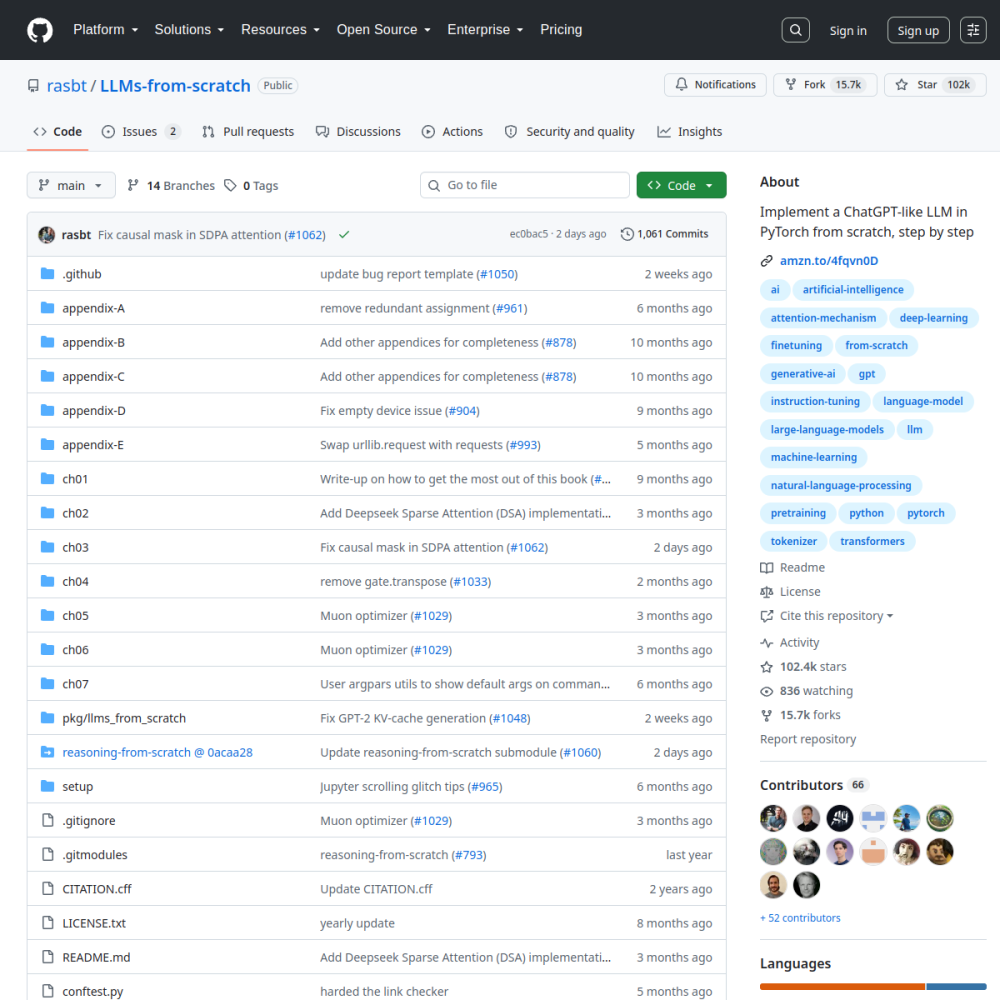
Vendor: rasbt
This project provides a step-by-step guide to implementing a ChatGPT-like large language model using PyTorch from scratch.
| Repository | rasbt/LLMs-from-scratch |
|---|---|
| GitHub Stars | ★ 103.7k |
| Forks | 15.9k forks |
| Primary Language | Jupyter Notebook |
| License | NOASSERTION |
| Technical Domain | OTHER |
$ git clone https://github.com/rasbt/LLMs-from-scratch.git && cd LLMs-from-scratch
This repository serves as an educational resource designed to demystify the inner workings of large language models. Rather than relying on high-level abstractions, it guides users through constructing a functional transformer architecture using PyTorch. The project emphasizes understanding the fundamental components, such as attention mechanisms and tokenization, before assembling them into a complete system.
The core capabilities include implementing pretraining loops, fine-tuning strategies, and instruction tuning techniques. By breaking down the process into manageable Jupyter Notebook sections, the codebase allows learners to inspect every layer of the model. This approach ensures that users gain insight into how weights are updated and how text generation occurs at a granular level.
A key highlight is the clarity of the implementation, which prioritizes readability over production optimization. While this makes it excellent for learning, it may not be suitable for direct deployment in high-performance production environments without significant modification. The project bridges the gap between theoretical knowledge and practical implementation, making complex concepts accessible to those with basic Python and deep learning experience.
Typical applications involve academic study, research prototyping, and upskilling for machine learning engineers. Individuals seeking to move beyond API usage to understand model architecture will find this resource particularly valuable. It acts as a foundational stepping stone for those intending to build or customize language models for specific domain tasks.
This repository was created to provide a transparent educational path for understanding large language models. It addresses the common barrier where developers rely on high-level APIs without grasping the underlying mechanics of transformer architectures. The goal is to demystify the inner workings of these systems for a broader technical audience interested in artificial intelligence.
The project guides users through constructing a functional ChatGPT-like model using PyTorch from scratch. By breaking down complex concepts into manageable Jupyter Notebook sections, it emphasizes fundamental components like attention mechanisms and tokenization before assembling a complete system. This structured approach ensures users understand the foundational elements before tackling complex generation tasks.
Machine learning engineers seeking to upskill beyond API usage will find this resource valuable for understanding model architecture. It serves as a foundational stepping stone for those intending to build or customize language models for specific domain tasks. The content supports those looking to move from theoretical knowledge to practical implementation in natural language processing.
Academic researchers and students can utilize the codebase for studying transformer internals and prototyping new ideas. The granular approach allows learners to inspect every layer of the model to understand how weights are updated and how text generation occurs. This visibility is crucial for academic study and research prototyping.
Individuals interested in generative AI can explore pretraining loops and fine-tuning strategies within a controlled environment. This hands-on experience bridges the gap between theoretical knowledge and practical implementation for those with basic Python and deep learning experience. Topics covered include instruction tuning and tokenizer implementation.
Users require a Python environment equipped with PyTorch to run the provided Jupyter Notebooks. The project structure relies on standard deep learning libraries to execute the step-by-step implementation guides. Accessing the repository allows immediate engagement with the educational material.
Installation involves setting up the necessary dependencies for PyTorch and notebook execution. Once configured, users can open the notebooks to begin constructing the transformer architecture layer by layer. The format supports interactive learning through direct code manipulation.
The first run typically involves executing the initial notebook sections to establish the tokenization and attention mechanism foundations. This iterative process allows developers to verify each component before proceeding to pretraining and fine-tuning stages. Users can follow the sequence to build the model incrementally.
The project prioritizes code readability and educational clarity over production optimization. While this makes it excellent for learning, it may not be suitable for direct deployment in high-performance production environments without significant modification. The focus remains on understanding rather than raw performance.
High ratings across functionality and documentation indicate strong utility for educational purposes. The implementation ensures users gain insight into model operations at a granular level, though production readiness requires adapting the code for efficiency and scalability. The overall rating of 4.8 out of 5 reflects strong community reception, with documentation scoring 4.8 and activity scoring 4.9.
Specific company adoption is not detailed in the provided documentation, suggesting primary usage within educational and research communities. Organizations may reference this repository as a training material for engineering teams needing to understand LLM fundamentals. Verification of enterprise usage requires external confirmation beyond the provided text.
Typical integration scenarios involve academic study and research prototyping where transparency is more critical than speed. Teams working on custom domain tasks might use the codebase as a baseline to experiment with architecture changes before moving to optimized frameworks. It acts as a reference point for custom language model development and upskilling for machine learning engineers.
LLMs-from-scratch is an open-source AI project developed primarily in Jupyter Notebook under the NOASSERTION license. This project provides a step-by-step guide to implementing a ChatGPT-like large language model using PyTorch from scratch.. This repository was created to provide a transparent educational path for understanding large language models. It addresses the common barrier where developers rely on high-level APIs without grasping the underlying mechanics of transformer architectures. The goal is to demystify the inner workings of these systems for a broader technical audience interested in artificial intelligence. The project guides users through constructing a functional ChatGPT-like model using PyTorch from scratch. By breaking down complex concepts into manageable Jupyter Notebook sections, it emphasizes fundamental components like attention mechanisms and tokenization before assembling a complete system. This structured approach ensures users understand the foundational elements before tackling complex generation tasks.
Users require a Python environment equipped with PyTorch to run the provided Jupyter Notebooks. The project structure relies on standard deep learning libraries to execute the step-by-step implementation guides. Accessing the repository allows immediate engagement with the educational material. Installation involves setting up the necessary dependencies for PyTorch and notebook execution. Once configured, users can open the notebooks to begin constructing the transformer architecture layer by layer. The format supports interactive learning through direct code manipulation. The first run typically involves executing the initial notebook sections to establish the tokenization and attention mechanism foundations. This iterative process allows developers to verify each component before proceeding to pretraining and fine-tuning stages. Users can follow the sequence to build the model incrementally.
LLMs-from-scratch is well-suited for Learning transformer architecture internals, Academic research and prototyping, Upskilling for ML engineers. With an overall rating of 4.8/5, it offers strong community activity, reliable performance, and easy integration with existing AI pipelines.
The project prioritizes code readability and educational clarity over production optimization. While this makes it excellent for learning, it may not be suitable for direct deployment in high-performance production environments without significant modification. The focus remains on understanding rather than raw performance. High ratings across functionality and documentation indicate strong utility for educational purposes. The implementation ensures users gain insight into model operations at a granular level, though production readiness requires adapting the code for efficiency and scalability. The overall rating of 4.8 out of 5 reflects strong community reception, with documentation scoring 4.8 and activity scoring 4.9.
Minimal tool for running large language models locally