pytorch
Vendor: pytorch
PyTorch is a widely adopted open-source machine learning framework offering tensor computation with GPU acceleration and dynamic neural network capabilities.
Official Preview
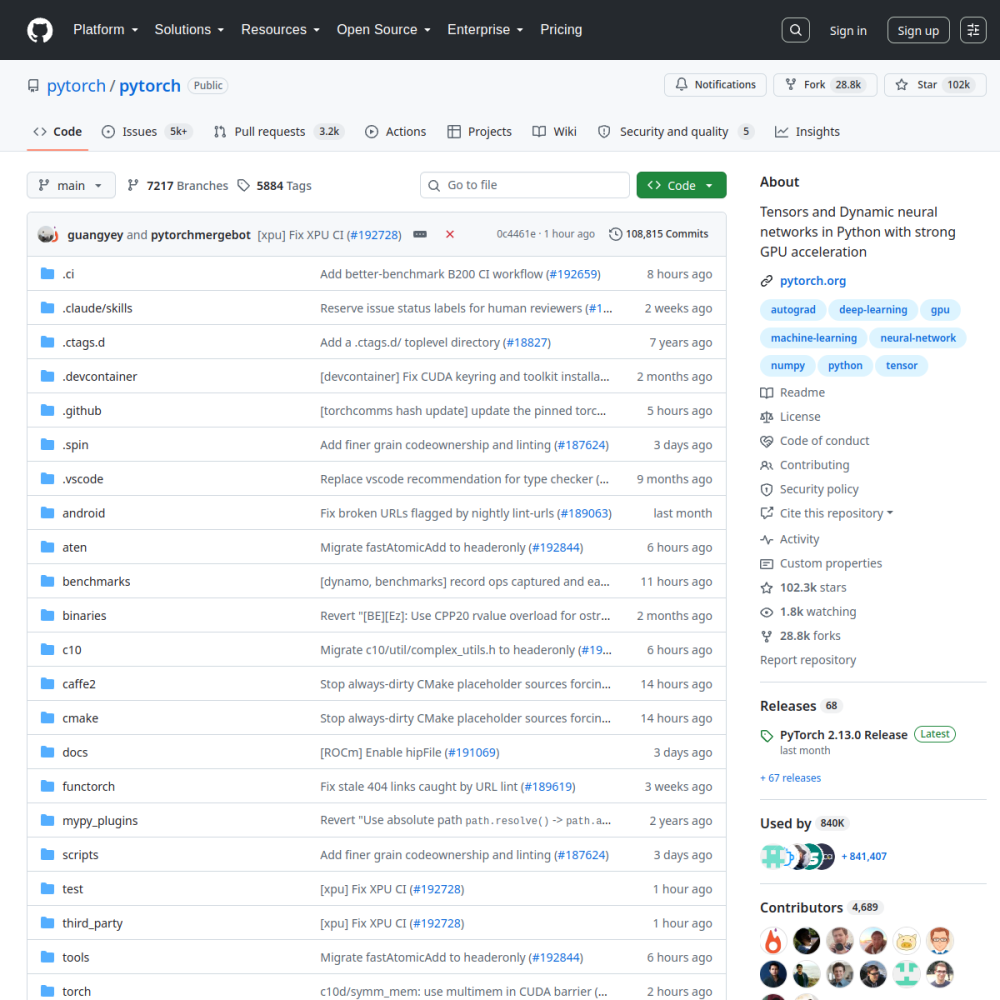
Vendor: pytorch
PyTorch is a widely adopted open-source machine learning framework offering tensor computation with GPU acceleration and dynamic neural network capabilities.
| Repository | pytorch/pytorch |
|---|---|
| GitHub Stars | ★ 102.6k |
| Forks | 29k forks |
| Primary Language | Python |
| License | NOASSERTION |
| Technical Domain | OTHER |
$ git clone https://github.com/pytorch/pytorch.git && cd pytorch
PyTorch stands as a dominant force in the machine learning ecosystem, recognized for its flexibility and researcher-friendly design. Originally developed by Meta's AI Research lab, it has garnered significant community support, evidenced by its substantial star count on GitHub. The framework positions itself as a robust alternative to static graph libraries, prioritizing ease of use and debugging during the development phase.
At its core, the library provides tensor computation similar to NumPy but with enhanced hardware acceleration capabilities. It features an automatic differentiation engine that simplifies the process of computing gradients for neural network training. This foundation allows developers to build complex models while leveraging GPU resources efficiently, making it suitable for both prototyping and large-scale production environments.
The dynamic computation graph approach distinguishes this framework from competitors, allowing for more intuitive control flow during model definition. However, this flexibility can sometimes introduce performance overhead compared to optimized static graphs in specific deployment scenarios. Despite this, the extensive ecosystem of tools and libraries built upon this foundation mitigates many deployment challenges, ensuring broad compatibility across various hardware platforms.
Common applications span across computer vision, natural language processing, and reinforcement learning domains. Researchers frequently utilize it for rapid experimentation due to its Pythonic interface, while enterprises adopt it for deploying scalable AI solutions. The active community continues to expand its capabilities, ensuring relevance in the rapidly evolving landscape of artificial intelligence technologies.
PyTorch originated from Meta's AI Research lab with a specific focus on creating a flexible machine learning framework. It addresses the critical need for intuitive model development by prioritizing ease of use and debugging over static graph constraints.
The library draws direct inspiration from NumPy for tensor computation but enhances it with significant hardware acceleration capabilities. This foundation allows developers to build complex models while leveraging GPU resources efficiently for both prototyping and production environments. It is recognized for its flexibility and researcher-friendly design throughout the industry.
Researchers frequently utilize the framework for rapid experimentation due to its Pythonic interface and dynamic computation graph approach. This flexibility allows for more intuitive control flow during model definition, making it ideal for deep learning research prototyping.
Common applications span across computer vision, natural language processing, and reinforcement learning domains. Teams train computer vision models and develop natural language processing applications using the extensive ecosystem of tools built upon this foundation.
Enterprises adopt it for deploying scalable AI solutions alongside academic use cases. The active community continues to expand its capabilities, ensuring relevance in the rapidly evolving landscape of artificial intelligence technologies.
Installation typically involves using the Python package manager to fetch the open-source library from the official repository. Users can execute standard installation commands to integrate the framework into their existing development environments seamlessly.
Once installed, developers can immediately begin defining tensors and building neural network layers within their scripts. The dynamic graph approach means models are constructed and executed in real-time during the script runtime without prior compilation.
Initial experiments often start with simple tensor operations similar to NumPy before progressing to automatic differentiation. This workflow allows for immediate feedback on model behavior without requiring complex configuration files or static graph definitions. This simplifies the process of computing gradients for neural network training.
The framework demonstrates high production readiness with a functionality rating of 4.9 out of 5 and strong community activity. Its extensive ecosystem mitigates many deployment challenges, ensuring broad compatibility across various hardware platforms for enterprise use. It is a widely adopted open-source machine learning framework offering tensor computation.
While the dynamic computation graph offers flexibility, it can sometimes introduce performance overhead compared to optimized static graphs in specific deployment scenarios. Documentation and ease of use ratings sit at 4.5 out of 5, indicating a robust but complex learning curve for advanced features.
Originally developed by Meta's AI Research lab, the framework serves as the backbone for many internal artificial intelligence projects. It positions itself as a robust alternative to static graph libraries within large-scale research environments globally.
Various enterprises adopt the framework for deploying scalable AI solutions across different industries. While specific company lists vary, the substantial community support indicates widespread integration in both academic and commercial sectors.
pytorch is an open-source AI project developed primarily in Python under the NOASSERTION license. PyTorch is a widely adopted open-source machine learning framework offering tensor computation with GPU acceleration and dynamic neural network capabilities.. PyTorch originated from Meta's AI Research lab with a specific focus on creating a flexible machine learning framework. It addresses the critical need for intuitive model development by prioritizing ease of use and debugging over static graph constraints. The library draws direct inspiration from NumPy for tensor computation but enhances it with significant hardware acceleration capabilities. This foundation allows developers to build complex models while leveraging GPU resources efficiently for both prototyping and production environments. It is recognized for its flexibility and researcher-friendly design throughout the industry.
Installation typically involves using the Python package manager to fetch the open-source library from the official repository. Users can execute standard installation commands to integrate the framework into their existing development environments seamlessly. Once installed, developers can immediately begin defining tensors and building neural network layers within their scripts. The dynamic graph approach means models are constructed and executed in real-time during the script runtime without prior compilation. Initial experiments often start with simple tensor operations similar to NumPy before progressing to automatic differentiation. This workflow allows for immediate feedback on model behavior without requiring complex configuration files or static graph definitions. This simplifies the process of computing gradients for neural network training.
pytorch is well-suited for Deep learning research prototyping, Computer vision model training, Natural language processing applications. With an overall rating of 4.8/5, it offers strong community activity, reliable performance, and easy integration with existing AI pipelines.
The framework demonstrates high production readiness with a functionality rating of 4.9 out of 5 and strong community activity. Its extensive ecosystem mitigates many deployment challenges, ensuring broad compatibility across various hardware platforms for enterprise use. It is a widely adopted open-source machine learning framework offering tensor computation. While the dynamic computation graph offers flexibility, it can sometimes introduce performance overhead compared to optimized static graphs in specific deployment scenarios. Documentation and ease of use ratings sit at 4.5 out of 5, indicating a robust but complex learning curve for advanced features.
Minimal tool for running large language models locally