dify
Vendor: langgenius
Dify is an open-source platform for building agentic workflows and RAG pipelines with multi-model support and flexible deployment options for teams.
Official Preview
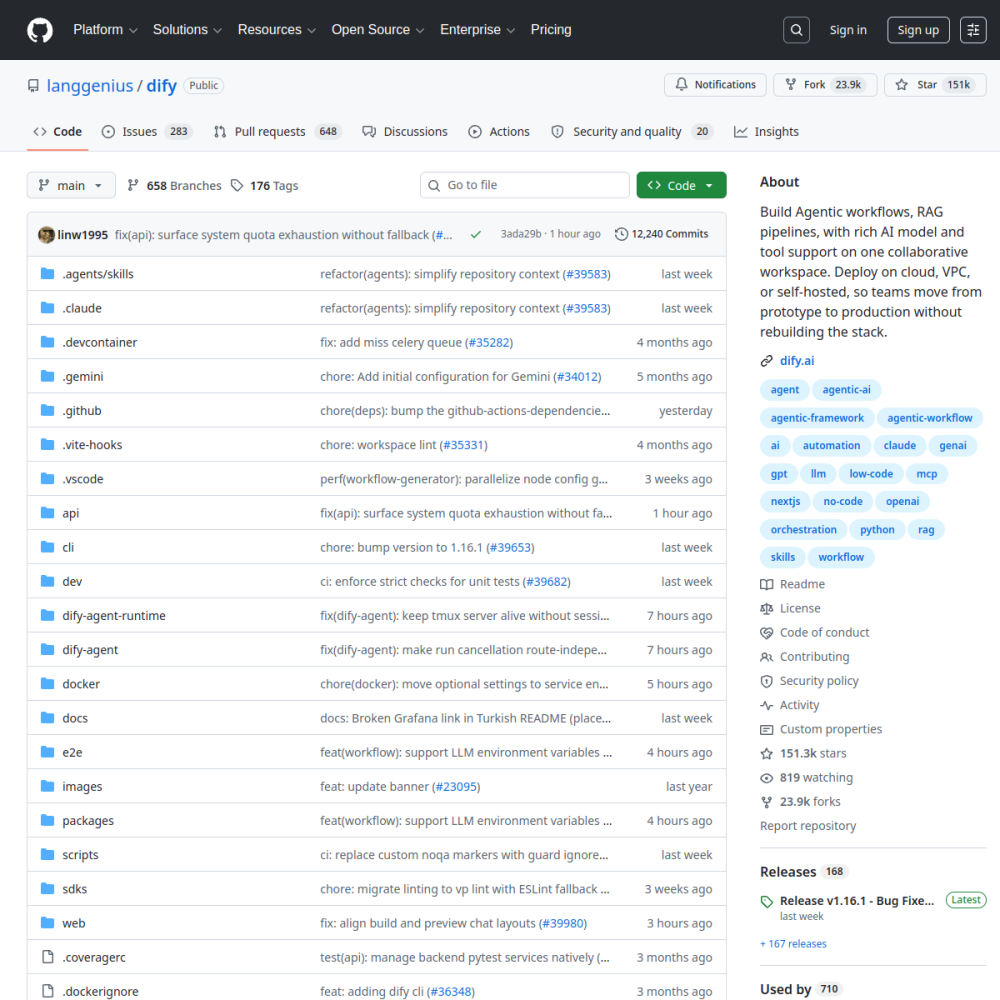
Vendor: langgenius
Dify is an open-source platform for building agentic workflows and RAG pipelines with multi-model support and flexible deployment options for teams.
| Repository | langgenius/dify |
|---|---|
| GitHub Stars | ★ 153.4k |
| Forks | 24.2k forks |
| Primary Language | TypeScript |
| License | NOASSERTION |
| Technical Domain | OTHER |
$ git clone https://github.com/langgenius/dify.git && cd dify
Dify positions itself as a comprehensive open-source platform designed to streamline the development of LLM-powered applications. It serves as a collaborative workspace where teams can construct agentic workflows and Retrieval-Augmented Generation pipelines without needing to rebuild infrastructure from scratch. The project aims to bridge the gap between initial prototyping and stable production deployment.
Core capabilities include extensive support for various AI models and tools, allowing users to integrate providers like OpenAI and Claude seamlessly. The platform emphasizes orchestration and automation through a low-code or no-code interface, enabling developers to manage complex logic visually. Deployment flexibility is a key feature, offering options for cloud, VPC, or self-hosted environments to suit different security and scalability requirements.
The project stands out due to its high community engagement, evidenced by significant star counts on GitHub, and its focus on agentic AI frameworks. While it provides robust features for enterprise-grade applications, the complexity of managing agentic workflows may require a learning curve for users unfamiliar with LLM orchestration. Documentation and community support appear strong given the project's maturity and topic coverage including MCP and NextJS.
Typical applications involve building intelligent customer support systems, internal knowledge management tools, and automated business process workflows. Teams utilize the platform to leverage multiple large language models within a single application, optimizing cost and performance. The collaborative nature of the workspace facilitates teamwork between developers and non-technical stakeholders during the application lifecycle.
Dify is a TypeScript-based open-source platform created by LangGenius to streamline the development of LLM-powered applications. It serves as a collaborative workspace where teams construct agentic workflows and Retrieval-Augmented Generation pipelines. The project aims to bridge the gap between initial prototyping and stable production deployment without rebuilding infrastructure.
The platform emphasizes orchestration and automation through a low-code or no-code interface. It supports various AI models and tools, allowing users to integrate providers like OpenAI and Claude seamlessly. This foundation enables developers to manage complex logic visually within a unified environment.
Teams utilize the platform to build intelligent customer support systems and internal knowledge management tools. These applications leverage multiple large language models within a single application to optimize cost and performance. The collaborative nature facilitates teamwork between developers and non-technical stakeholders during the application lifecycle.
Developers automate complex business process workflows using the visual orchestration interface. Typical applications involve creating enterprise customer support chatbots with RAG capabilities. Organizations also develop internal knowledge base assistants for teams to streamline information access.
Deployment flexibility allows users to choose between cloud, VPC, or self-hosted environments. This suits different security and scalability requirements depending on the organization's specific needs. Users can integrate providers like OpenAI and Claude seamlessly to begin building workflows immediately.
The low-code interface enables developers to manage complex logic visually without extensive coding. This setup supports rapid iteration from prototype to production. Flexible deployment options ensure the platform can adapt to various security and scalability requirements.
The project demonstrates high community engagement and strong documentation maturity. Ratings indicate high functionality and activity scores, though ease of use suggests a learning curve for complex agentic workflows. Users unfamiliar with LLM orchestration may need time to master the platform's capabilities.
It offers robust features for enterprise-grade applications with support for topics including MCP and NextJS. While it provides strong features, the complexity of managing agentic workflows may require a learning curve. Documentation and community support appear strong given the project's maturity.
Integration scenarios often include leveraging multiple large language models within a single application. This approach helps optimize cost and performance across different business process workflows. The project focuses on agentic AI frameworks and Retrieval-Augmented Generation pipelines.
Typical applications involve building intelligent customer support systems and internal knowledge management tools. The collaborative nature facilitates teamwork between developers and non-technical stakeholders during the application lifecycle. Organizations use these tools to create internal knowledge base assistants for teams.
dify is an open-source AI project developed primarily in TypeScript under the NOASSERTION license. Dify is an open-source platform for building agentic workflows and RAG pipelines with multi-model support and flexible deployment options for teams.. Dify is a TypeScript-based open-source platform created by LangGenius to streamline the development of LLM-powered applications. It serves as a collaborative workspace where teams construct agentic workflows and Retrieval-Augmented Generation pipelines. The project aims to bridge the gap between initial prototyping and stable production deployment without rebuilding infrastructure. The platform emphasizes orchestration and automation through a low-code or no-code interface. It supports various AI models and tools, allowing users to integrate providers like OpenAI and Claude seamlessly. This foundation enables developers to manage complex logic visually within a unified environment.
Deployment flexibility allows users to choose between cloud, VPC, or self-hosted environments. This suits different security and scalability requirements depending on the organization's specific needs. Users can integrate providers like OpenAI and Claude seamlessly to begin building workflows immediately. The low-code interface enables developers to manage complex logic visually without extensive coding. This setup supports rapid iteration from prototype to production. Flexible deployment options ensure the platform can adapt to various security and scalability requirements.
dify is well-suited for Building enterprise customer support chatbots with RAG, Automating complex business processes using agentic workflows, Developing internal knowledge base assistants for teams. With an overall rating of 4.5/5, it offers strong community activity, reliable performance, and easy integration with existing AI pipelines.
The project demonstrates high community engagement and strong documentation maturity. Ratings indicate high functionality and activity scores, though ease of use suggests a learning curve for complex agentic workflows. Users unfamiliar with LLM orchestration may need time to master the platform's capabilities. It offers robust features for enterprise-grade applications with support for topics including MCP and NextJS. While it provides strong features, the complexity of managing agentic workflows may require a learning curve. Documentation and community support appear strong given the project's maturity.
Minimal tool for running large language models locally