firecrawl
Vendor: firecrawl
Firecrawl is a TypeScript-based API designed to search, scrape, and interact with web data at scale for AI applications.
Official Preview
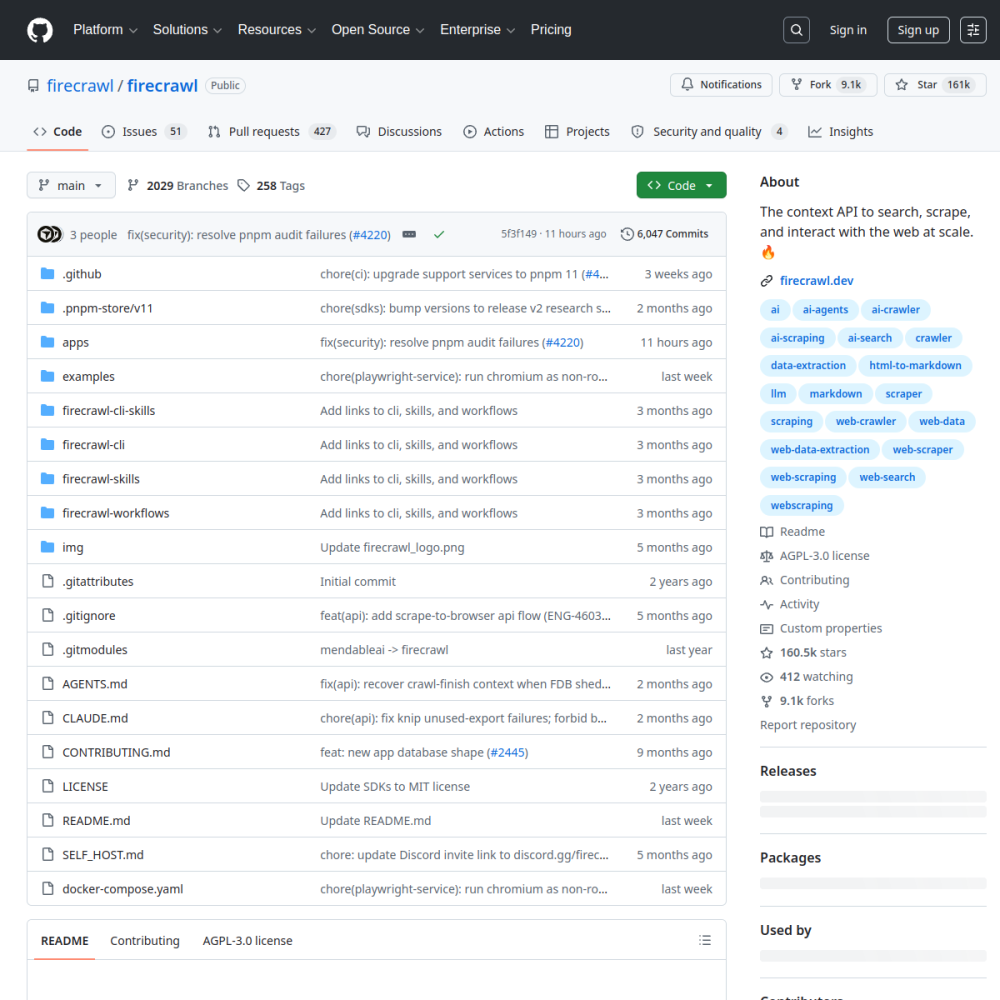
Vendor: firecrawl
Firecrawl is a TypeScript-based API designed to search, scrape, and interact with web data at scale for AI applications.
| Repository | firecrawl/firecrawl |
|---|---|
| GitHub Stars | ★ 172k |
| Forks | 9.5k forks |
| Primary Language | TypeScript |
| License | AGPL-3.0 |
| Technical Domain | OTHER |
$ git clone https://github.com/firecrawl/firecrawl.git && cd firecrawl
Firecrawl positions itself as a specialized context API built to facilitate large-scale web interaction, searching, and scraping. Written in TypeScript, it targets developers integrating web data into artificial intelligence workflows.
The platform offers core capabilities centered around converting web content into structured formats suitable for machine processing. Key features include HTML-to-Markdown conversion, web searching, and data extraction tools designed to feed information into large language models.
Its focus on AI agents and crawlers suggests optimization for automated workflows requiring reliable data ingestion. The project emphasizes scalability, allowing users to handle significant volumes of web data while maintaining compatibility with modern AI stacks.
Potential applications range from building autonomous AI agents to creating search engines that require clean, structured web data. Developers seeking to bridge the gap between raw web content and LLM contexts may find this tool particularly relevant.
Firecrawl emerges as a specialized context API designed to address the challenges of integrating raw web data into artificial intelligence workflows. It targets developers who need reliable mechanisms for searching, scraping, and interacting with web content at scale. The project is open-source under the AGPL-3.0 license, encouraging community contribution while maintaining clear usage terms.
Written in TypeScript, the project focuses on converting unstructured web content into structured formats suitable for machine processing. The inspiration stems from the growing need for AI agents to access clean, formatted information without manual preprocessing.
Primary applications involve feeding structured web data directly into large language models to enhance context windows. Developers utilize the platform to bridge the gap between raw HTML and the clean text required for effective LLM inference. The tool specifically supports AI search functionalities within these pipelines.
Building autonomous AI agents that browse the web represents another significant use case. These agents rely on Firecrawl to extract and convert HTML content to Markdown format, ensuring compatibility with modern AI stacks.
Search engines requiring clean, structured web data also benefit from the tool's extraction capabilities. The system supports scalable scraping operations, allowing users to handle significant volumes of web data while maintaining workflow reliability. This aligns with the project's focus on web-data-extraction topics.
Getting started involves accessing the repository at firecrawl/firecrawl to initialize the TypeScript-based API. Developers typically clone the project to begin configuring the environment for web interaction and scraping tasks.
The setup process focuses on establishing the connection between the local environment and the web data extraction services. Once installed, users can configure the API to begin searching and scraping web content immediately.
Initial runs usually involve testing the HTML-to-Markdown conversion feature to verify data ingestion. This step confirms that the system is correctly processing web content for downstream AI applications.
The project demonstrates strong production readiness with a high functionality rating of 4.5 out of 5. Strengths include optimized performance for AI agents and reliable scalability for handling significant volumes of web data. Users must consider the AGPL-3.0 license implications for commercial deployment.
Documentation and ease of use ratings sit slightly lower at 4.0, suggesting a learning curve for complex configurations. Activity levels remain high at 4.5, indicating ongoing maintenance, though limitations may arise when handling highly dynamic websites.
While specific enterprise adoption details are not publicly quantified, the tool is commonly integrated into autonomous agent architectures. Typical scenarios involve creating search engines that require clean, structured web data for accurate results.
Developers often deploy Firecrawl within pipelines that demand consistent data extraction from diverse web sources. The platform serves as a foundational layer for applications needing to bridge raw web content and LLM contexts effectively. It functions as a robust web-scraper within these complex systems.
firecrawl is an open-source AI project developed primarily in TypeScript under the AGPL-3.0 license. Firecrawl is a TypeScript-based API designed to search, scrape, and interact with web data at scale for AI applications.. Firecrawl emerges as a specialized context API designed to address the challenges of integrating raw web data into artificial intelligence workflows. It targets developers who need reliable mechanisms for searching, scraping, and interacting with web content at scale. The project is open-source under the AGPL-3.0 license, encouraging community contribution while maintaining clear usage terms. Written in TypeScript, the project focuses on converting unstructured web content into structured formats suitable for machine processing. The inspiration stems from the growing need for AI agents to access clean, formatted information without manual preprocessing.
Getting started involves accessing the repository at firecrawl/firecrawl to initialize the TypeScript-based API. Developers typically clone the project to begin configuring the environment for web interaction and scraping tasks. The setup process focuses on establishing the connection between the local environment and the web data extraction services. Once installed, users can configure the API to begin searching and scraping web content immediately. Initial runs usually involve testing the HTML-to-Markdown conversion feature to verify data ingestion. This step confirms that the system is correctly processing web content for downstream AI applications.
firecrawl is well-suited for Feeding structured web data into large language models, Building autonomous AI agents that browse the web, Extracting and converting HTML content to Markdown format. With an overall rating of 4.5/5, it offers strong community activity, reliable performance, and easy integration with existing AI pipelines.
The project demonstrates strong production readiness with a high functionality rating of 4.5 out of 5. Strengths include optimized performance for AI agents and reliable scalability for handling significant volumes of web data. Users must consider the AGPL-3.0 license implications for commercial deployment. Documentation and ease of use ratings sit slightly lower at 4.0, suggesting a learning curve for complex configurations. Activity levels remain high at 4.5, indicating ongoing maintenance, though limitations may arise when handling highly dynamic websites.
Minimal tool for running large language models locally