transformers
Vendor: huggingface
A Python framework facilitating the development and deployment of transformer models across text, vision, audio, and multimodal machine learning tasks.
Official Preview
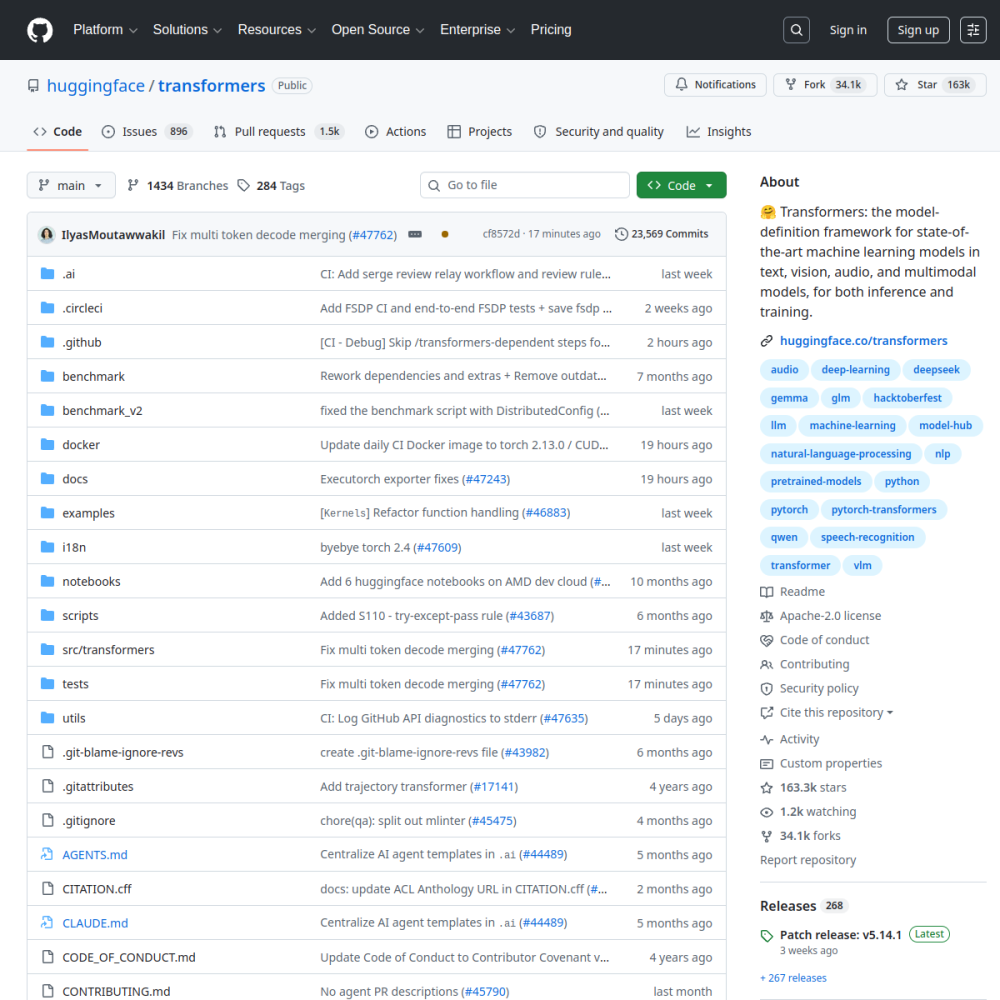
Vendor: huggingface
A Python framework facilitating the development and deployment of transformer models across text, vision, audio, and multimodal machine learning tasks.
| Repository | huggingface/transformers |
|---|---|
| GitHub Stars | ★ 164.4k |
| Forks | 34.3k forks |
| Primary Language | Python |
| License | Apache-2.0 |
| Technical Domain | OTHER |
$ git clone https://github.com/huggingface/transformers.git && cd transformers
This library serves as foundational infrastructure for the machine learning community, standardizing the implementation of transformer architectures. It enables developers to access and utilize pre-trained models without needing to build complex neural networks from scratch, reducing the effort required for advanced AI research and application.
The framework supports a wide array of modalities, including natural language processing, computer vision, audio processing, and multimodal tasks. It provides unified APIs for both training new models and running inference on existing ones, ensuring consistency across different model families and hardware environments.
While the ecosystem is extensive, the sheer volume of models and configuration options can present a learning curve for newcomers. Additionally, running large-scale models often requires substantial computational resources, which may limit accessibility for users without dedicated hardware. Despite this, the community-driven nature ensures continuous updates and broad compatibility.
Typical applications range from text generation and translation to image classification and speech recognition. Organizations leverage this tooling to integrate advanced AI capabilities into production systems, research prototypes, and educational projects alike.
The transformers library was developed by Hugging Face to address the complexity of implementing transformer architectures from scratch. It serves as foundational infrastructure for the machine learning community by standardizing how these models are built and utilized across text, vision, audio, and multimodal machine learning tasks.
This framework solves the problem of accessibility in advanced AI research by providing a unified interface for pre-trained models. Developers can leverage existing neural networks without needing to construct complex underlying structures manually, significantly reducing development effort.
Primary use cases include natural language processing applications such as text generation, translation, and summarization. Developers utilize the library to integrate these capabilities into production systems, research prototypes, and educational projects alike.
Beyond text, the framework supports computer vision model deployment and speech recognition system development. This multi-modal support allows teams to handle diverse data types within a single consistent environment.
Target users range from individual researchers exploring new model families to organizations requiring robust AI integration. The unified APIs ensure consistency across different model families and hardware environments for all user levels.
Installation is straightforward for Python environments using standard package managers via pip. Users can add the library to their project dependencies to begin accessing the model hub immediately.
Once installed, developers can load pre-trained models for inference or training tasks. The framework provides unified APIs for both training new models and running inference on existing ones.
A typical first run involves importing the necessary pipeline classes and selecting a model from the extensive library. This allows users to generate outputs or process inputs without configuring complex neural network layers manually.
The library demonstrates high production readiness with a functionality rating of 4.9 out of 5 and documentation rated 4.7 out of 5. Its community-driven nature ensures continuous updates and broad compatibility across different hardware environments.
However, the sheer volume of models and configuration options can present a learning curve for newcomers. Additionally, running large-scale models often requires substantial computational resources, which may limit accessibility for users without dedicated hardware.
Organizations leverage this tooling to integrate advanced AI capabilities into production systems and research prototypes. Typical integration scenarios involve deploying pre-trained models for specific tasks like translation or classification within larger software stacks.
Research teams utilize the framework to prototype new ideas without building infrastructure from scratch. The ecosystem supports broad compatibility, allowing various projects to adopt the same underlying model standards.
transformers is an open-source AI project developed primarily in Python under the Apache-2.0 license. A Python framework facilitating the development and deployment of transformer models across text, vision, audio, and multimodal machine learning tasks.. The transformers library was developed by Hugging Face to address the complexity of implementing transformer architectures from scratch. It serves as foundational infrastructure for the machine learning community by standardizing how these models are built and utilized across text, vision, audio, and multimodal machine learning tasks. This framework solves the problem of accessibility in advanced AI research by providing a unified interface for pre-trained models. Developers can leverage existing neural networks without needing to construct complex underlying structures manually, significantly reducing development effort.
Installation is straightforward for Python environments using standard package managers via pip. Users can add the library to their project dependencies to begin accessing the model hub immediately. Once installed, developers can load pre-trained models for inference or training tasks. The framework provides unified APIs for both training new models and running inference on existing ones. A typical first run involves importing the necessary pipeline classes and selecting a model from the extensive library. This allows users to generate outputs or process inputs without configuring complex neural network layers manually.
transformers is well-suited for Natural language processing applications, Computer vision model deployment, Speech recognition system development. With an overall rating of 4.8/5, it offers strong community activity, reliable performance, and easy integration with existing AI pipelines.
The library demonstrates high production readiness with a functionality rating of 4.9 out of 5 and documentation rated 4.7 out of 5. Its community-driven nature ensures continuous updates and broad compatibility across different hardware environments. However, the sheer volume of models and configuration options can present a learning curve for newcomers. Additionally, running large-scale models often requires substantial computational resources, which may limit accessibility for users without dedicated hardware.
Minimal tool for running large language models locally