hermes-agent
Vendor: NousResearch
A Python-based AI agent framework designed to adapt and evolve alongside users through integration with major LLM providers.
Official Preview
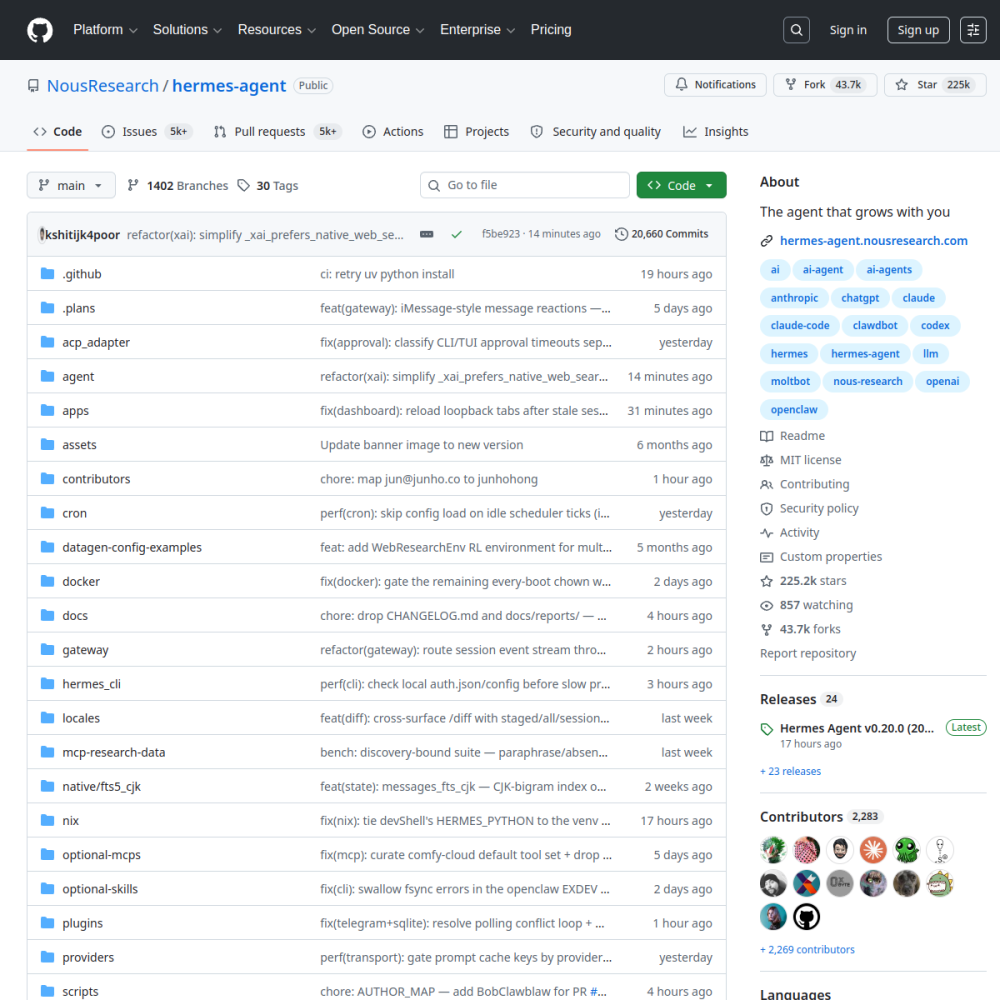
Vendor: NousResearch
A Python-based AI agent framework designed to adapt and evolve alongside users through integration with major LLM providers.
| Repository | NousResearch/hermes-agent |
|---|---|
| GitHub Stars | ★ 236.1k |
| Forks | 47.6k forks |
| Primary Language | Python |
| License | MIT |
| Technical Domain | OTHER |
$ git clone https://github.com/NousResearch/hermes-agent.git && cd hermes-agent
NousResearch presents hermes-agent as a Python-based framework intended to evolve alongside its users, leveraging the organization's expertise in open-weight models. The project positions itself within the broader AI agent landscape, emphasizing adaptability and long-term utility rather than static task execution.
Core capabilities appear centered around integration with diverse large language model providers, including Anthropic and OpenAI, as indicated by the project topics. This multi-provider approach allows developers to switch underlying models while maintaining the agent's structural integrity and learning progression.
Highlights include its focus on growth and personalization, distinguishing it from one-off automation scripts. However, like many agent frameworks, it may require technical proficiency to configure effectively, and performance depends heavily on the chosen underlying model and API availability.
Typical applications involve personalized assistance systems, development workflow automation, and scenarios requiring persistent context over time. The project serves developers looking to build custom agent solutions that improve through interaction rather than remaining static tools.
NousResearch developed hermes-agent to address the limitations of static automation scripts in dynamic AI environments. The Python-based framework leverages the organization's background in open-weight models to create a system that adapts alongside its users rather than executing fixed tasks.
The project positions itself within the broader AI agent landscape by emphasizing long-term utility and structural integrity. It integrates with major LLM providers to ensure developers can switch underlying models while maintaining the agent's learning progression. This design philosophy supports the MIT licensed codebase intended for community contribution.
Developers utilize this framework for personalized task automation where the agent improves through interaction over time. This approach distinguishes the tool from one-off scripts by focusing on growth and personalization within specific workflows.
Development workflow assistance represents another primary application, allowing teams to integrate AI support that understands persistent context. Users managing complex projects benefit from the ability to maintain context across sessions without manual reconfiguration.
The multi-provider support enables scenarios requiring flexibility in model selection based on cost or capability needs. This makes the framework suitable for environments where API availability or model performance varies significantly across different providers. Developers can select models based on specific task requirements.
Getting started requires a Python environment capable of handling the framework's dependencies and API connections. Users typically clone the repository and configure their preferred large language model provider credentials within the project structure.
The Python-native architecture allows for standard package management practices during the installation phase. Developers configure the system to connect with supported providers like Anthropic or OpenAI before initiating the agent's core loop.
Initial execution involves launching the agent framework to establish a connection with the selected underlying model. This process validates the API keys and ensures the adaptive growth mechanism can begin logging interaction data. Successful startup confirms the environment is ready for use.
The project demonstrates strong functionality and activity levels, reflected in its overall rating of 4.2 out of 5. Strengths include the adaptive growth mechanism and robust multi-LLM provider support, which enhance long-term utility for technical users.
However, production readiness may require significant technical proficiency to configure effectively due to an ease score of 3.8. Performance remains heavily dependent on the chosen underlying model and the availability of external APIs, introducing potential variability in real-world deployment. Users should plan for configuration time.
While specific enterprise adoption data is not publicly detailed, the framework is designed for developers building custom agent solutions. Typical integration scenarios involve teams seeking persistent context management within their internal development pipelines.
The architecture supports use cases where organizations require flexibility in switching between different large language model providers. This adaptability makes it a candidate for projects needing to mitigate vendor lock-in while maintaining consistent agent behavior. Integration typically occurs within existing software stacks.
hermes-agent is an open-source AI project developed primarily in Python under the MIT license. A Python-based AI agent framework designed to adapt and evolve alongside users through integration with major LLM providers.. NousResearch developed hermes-agent to address the limitations of static automation scripts in dynamic AI environments. The Python-based framework leverages the organization's background in open-weight models to create a system that adapts alongside its users rather than executing fixed tasks. The project positions itself within the broader AI agent landscape by emphasizing long-term utility and structural integrity. It integrates with major LLM providers to ensure developers can switch underlying models while maintaining the agent's learning progression. This design philosophy supports the MIT licensed codebase intended for community contribution.
Getting started requires a Python environment capable of handling the framework's dependencies and API connections. Users typically clone the repository and configure their preferred large language model provider credentials within the project structure. The Python-native architecture allows for standard package management practices during the installation phase. Developers configure the system to connect with supported providers like Anthropic or OpenAI before initiating the agent's core loop. Initial execution involves launching the agent framework to establish a connection with the selected underlying model. This process validates the API keys and ensures the adaptive growth mechanism can begin logging interaction data. Successful startup confirms the environment is ready for use.
hermes-agent is well-suited for Personalized task automation, Development workflow assistance, Persistent context management. With an overall rating of 4.2/5, it offers strong community activity, reliable performance, and easy integration with existing AI pipelines.
The project demonstrates strong functionality and activity levels, reflected in its overall rating of 4.2 out of 5. Strengths include the adaptive growth mechanism and robust multi-LLM provider support, which enhance long-term utility for technical users. However, production readiness may require significant technical proficiency to configure effectively due to an ease score of 3.8. Performance remains heavily dependent on the chosen underlying model and the availability of external APIs, introducing potential variability in real-world deployment. Users should plan for configuration time.
Minimal tool for running large language models locally