AutoGen
Vendor: microsoft
Microsoft's multi-agent collaboration framework
Official Preview
Vendor: microsoft
Microsoft's multi-agent collaboration framework
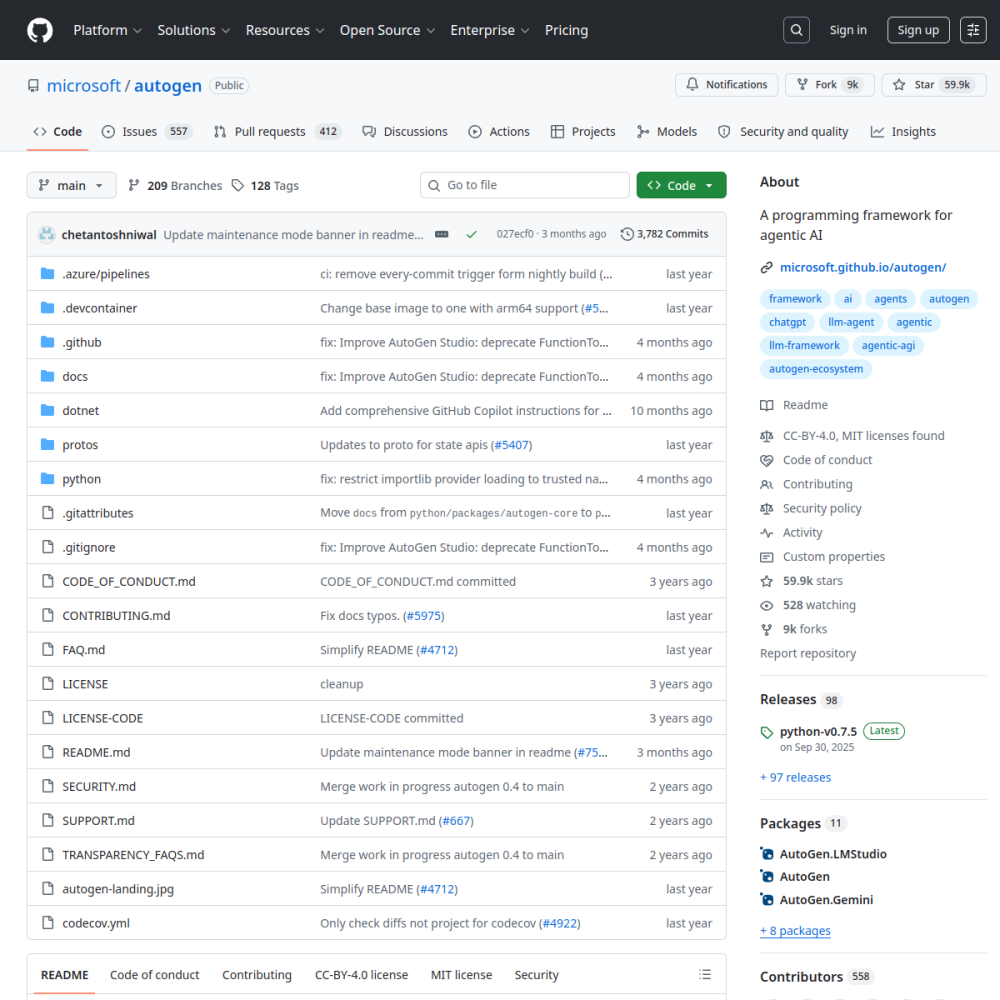
| Repository | microsoft/autogen |
|---|---|
| GitHub Stars | ★ 60.6k |
| Forks | 9.1k forks |
| Primary Language | Python |
| License | CC-BY-4.0 |
| Technical Domain | AGENTS |
$ git clone https://github.com/microsoft/autogen.git && cd autogen
AutoGen is Microsoft's multi-agent collaboration framework that engineers the paradigm of multiple agents conversing to complete complex tasks. It emphasizes conversational agents and composable GroupChat, and is a common baseline for both academia and early practitioners in the multi-agent orchestration space.
Core capabilities include the ConversableAgent abstraction, GroupChat orchestration, nestable tool calls, code executors, human-in-the-loop mode, and the asynchronous and event-driven architecture introduced in v0.4. It adapts to OpenAI, Anthropic, and local models.
The highlight is expressive multi-agent conversation flows, well suited for studying how agents divide and cooperate. The downside is documentation clearly lags behind code iteration, with significant API changes between 0.2 and 0.4, and old examples often need manual fixes. Behavior predictability degrades under complex topologies.
Use cases: multi-agent collaboration research, workflows requiring human-machine mixed decision-making, complex task decomposition and orchestration prototypes. Build your own observability and replay before going to production.
AutoGen is a multi-agent collaboration framework developed by Microsoft. It engineers a paradigm where multiple agents converse to complete complex tasks, moving beyond single-agent interactions. The project emphasizes conversational agents and composable GroupChat structures, serving as a common baseline for both academia and early practitioners in the multi-agent orchestration space.
The framework is built in Python and released under the MIT license. It adapts to OpenAI, Anthropic, and local models, providing flexibility for different deployment environments. This accessibility encourages broader experimentation within the research community and industry alike.
Researchers utilize AutoGen for multi-agent collaboration studies, exploring how agents divide and cooperate within expressive conversation flows. It provides a structured environment to test orchestration strategies without building infrastructure from scratch. The framework supports studying how agents divide and cooperate effectively.
Practitioners apply it to workflows requiring human-machine mixed decision-making, leveraging the human-in-the-loop mode for critical interventions. It is also suitable for complex task decomposition and orchestration prototypes where multiple specialized agents must coordinate to solve problems. Users often build custom observability before production.
Installation is straightforward via pip for Python environments. Users can install the package and configure environment variables for their preferred model provider, such as OpenAI, Anthropic, or local models. This setup allows for immediate experimentation with agent interactions.
A basic run involves defining ConversableAgent instances and initiating a chat session. While specific commands vary by version, the core flow requires setting up agents and triggering a conversation loop to observe multi-agent interaction. Users should verify API compatibility due to recent version changes.
The framework offers strong functionality with an asynchronous and event-driven architecture introduced in v0.4. However, documentation clearly lags behind code iteration, and significant API changes between versions 0.2 and 0.4 mean old examples often need manual fixes. The rating reflects high functionality but lower documentation scores.
Behavior predictability degrades under complex topologies, requiring caution in production deployments. Users should build their own observability and replay systems before going to production to manage these stability concerns effectively. Production readiness depends heavily on managing these architectural complexities.
As a Microsoft-hosted project, it sees adoption within research institutions studying agent orchestration. It functions as a standard baseline for evaluating multi-agent systems in academic papers and early-stage industry prototypes. The project is widely recognized for its role in the space.
Integration scenarios typically involve connecting the framework to external tools via nestable tool calls and code executors. While specific enterprise deployments vary, the architecture supports adapting to various model providers for flexible integration. Teams often customize the observability layer for their specific needs.
AutoGen is an open-source AI project developed primarily in Python under the CC-BY-4.0 license. Microsoft's multi-agent collaboration framework. AutoGen is a multi-agent collaboration framework developed by Microsoft. It engineers a paradigm where multiple agents converse to complete complex tasks, moving beyond single-agent interactions. The project emphasizes conversational agents and composable GroupChat structures, serving as a common baseline for both academia and early practitioners in the multi-agent orchestration space. The framework is built in Python and released under the MIT license. It adapts to OpenAI, Anthropic, and local models, providing flexibility for different deployment environments. This accessibility encourages broader experimentation within the research community and industry alike.
Installation is straightforward via pip for Python environments. Users can install the package and configure environment variables for their preferred model provider, such as OpenAI, Anthropic, or local models. This setup allows for immediate experimentation with agent interactions. A basic run involves defining ConversableAgent instances and initiating a chat session. While specific commands vary by version, the core flow requires setting up agents and triggering a conversation loop to observe multi-agent interaction. Users should verify API compatibility due to recent version changes.
AutoGen is well-suited for Multi-agent collaboration research, Complex task decomposition, Human-machine decision workflows. With an overall rating of 4.0/5, it offers strong community activity, reliable performance, and easy integration with existing AI pipelines.
The framework offers strong functionality with an asynchronous and event-driven architecture introduced in v0.4. However, documentation clearly lags behind code iteration, and significant API changes between versions 0.2 and 0.4 mean old examples often need manual fixes. The rating reflects high functionality but lower documentation scores. Behavior predictability degrades under complex topologies, requiring caution in production deployments. Users should build their own observability and replay systems before going to production to manage these stability concerns effectively. Production readiness depends heavily on managing these architectural complexities.
Minimal tool for running large language models locally