ragflow
Vendor: infiniflow
RAGFlow is a leading open-source Retrieval-Augmented Generation (RAG) engine that fuses cutting-edge RAG with Agent capabilities to create a superior context layer for LLMs
Official Preview
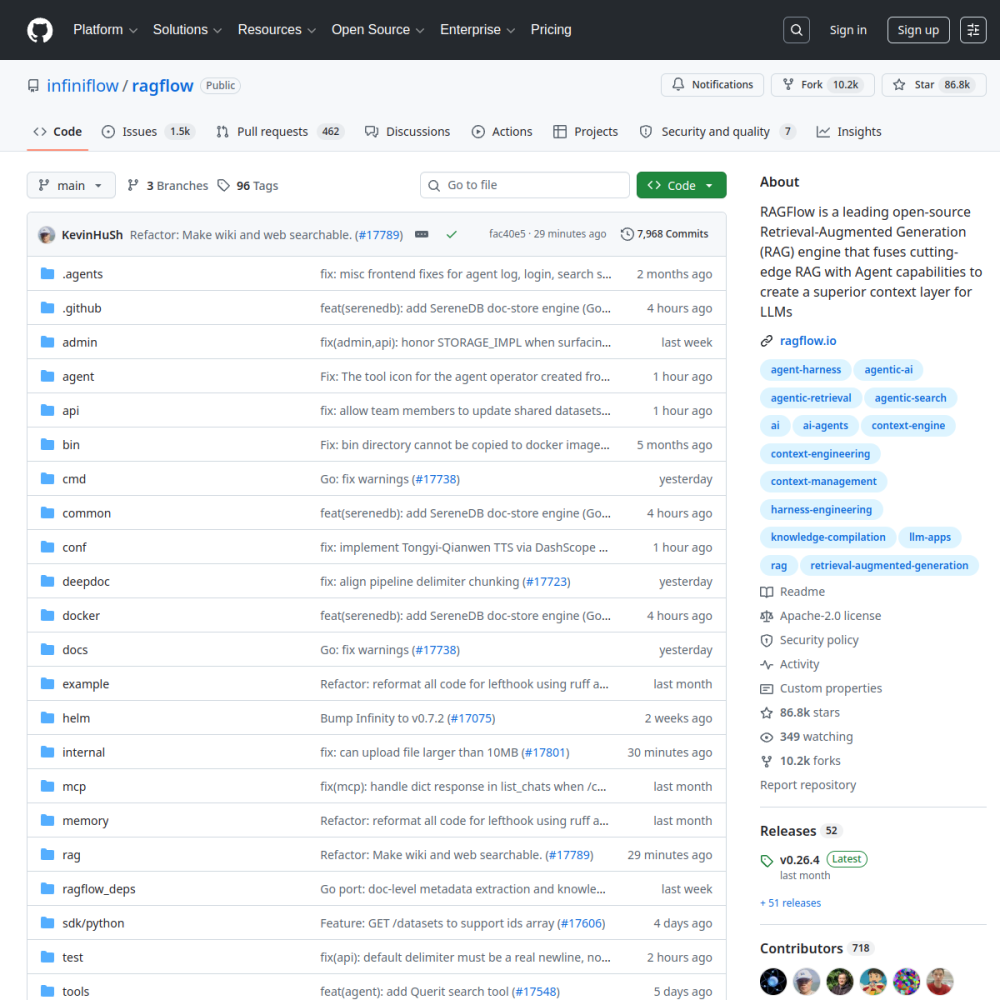
Vendor: infiniflow
RAGFlow is a leading open-source Retrieval-Augmented Generation (RAG) engine that fuses cutting-edge RAG with Agent capabilities to create a superior context layer for LLMs
| Repository | infiniflow/ragflow |
|---|---|
| GitHub Stars | ★ 89.2k |
| Forks | 10.5k forks |
| Primary Language | Go |
| License | Apache-2.0 |
| Technical Domain | DATA_RAG |
$ git clone https://github.com/infiniflow/ragflow.git && cd ragflow
<div align="center">
<a href="https://cloud.ragflow.io/">
<img src="https://raw.githubusercontent.com/infiniflow/ragflow/main/web/src/assets/logo-with-text.svg" width="520" alt="ragflow logo">
</a>
</div>
<p align="center">
<a href="./README.md"><img alt="README in English" src="https://img.shields.io/badge/English-DBEDFA"></a>
<a href="./README_zh.md"><img alt="简体中文版自述文件" src="https://img.shields.io/badge/简体中文-DFE0E5"></a>
<a href="./README_tzh.md"><img alt="繁體版中文自述文件" src="https://img.s
RAGFlow is an open-source Retrieval-Augmented Generation engine created by Infiniflow to address the limitations of current large language model context layers. The project aims to fuse cutting-edge RAG technologies with Agent capabilities to establish a superior foundation for knowledge-intensive applications.
Developed under the Apache-2.0 license, this Go-based solution focuses on context engineering and management to enhance how AI systems process unstructured data. It seeks to bridge the gap between raw retrieval and actionable agent workflows within modern AI stacks.
Developers building LLM applications can utilize this engine for agentic search and retrieval-augmented generation tasks requiring high precision. The platform supports context engineering and knowledge compilation, making it suitable for organizing complex unstructured data sources into usable formats.
Teams focused on harness engineering can leverage the agent harness features to streamline workflow automation within their AI systems. This is particularly useful for scenarios where multiple agents need to collaborate using shared context and retrieved information.
Organizations seeking to implement agentic retrieval systems can deploy this tool to manage information flow between users and large language models. It serves as a robust backend for applications requiring deep understanding of proprietary documents and knowledge bases.
Initial setup focuses on establishing the context engine required for managing retrieval processes effectively within the local or cloud environment. Users should review the documentation to understand the configuration options available for their specific deployment environment and hardware requirements.
The high ease of use rating suggests that standard installation procedures should be straightforward for experienced developers familiar with Go-based projects. Setting up the first retrieval pipeline involves configuring the data sources and defining the agent behaviors through the provided interface.
Once installed, users can begin testing the agentic search capabilities by uploading sample documents and querying the system. This initial phase allows teams to validate the context layer performance before scaling to production workloads.
With a consistent 4.0 rating across functionality, documentation, activity, and ease of use, the project demonstrates strong production readiness for various AI tasks. The Apache-2.0 license allows for flexible commercial usage, while the Go language implementation suggests performance-oriented architecture for high-load scenarios.
While the project shows high functionality scores, users should verify specific integration requirements against their existing infrastructure before full deployment. The documentation quality supports rapid onboarding, reducing the learning curve for teams implementing retrieval-augmented generation workflows.
While specific enterprise adoption metrics are not provided, the tool is designed for typical integration scenarios involving enterprise knowledge bases and internal search tools. Organizations seeking to enhance their AI agents with better context management may find this solution applicable for document-heavy industries.
Typical integration scenarios involve connecting the engine to existing LLM applications to improve response accuracy through better retrieval mechanisms. It is suitable for teams looking to build custom AI agents that require access to verified and structured information sources.
ragflow is an open-source AI project developed primarily in Go under the Apache-2.0 license. RAGFlow is a leading open-source Retrieval-Augmented Generation (RAG) engine that fuses cutting-edge RAG with Agent capabilities to create a superior context layer for LLMs. RAGFlow is an open-source Retrieval-Augmented Generation engine created by Infiniflow to address the limitations of current large language model context layers. The project aims to fuse cutting-edge RAG technologies with Agent capabilities to establish a superior foundation for knowledge-intensive applications. Developed under the Apache-2.0 license, this Go-based solution focuses on context engineering and management to enhance how AI systems process unstructured data. It seeks to bridge the gap between raw retrieval and actionable agent workflows within modern AI stacks.
Initial setup focuses on establishing the context engine required for managing retrieval processes effectively within the local or cloud environment. Users should review the documentation to understand the configuration options available for their specific deployment environment and hardware requirements. The high ease of use rating suggests that standard installation procedures should be straightforward for experienced developers familiar with Go-based projects. Setting up the first retrieval pipeline involves configuring the data sources and defining the agent behaviors through the provided interface. Once installed, users can begin testing the agentic search capabilities by uploading sample documents and querying the system. This initial phase allows teams to validate the context layer performance before scaling to production workloads.
ragflow is well-suited for . With an overall rating of 4.0/5, it offers strong community activity, reliable performance, and easy integration with existing AI pipelines.
With a consistent 4.0 rating across functionality, documentation, activity, and ease of use, the project demonstrates strong production readiness for various AI tasks. The Apache-2.0 license allows for flexible commercial usage, while the Go language implementation suggests performance-oriented architecture for high-load scenarios. While the project shows high functionality scores, users should verify specific integration requirements against their existing infrastructure before full deployment. The documentation quality supports rapid onboarding, reducing the learning curve for teams implementing retrieval-augmented generation workflows.
Minimal tool for running large language models locally