LangChain
Vendor: langchain-ai
Framework for building LLM applications
Official Preview
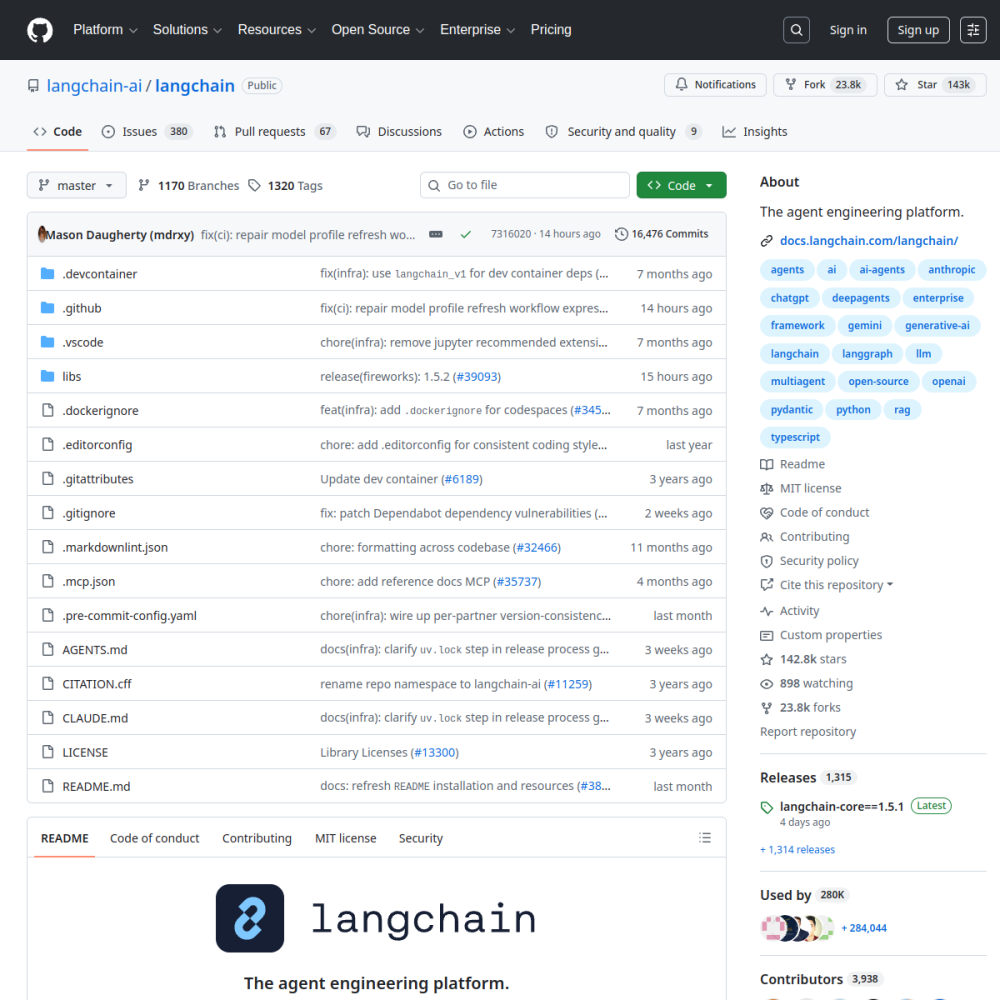
Vendor: langchain-ai
Framework for building LLM applications
| Repository | langchain-ai/langchain |
|---|---|
| GitHub Stars | ★ 144.9k |
| Forks | 24.2k forks |
| Primary Language | Python |
| License | MIT |
| Technical Domain | FRAMEWORK |
$ git clone https://github.com/langchain-ai/langchain.git && cd langchain
LangChain is the earliest mature LLM application framework, defining abstractions (chains, agents, tools, retrievers) that are still widely reused today. It standardizes how LLMs compose with external tools, memory, and vector stores, and is a common starting point for learning LLM application development.
Core capabilities cover prompt templates, memory modules, document loading and splitting, vector retrieval, agent tool calling, LangGraph state-machine orchestration, and the LangSmith observability platform. The ecosystem integrates over a hundred model and data-source providers, so almost anything you can think of has an integration.
The highlight is a huge ecosystem with rich tutorials, and almost any provider has a ready-made integration. The downside follows from the same root: abstraction layers are thick, versions change frequently, official docs often lag behind code, and the 0.x to 1.x migration cost is non-trivial. Debugging deep chains can be painful.
Use cases: rapid RAG prototyping, applications needing multi-provider switching, teaching and course experiments. Evaluate the controllability cost of abstractions before production deployment.
LangChain emerged as one of the earliest mature frameworks for building LLM applications, establishing core abstractions like chains, agents, tools, and retrievers that remain widely reused today. It addresses the significant complexity involved in composing large language models with external tools, memory systems, and vector stores.
The project standardizes how developers interact with model providers and data sources, serving as a common starting point for learning LLM application development. Its design inspiration focuses on reducing boilerplate code while maintaining necessary flexibility across different model architectures and deployment environments.
Developers frequently use LangChain for rapid RAG prototyping, leveraging built-in document loaders and splitters to quickly test retrieval-augmented generation workflows. The framework simplifies the initial setup required to connect private data sources with language models without writing extensive custom glue code.
It is also suitable for applications requiring multi-provider switching, allowing teams to test different model APIs without rewriting core logic. Educators and students utilize the library for LLM app teaching experiments due to its extensive tutorials and clear abstraction layers.
Users building agent-based systems benefit from the standardized tool-calling interfaces and state-machine orchestration provided by LangGraph. These use cases prioritize speed of iteration over fine-grained control during the early development phases.
Installation requires a Python environment where users can run the pip command to fetch the core library and specific provider packages. The framework is modular, so developers often install only the components needed for their specific model or vector store integration.
A basic first run involves importing the chain class, configuring a prompt template, and invoking the model with user input. This minimal setup allows developers to verify connectivity before adding complex memory or tool-calling logic.
Users should ensure they have the necessary API keys configured in their environment variables before executing the initial script. This step is critical for authenticating requests to the underlying large language model providers securely.
The framework scores highly on functionality and activity but faces challenges with documentation and ease of use during version migrations. Production readiness depends on evaluating the controllability cost of its abstraction layers before deployment.
Strengths include a vast ecosystem with over one hundred provider integrations and robust observability through LangSmith. However, debugging deep chains can be painful, and official documentation often lags behind code changes.
Teams must weigh the speed of development against the potential instability introduced by frequent version updates. The migration from 0.x to 1.x versions involves non-trivial effort, requiring careful planning for long-term maintenance.
Typical integration scenarios involve connecting enterprise data sources to various model providers using the standardized retriever interfaces. Organizations often adopt the framework to unify access across multiple AI vendors within a single codebase.
While specific company lists are not detailed in the review, the widespread adoption of its abstractions suggests usage across diverse sectors. Projects utilizing LangGraph for state-machine orchestration benefit from the structured approach to managing complex agent workflows.
The LangSmith platform is commonly used alongside the framework for end-to-end tracing and monitoring of application performance. This combination helps teams identify bottlenecks in their retrieval and generation pipelines during active development.
LangChain is an open-source AI project developed primarily in Python under the MIT license. Framework for building LLM applications. LangChain emerged as one of the earliest mature frameworks for building LLM applications, establishing core abstractions like chains, agents, tools, and retrievers that remain widely reused today. It addresses the significant complexity involved in composing large language models with external tools, memory systems, and vector stores. The project standardizes how developers interact with model providers and data sources, serving as a common starting point for learning LLM application development. Its design inspiration focuses on reducing boilerplate code while maintaining necessary flexibility across different model architectures and deployment environments.
Installation requires a Python environment where users can run the pip command to fetch the core library and specific provider packages. The framework is modular, so developers often install only the components needed for their specific model or vector store integration. A basic first run involves importing the chain class, configuring a prompt template, and invoking the model with user input. This minimal setup allows developers to verify connectivity before adding complex memory or tool-calling logic. Users should ensure they have the necessary API keys configured in their environment variables before executing the initial script. This step is critical for authenticating requests to the underlying large language model providers securely.
LangChain is well-suited for Rapid RAG prototyping, Multi-provider app switching, LLM app teaching experiments. With an overall rating of 4.0/5, it offers strong community activity, reliable performance, and easy integration with existing AI pipelines.
The framework scores highly on functionality and activity but faces challenges with documentation and ease of use during version migrations. Production readiness depends on evaluating the controllability cost of its abstraction layers before deployment. Strengths include a vast ecosystem with over one hundred provider integrations and robust observability through LangSmith. However, debugging deep chains can be painful, and official documentation often lags behind code changes. Teams must weigh the speed of development against the potential instability introduced by frequent version updates. The migration from 0.x to 1.x versions involves non-trivial effort, requiring careful planning for long-term maintenance.
Minimal tool for running large language models locally