12-factor-agents
Vendor: humanlayer
What are the principles we can use to build LLM-powered software that is actually good enough to put in the hands of production customers?
Official Preview
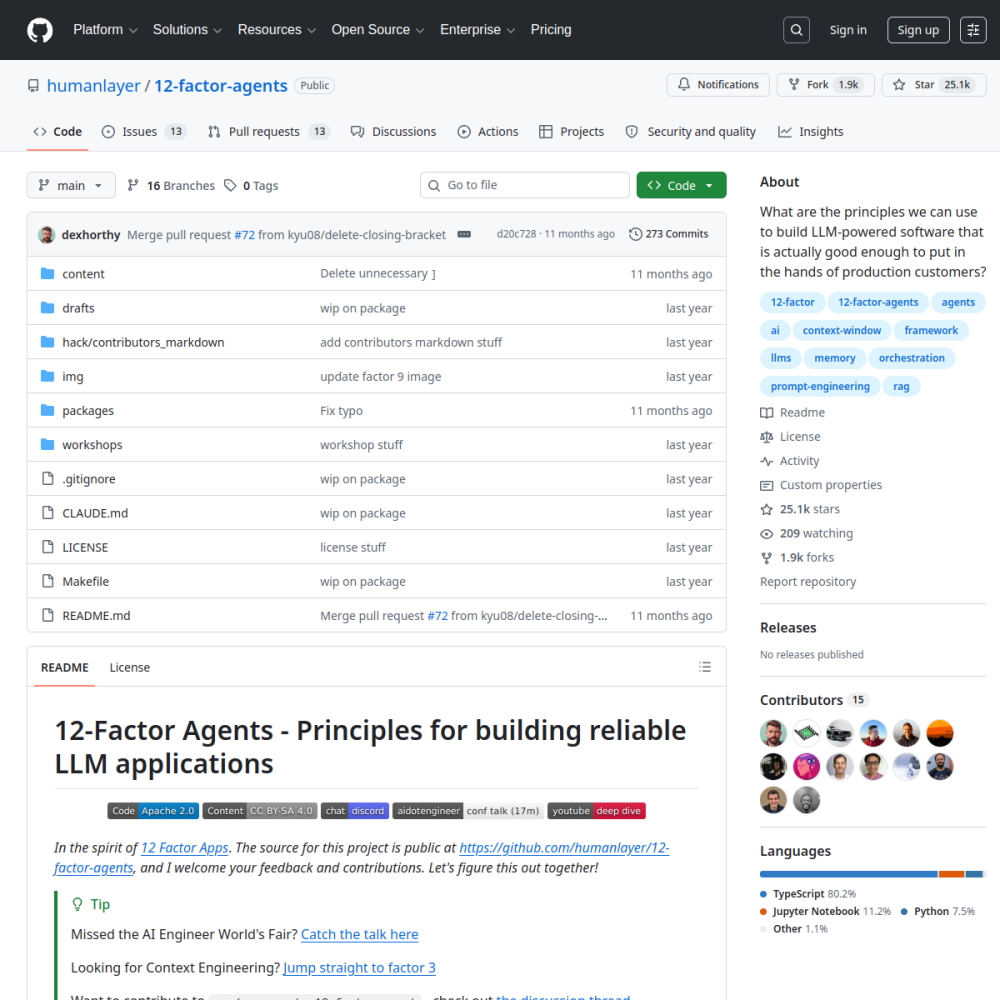
Vendor: humanlayer
What are the principles we can use to build LLM-powered software that is actually good enough to put in the hands of production customers?
| Repository | humanlayer/12-factor-agents |
|---|---|
| GitHub Stars | ★ 25.5k |
| Forks | 1.9k forks |
| Primary Language | TypeScript |
| License | NOASSERTION |
| Technical Domain | FRAMEWORK |
$ git clone https://github.com/humanlayer/12-factor-agents.git && cd 12-factor-agents
# 12-Factor Agents - Principles for building reliable LLM applications
<div align="center">
<a href="https://www.apache.org/licenses/LICENSE-2.0">
<img src="https://img.shields.io/badge/Code-Apache%202.0-blue.svg" alt="Code License: Apache 2.0"></a>
<a href="https://creativecommons.org/licenses/by-sa/4.0/">
<img src="https://img.shields.io/badge/Content-CC%20BY--SA%204.0-lightgrey.svg" alt="Content License: CC BY-SA 4.0"></a>
<a href="https://humanlayer.dev/discord">
<img sr
Humanlayer developed this repository to address the significant gap between experimental large language model demos and software robust enough for production customers. The project adapts the well-known twelve-factor app methodology specifically for the unique challenges of AI agents and LLM applications.
It aims to define concrete principles for reliability, scalability, and maintainability in LLM-powered systems where state management and context handling are critical. By establishing a standard vocabulary and architectural expectations, the framework helps teams move beyond ad-hoc scripting toward enterprise-grade software engineering practices.
Developers building autonomous agents or complex orchestration pipelines can apply these guidelines to structure their codebases effectively from the ground up. The principles help organize logic related to prompt engineering, memory management, and external tool interactions within a cohesive system.
Teams implementing retrieval-augmented generation or sophisticated memory systems benefit from standardized architectural patterns that prevent common pitfalls. These patterns ensure that context windows are managed efficiently and that data retrieval processes remain consistent across different application states.
The framework targets engineers who need to manage complex LLM workflows in a stable environment without sacrificing flexibility. It is particularly useful for organizations transitioning from prototype scripts to maintained services that require clear separation of concerns and configuration management.
Users begin by reviewing the TypeScript-based repository structure to understand the proposed architectural patterns and design philosophy. Adoption involves integrating the defined principles into existing development workflows rather than installing a single binary or runtime dependency.
Teams should consult the provided documentation to map their current LLM application logic against the twelve-factor criteria systematically. This process allows developers to identify gaps in their current implementation regarding config separation, dependency management, and process execution.
Implementation requires applying the guidelines to specific code modules, ensuring that each component adheres to the established factors for AI applications. Developers can start by auditing their prompt engineering workflows and memory handling mechanisms against the documented standards.
The project holds a consistent rating of 4.0 out of 5 across functionality, documentation, activity, and ease of use metrics. This suggests a mature set of guidelines that are accessible to developers while remaining technically robust for serious engineering tasks.
Limitations may exist regarding specific implementation details since the project focuses on principles rather than a monolithic software solution. Users must adapt the general guidelines to their specific technology stack, which requires some initial architectural effort before seeing benefits.
While specific company adoptions are not publicly listed, the patterns align with common enterprise needs for reliable AI integration and governance. Typical scenarios include structuring backend services that manage LLM state, memory persistence, and external tool orchestration securely.
Organizations seeking to reduce technical debt in AI projects can use this as a reference architecture for internal standards and code reviews. The methodology supports long-term maintenance by enforcing clear boundaries between application logic and external model dependencies.
12-factor-agents is an open-source AI project developed primarily in TypeScript under the NOASSERTION license. What are the principles we can use to build LLM-powered software that is actually good enough to put in the hands of production customers?. Humanlayer developed this repository to address the significant gap between experimental large language model demos and software robust enough for production customers. The project adapts the well-known twelve-factor app methodology specifically for the unique challenges of AI agents and LLM applications. It aims to define concrete principles for reliability, scalability, and maintainability in LLM-powered systems where state management and context handling are critical. By establishing a standard vocabulary and architectural expectations, the framework helps teams move beyond ad-hoc scripting toward enterprise-grade software engineering practices.
Users begin by reviewing the TypeScript-based repository structure to understand the proposed architectural patterns and design philosophy. Adoption involves integrating the defined principles into existing development workflows rather than installing a single binary or runtime dependency. Teams should consult the provided documentation to map their current LLM application logic against the twelve-factor criteria systematically. This process allows developers to identify gaps in their current implementation regarding config separation, dependency management, and process execution. Implementation requires applying the guidelines to specific code modules, ensuring that each component adheres to the established factors for AI applications. Developers can start by auditing their prompt engineering workflows and memory handling mechanisms against the documented standards.
12-factor-agents is well-suited for . With an overall rating of 4.0/5, it offers strong community activity, reliable performance, and easy integration with existing AI pipelines.
The project holds a consistent rating of 4.0 out of 5 across functionality, documentation, activity, and ease of use metrics. This suggests a mature set of guidelines that are accessible to developers while remaining technically robust for serious engineering tasks. Limitations may exist regarding specific implementation details since the project focuses on principles rather than a monolithic software solution. Users must adapt the general guidelines to their specific technology stack, which requires some initial architectural effort before seeing benefits.
Minimal tool for running large language models locally