Official Preview
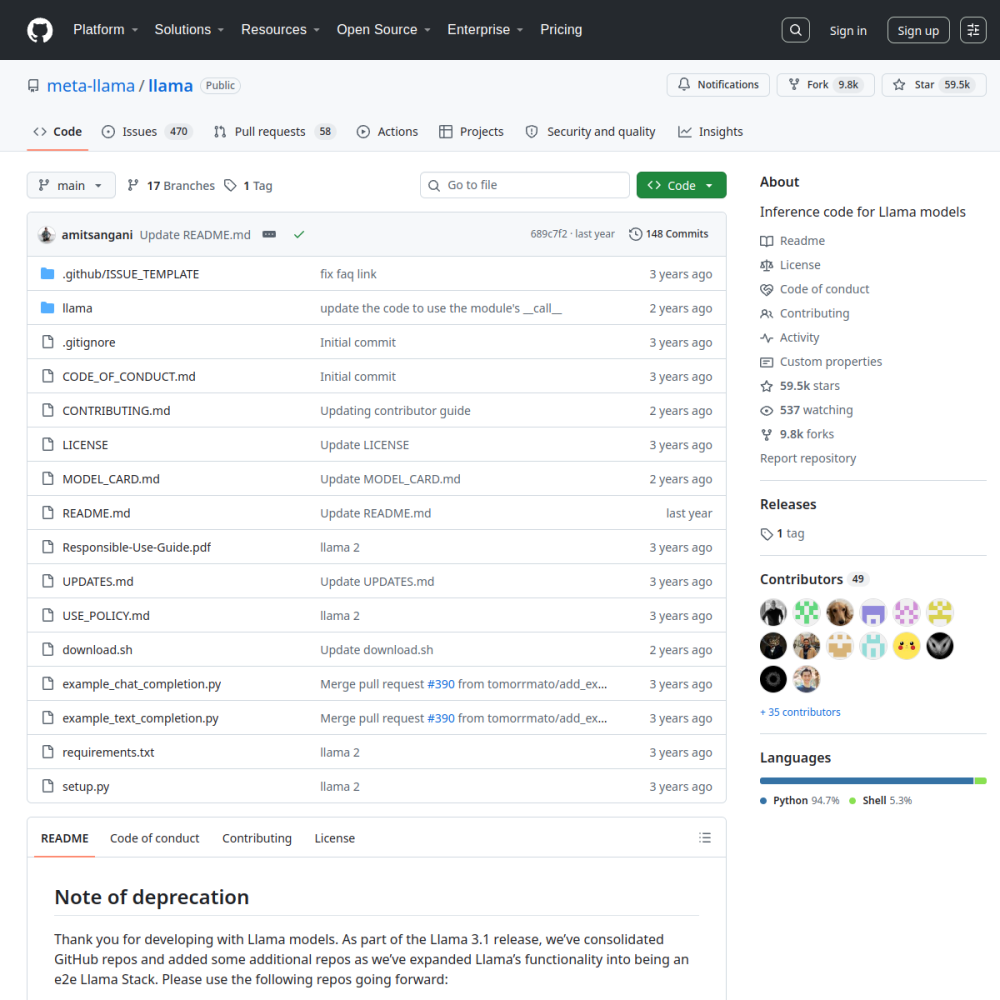
| Repository | meta-llama/llama |
|---|---|
| GitHub Stars | ★ 59.6k |
| Forks | 9.8k forks |
| Primary Language | Python |
| License | NOASSERTION |
| Technical Domain | INFERENCE |
$ git clone https://github.com/meta-llama/llama.git && cd llama
## Note of deprecation
Thank you for developing with Llama models. As part of the Llama 3.1 release, we’ve consolidated GitHub repos and added some additional repos as we’ve expanded Llama’s functionality into being an e2e Llama Stack. Please use the following repos going forward:
- llama-models - Central repo for the foundation models including basic utilities, model cards, license and use policies
- [PurpleLlama](https://github.com/meta-llama/
This repository serves as the official inference codebase for Llama models developed by Meta. It provides developers with tools to run and interact with foundation models directly on their infrastructure. The project aims to solve accessibility problems for large language model inference within the ecosystem.
As part of the Llama 3.1 release, the project underwent significant restructuring to align with expanded functionality. Meta consolidated multiple GitHub repositories to create an end-to-end Llama Stack encompassing more than just inference. This shift indicates a strategic move toward centralized model management and broader utility.
Developers utilize this codebase to execute Llama models locally for testing and evaluation purposes. It allows technical teams to explore model capabilities while maintaining control over the data processing environment. This is particularly useful for privacy-sensitive applications where data must remain on-premises.
Researchers and engineers use the repository to understand the underlying architecture and inference mechanisms of the Llama series. It supports experimentation with different model configurations and parameters to optimize performance for specific tasks. Users can leverage this foundation to build custom applications tailored to enterprise needs.
The tooling supports integration into broader machine learning workflows where direct model control is required. Teams can deploy these models in controlled environments to assess performance before scaling to larger user bases. It serves as a bridge between raw model weights and functional application deployment.
Users begin by cloning the repository and setting up a Python environment compatible with the provided code. The installation process involves installing necessary libraries listed within the project structure to ensure proper execution. Developers should verify their system meets hardware requirements for running large language models locally.
Once the environment is configured, users can import modules to load model weights and initiate the inference process. The workflow typically involves specifying the model path and defining input prompts for generation to test the system. This setup allows for immediate interaction with the model to verify functionality.
Attention should be paid to the updated repository structure mentioned in the deprecation notice regarding the Llama 3.1 release. Users are encouraged to check the linked llama-models repository for the most current installation instructions. Following the consolidated documentation ensures access to the latest utilities and avoids outdated code paths.
The project receives a strong rating of 4.0 out of 5 across functionality, documentation, activity, and ease of use. This suggests a robust codebase that was well-maintained during its active lifecycle. However, the deprecation notice indicates that this specific repository is no longer the primary source for development.
Production readiness is affected by the consolidation into the Llama Stack and the llama-models repository for future updates. Teams should evaluate whether their needs align with the newer, centralized repositories before committing to this codebase. The existing code remains valuable for understanding historical implementations and specific inference logic.
While specific company adoptions are not detailed in the provided notes, the project serves as a foundational component for AI integrations. Organizations typically utilize such inference code to power internal chatbots or document analysis tools. The open-source nature allows for customization within various enterprise environments.
Integration scenarios often involve embedding model capabilities into larger applications requiring advanced natural language processing features. Developers may use this code to create prototypes that demonstrate Llama model capabilities to stakeholders before full deployment. It provides a baseline for building complex AI-driven features in production environments.
llama is an open-source AI project developed primarily in Python under the NOASSERTION license. Inference code for Llama models. This repository serves as the official inference codebase for Llama models developed by Meta. It provides developers with tools to run and interact with foundation models directly on their infrastructure. The project aims to solve accessibility problems for large language model inference within the ecosystem. As part of the Llama 3.1 release, the project underwent significant restructuring to align with expanded functionality. Meta consolidated multiple GitHub repositories to create an end-to-end Llama Stack encompassing more than just inference. This shift indicates a strategic move toward centralized model management and broader utility.
Users begin by cloning the repository and setting up a Python environment compatible with the provided code. The installation process involves installing necessary libraries listed within the project structure to ensure proper execution. Developers should verify their system meets hardware requirements for running large language models locally. Once the environment is configured, users can import modules to load model weights and initiate the inference process. The workflow typically involves specifying the model path and defining input prompts for generation to test the system. This setup allows for immediate interaction with the model to verify functionality. Attention should be paid to the updated repository structure mentioned in the deprecation notice regarding the Llama 3.1 release. Users are encouraged to check the linked llama-models repository for the most current installation instructions. Following the consolidated documentation ensures access to the latest utilities and avoids outdated code paths.
llama is well-suited for . With an overall rating of 4.0/5, it offers strong community activity, reliable performance, and easy integration with existing AI pipelines.
The project receives a strong rating of 4.0 out of 5 across functionality, documentation, activity, and ease of use. This suggests a robust codebase that was well-maintained during its active lifecycle. However, the deprecation notice indicates that this specific repository is no longer the primary source for development. Production readiness is affected by the consolidation into the Llama Stack and the llama-models repository for future updates. Teams should evaluate whether their needs align with the newer, centralized repositories before committing to this codebase. The existing code remains valuable for understanding historical implementations and specific inference logic.
Minimal tool for running large language models locally