Official Preview
In-Depth Review
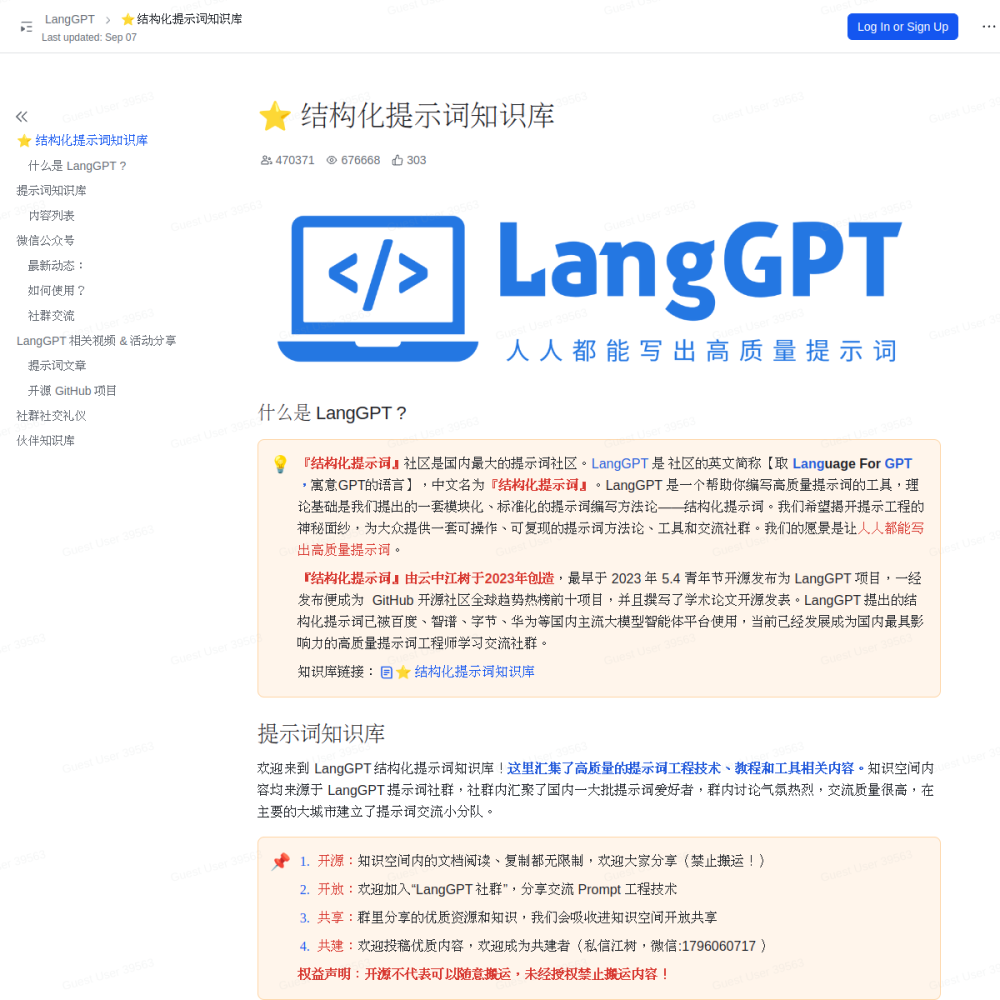
LangGPT is a structured prompt engineering framework designed to help developers and teams build consistent, repeatable prompts for large language models. Rather than writing prompts from scratch each time, LangGPT provides a systematic approach to organizing instructions, context, and output formats.
If you work with LLMs regularly, you likely know that small changes in wording can produce wildly different results. LangGPT addresses this by offering a framework that standardizes how prompts are constructed, making it easier to test, iterate, and share prompt strategies across a team.
LangGPT is a prompt engineering framework built around the idea that effective prompts follow a repeatable structure. It breaks down prompt creation into defined components such as role, task, context, constraints, and output format.
By treating prompts as structured objects rather than free-form text, LangGPT makes it easier to debug poor outputs, compare variations, and maintain a library of working prompts over time.
LangGPT emphasizes modularity. Each prompt is composed of interchangeable parts, so you can swap a role definition or change an output format without rewriting the entire prompt.
The framework also supports versioning and documentation, which is useful when multiple team members contribute prompts. You can track what changed, why it changed, and whether the new version performs better.
Additionally, LangGPT encourages testing prompts against a set of example inputs before deploying them in production workflows.
LangGPT is designed for developers, AI engineers, and content teams who interact with LLMs on a regular basis. If your work involves building chatbots, summarization pipelines, or any LLM-powered feature, a structured approach to prompts will save time.
It is also useful for teams that need to hand off prompt logic between members. A shared framework reduces ambiguity and ensures everyone follows the same conventions.
One common use case is building production chatbots where consistency matters. LangGPT helps define system prompts that behave predictably across different user inputs.
Another use case is content generation at scale. Teams producing blog posts, product descriptions, or social media copy can use LangGPT templates to maintain brand voice and formatting standards.
Developers building RAG (retrieval-augmented generation) pipelines also benefit, as LangGPT provides a clear structure for combining retrieved context with generation instructions.
To get started with LangGPT, visit the website at langgpt.ai and review the framework documentation. Begin by identifying a single prompt you already use and restructure it using LangGPT's component model.
A practical tip is to start small. Pick one workflow, apply the framework, and measure whether outputs improve or become more consistent. Once you see results, expand the framework to other prompts in your stack.
Remember that LangGPT is a guide, not a rigid rule set. Adapt the structure to fit your specific model and use case rather than forcing every prompt into the same shape.
LangGPT is a framework and methodology. The core framework documentation is available on the LangGPT website. Specific pricing or licensing details should be confirmed directly at langgpt.ai.
LangGPT is model-agnostic. Its structured approach to prompt design can be applied to any large language model, including GPT-series, Claude, Llama, and others. The framework focuses on how you construct the prompt, not on the underlying model architecture.
Basic familiarity with how LLMs work is helpful, but LangGPT itself is a prompt design methodology. Non-engineers who write prompts for content or research workflows can also benefit from its structured approach.
AI prompt marketplace
Google's prompt library
Community-driven daily top prompts for ChatGPT & Midjourney
Curated collection of ChatGPT prompts tailored for professionals
Systematic prompt engineering guide