SWE-bench
Benchmark testing AI agents on solving real-world GitHub issues
Official Preview
Benchmark testing AI agents on solving real-world GitHub issues
In-Depth Review
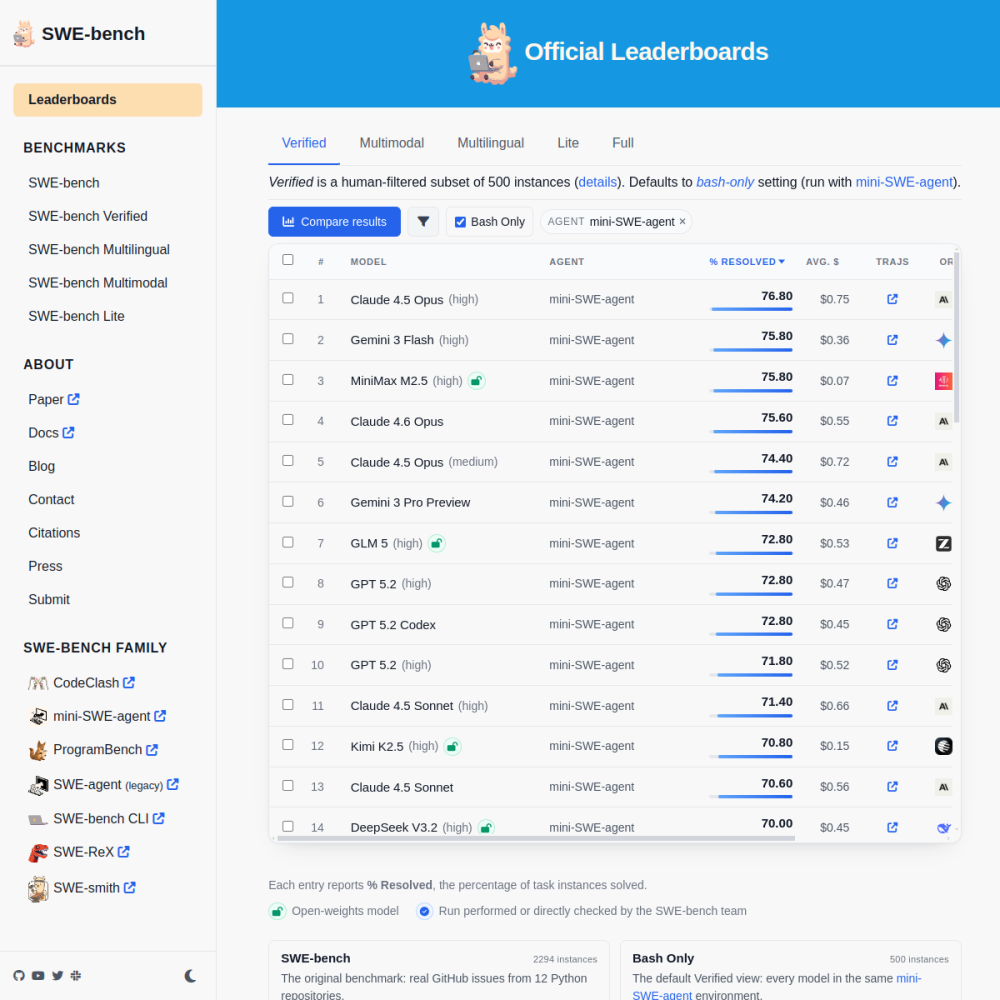
SWE-bench is an open benchmark that measures how well AI agents can resolve real-world software issues sourced from popular GitHub repositories. Unlike synthetic coding tests, it uses actual pull requests and bug reports, giving developers a realistic picture of an agent's problem-solving ability.
Whether you're evaluating a new coding model or comparing agent frameworks, SWE-bench provides a standardized way to test whether an AI can navigate a codebase, understand a bug report, and produce a working fix. This guide covers what SWE-bench is, who benefits from it, and how to get started.
SWE-bench is a benchmark designed to evaluate AI agents on their ability to solve real-world software engineering tasks. It collects issues and their corresponding fixes from active GitHub repositories, creating a test set that mirrors the kind of debugging work developers do every day.
Each task presents an agent with a repository, a bug report or feature request, and hidden tests. The agent must produce a patch that resolves the issue and passes those tests. This end-to-end format tests not just code generation but also reasoning, navigation, and debugging skills.
SWE-bench uses real pull requests from open-source projects, ensuring tasks are grounded in actual software problems rather than artificial exercises. The benchmark covers a range of difficulty levels, from straightforward bug fixes to more complex multi-file changes.
It supports multiple programming languages and repository structures, making it applicable across different development stacks. The evaluation is automated: patches are applied, tests are run, and results are scored based on whether the fix passes hidden test cases.
SWE-bench is primarily aimed at AI researchers and engineers building or evaluating coding agents. If you're developing a tool that autonomously resolves issues, this benchmark gives you a reliable yardstick to measure progress.
It also serves software teams exploring AI-assisted development. By running agents through SWE-bench, teams can gauge whether a tool is ready for production use on their own codebases before committing to integration.
Researchers use SWE-bench to compare the performance of different language models and agent architectures on coding tasks. It helps identify which approaches handle complex debugging better and where current models still fall short.
Engineering teams use it during tool selection to shortlist coding agents that demonstrate strong real-world performance. It is also useful for tracking improvements over time as models are updated or fine-tuned.
To use SWE-bench, visit the official website at swebench.com to access the dataset and evaluation harness. The benchmark provides scripts to run agents against the test set and collect pass/fail results for each issue.
Start with a subset of tasks to validate your setup before running the full benchmark. Pay attention to the repository setup instructions, as some tasks require specific environment configurations. For best results, ensure your agent has access to the full repository context and can iterate on its patches.
Yes, SWE-bench is an open benchmark. The dataset and evaluation tools are publicly available on the official website and associated repositories.
Yes. SWE-bench is designed to accept any agent that can produce code patches. You integrate your agent with the evaluation harness and run it against the benchmark tasks.
A task is marked as passed when the agent's patch resolves the issue and passes all hidden test cases associated with that pull request.
HF open LLM leaderboard
Crowdsourced open LLM benchmark leaderboard for Chinese language
Independent AI model speed & quality evals
Contamination-free coding benchmark
AI model battle & evaluation platform