FastChat
Open platform for training, serving, and evaluating LLM chatbots
Official Preview
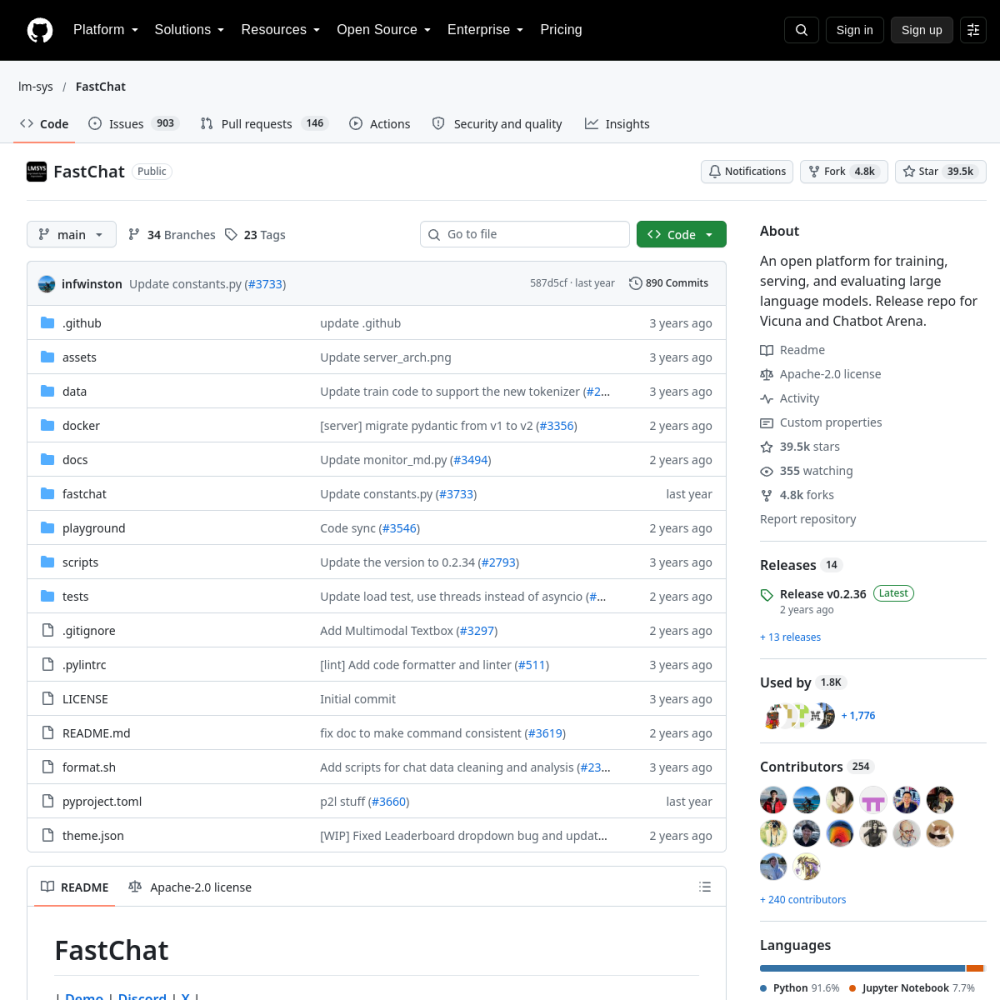
Open platform for training, serving, and evaluating LLM chatbots
In-Depth Review
FastChat is an open-source platform developed by LMSYS for training, serving, and evaluating large language model chatbots. It provides a unified workflow that covers model fine-tuning, multi-instance deployment, and systematic benchmarking, making it a practical toolkit for teams building production-grade LLM applications.
Whether you are an individual researcher experimenting with open-weight models or an engineering team scaling chatbot infrastructure, FastChat offers the building blocks to move from prototype to deployment without switching frameworks.
FastChat is an open-source software platform that brings together the full lifecycle of LLM chatbot development. It includes tools for fine-tuning models on custom datasets, serving multiple model instances behind a unified API, and running structured evaluations to compare model quality.
The project is hosted on GitHub and maintained by the LMSYS community. It supports popular open-weight models and provides a web-based interface for interacting with deployed chatbots.
FastChat offers several core capabilities. Its training pipeline supports supervised fine-tuning and reinforcement learning from human feedback (RLHF). The serving layer handles multi-instance model deployment with load balancing. The evaluation module runs standardized benchmarks to measure chatbot performance.
The platform also includes a web UI for chatting with deployed models, making it easy to test outputs interactively. Developers can plug in their own models and datasets without modifying core infrastructure code.
FastChat is designed for AI researchers, machine learning engineers, and development teams that need to build, customize, and deploy LLM-based chatbots. It is particularly useful for organizations working with open-weight models such as LLaMA, Vicuna, or other community-maintained architectures.
Individual practitioners can use it to experiment with fine-tuning on small datasets, while larger teams can leverage the serving and evaluation components to manage production deployments.
Teams use FastChat to fine-tune open-weight models on domain-specific data, creating specialized chatbots for customer support, education, or internal knowledge bases. The evaluation tools help compare fine-tuned variants against baseline models before deployment.
Researchers also use the platform to run systematic benchmarks across multiple models and prompt strategies, generating comparative data for papers or internal reports.
To get started, clone the FastChat repository from GitHub and follow the installation instructions. The project requires Python and GPU resources for training tasks. Once installed, you can launch the web UI, start a model server, or kick off a fine-tuning run from the command line.
For best results, begin with a small dataset and a lightweight model to validate your pipeline. Use the built-in evaluation scripts to establish a baseline before iterating on training hyperparameters. The GitHub repository includes documentation and examples to guide each step.
Yes. FastChat is open-source and freely available on GitHub. You can use it for research and commercial projects, subject to the licenses of the individual models you deploy.
FastChat supports multiple open-weight model architectures. The platform is designed to be model-agnostic, so you can integrate other compatible LLMs as long as they follow the expected interface.
Training and serving LLMs typically require GPU resources. For lightweight inference or evaluation tasks, you may be able to run smaller models on CPU, but performance will be significantly slower.
Largest AI model & dataset hub
Open-source full-stack AI client
Open-source multi-model AI client
Run LLMs locally