AI Security Agents Compared: Claude, Codex, Mantis, Cloudflare
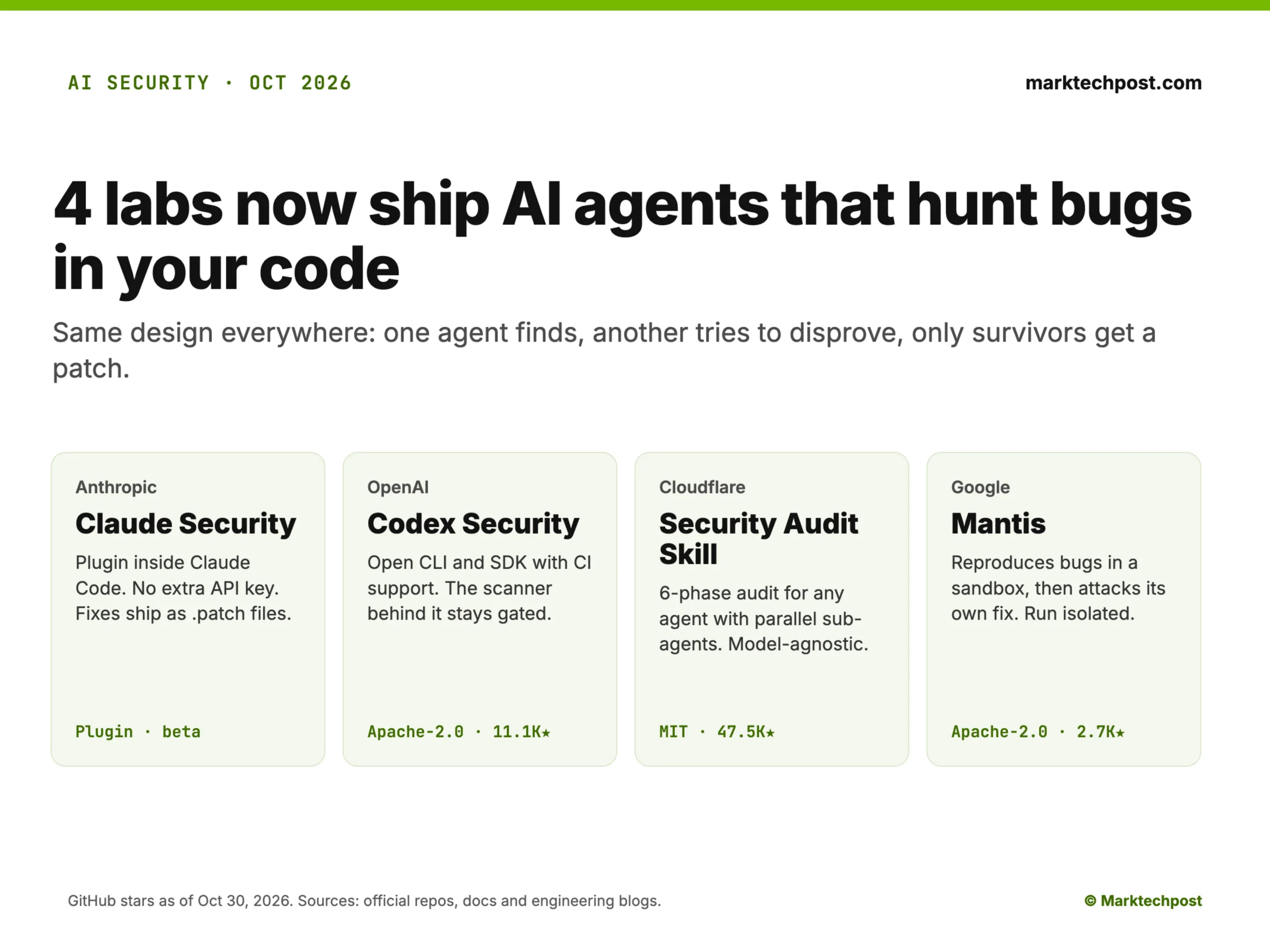
Anthropic, OpenAI, Cloudflare, and Google have released AI agents that find and patch security bugs in code, using a find, disprove, then patch loop. The post compares these four and 12 other tools.
Key Takeaways
- Key Highlight:Anthropic, OpenAI, Cloudflare, and Google have released AI agents that find and patch security bugs in code, using a find, disprove, then patch loop. The post compares these four and 12 other tools.
- Key Topics:OpenAI, Google, Anthropic, AI
The four AI security agents—Claude from Anthropic, Codex from OpenAI, Mantis from Google, and Cloudflare's agent—share a common workflow: they scan source code for potential vulnerabilities, attempt to disprove each finding, and then generate patches for confirmed issues. This "find, disprove, patch" loop is a notable shift from static analysis tools that often produce high false-positive rates.
The comparison highlights differences in how each agent handles context, reasoning, and integration with developer workflows. Claude and Codex leverage their underlying LLMs' code understanding, while Mantis and Cloudflare's agent are designed for specific security use cases. The post also lists 12 additional tools, suggesting a rapidly expanding ecosystem.
Why it matters: These agents could reduce the time developers spend triaging security alerts and writing fixes. If they prove reliable, they may become standard parts of CI/CD pipelines, shifting some security work from human analysts to AI. However, the effectiveness depends on the agents' ability to avoid false positives and produce safe patches.
Likely impact: For enterprises, this could lower the cost of maintaining secure codebases. For AI vendors, security agents represent a new product category that ties model performance to tangible outcomes. The competition among Anthropic, OpenAI, Google, and Cloudflare signals that AI security is becoming a key battleground.
This page provides an editorial summary based on publicly available information. It is not a republished article. Use the source link below for the original report.