Google Cloud Launches Agent Compute Engine: A MicroVM per AI Agent
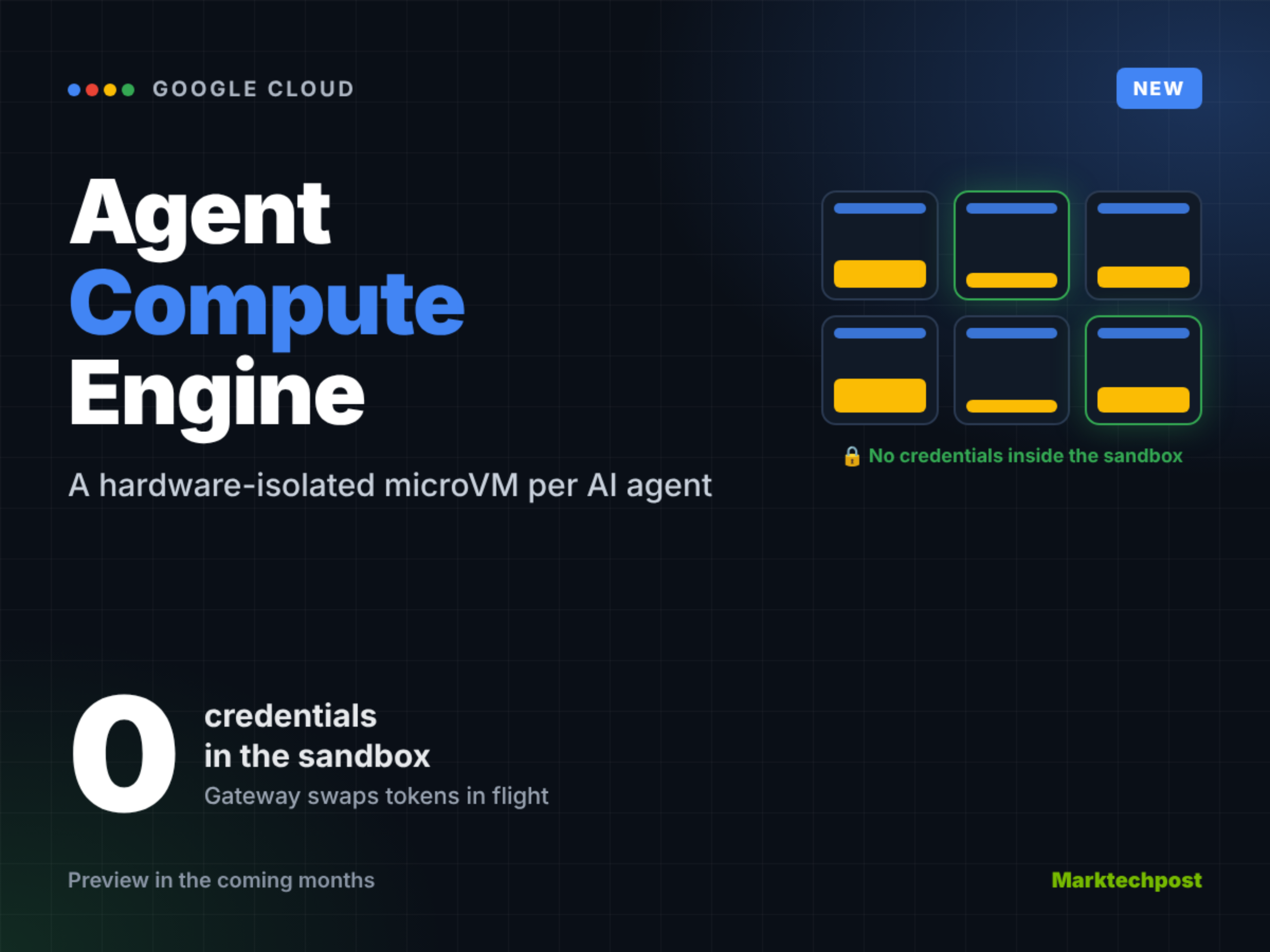
Google Cloud announced Agent Compute Engine, a service that provisions hardware-isolated microVMs for each AI agent, already running Gemini agents and entering public preview soon.
Key Takeaways
- Key Highlight:Google Cloud announced Agent Compute Engine, a service that provisions hardware-isolated microVMs for each AI agent, already running Gemini agents and entering public preview soon.
- Innovation & Tech:Highlights advancements in Google, Gemini, Agent, demonstrating rapid progress in model capabilities.
- Industry Impact:Reported via MarkTechPost, offering actionable signals for developers and technology leaders.
Google Cloud has unveiled Agent Compute Engine, a new compute service designed specifically for AI agents. Each agent is assigned its own hardware-isolated microVM with no embedded credentials, giving it a dedicated and sandboxed runtime environment.
The service is already powering Gemini agents internally and is set to enter public preview in the coming months. This marks Google Cloud's move to build agent-native infrastructure rather than relying on general-purpose compute options.
AI agents frequently need to execute code, call tools, and interact with external systems. Running them inside isolated microVMs reduces the security surface compared to shared containers or serverless functions, which is critical as agents gain more autonomy and access to sensitive resources.
As agentic AI adoption accelerates, cloud providers are increasingly investing in purpose-built compute layers. Agent Compute Engine reflects a broader industry trend toward infrastructure tailored to the unique execution patterns and safety requirements of autonomous AI agents.
This page provides an editorial summary based on publicly available information. It is not a republished article. Use the source link below for the original report.
Industry Insights & Analysis
As artificial intelligence rapidly evolves, breakthroughs surrounding Google, Gemini, Agent, Cloud are shifting toward scalable, robust real-world implementations.
Driven by both open-source ecosystems and proprietary model architectures, the integration between compute optimization, data engineering, and agentic workflows is accelerating. This development provides a strategic benchmark for upcoming AI tooling and developer workflows.