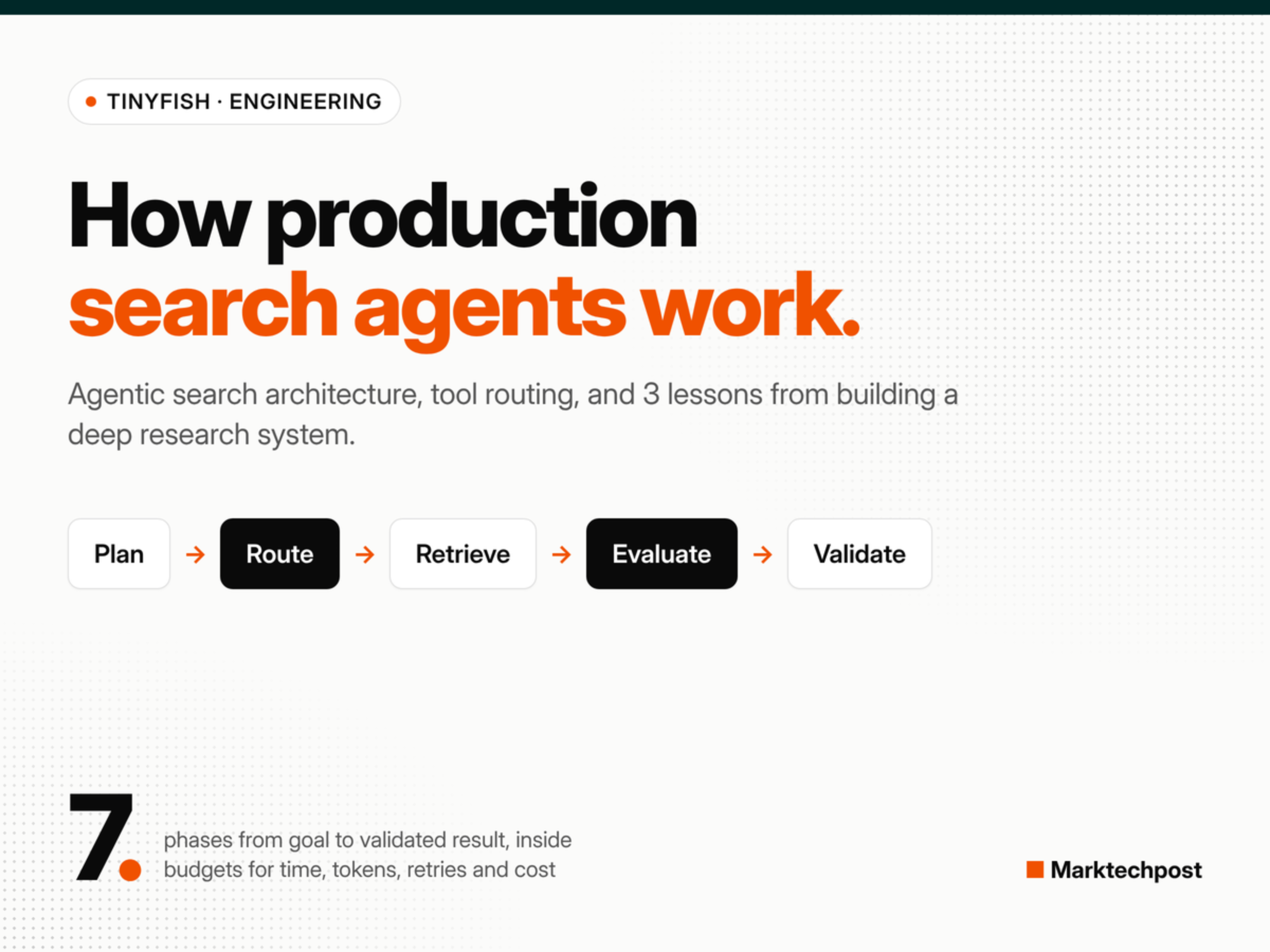
TinyFish Breaks Down Agentic Search Architecture for Production AI Agents
TinyFish published two engineering articles detailing a 7-phase production architecture for agentic search with evidence contracts and bounded retries, plus rationale for removing a separate planner and per-query subagents.
Key Takeaways
- Key Highlight:TinyFish published two engineering articles detailing a 7-phase production architecture for agentic search with evidence contracts and bounded retries, plus rationale for removing a separate planner and per-query subagents.
- Innovation & Tech:Highlights advancements in Agent, TinyFish, Breaks, demonstrating rapid progress in model capabilities.
- Industry Impact:Reported via MarkTechPost, offering actionable signals for developers and technology leaders.
TinyFish, a company focused on agentic search infrastructure, released two engineering research articles that lay out concrete architectural patterns for deploying AI agents in production. The first article defines a seven-phase pipeline that incorporates evidence contracts and bounded retry mechanisms, addressing reliability concerns that often plague multi-step agent systems.
The second article explains a notable design decision: TinyFish's deep research system eliminated a separate planner component and per-query subagents. This simplification suggests the company found that a leaner architecture could match or exceed the performance of more complex multi-agent setups, at least for their use case.
These posts matter because agentic search is one of the most active areas of AI engineering right now. Many teams are still experimenting with how to structure retrieval-augmented generation pipelines that involve multiple reasoning steps, tool calls, and verification loops. Publishing detailed architecture decisions—especially the reasoning behind removing components—gives practitioners real-world reference points rather than just theoretical frameworks.
The emphasis on evidence contracts and bounded retries speaks to a broader industry trend toward making agent systems more deterministic and debuggable. As organizations move from prototype agents to production deployments, concerns about reliability, cost control, and failure recovery become central. TinyFish's approach of encoding verification requirements directly into the architecture, rather than relying on post-hoc checks, could influence how other teams design their agent pipelines.
It remains to be seen whether these patterns generalize beyond TinyFish's specific domain, but the level of engineering detail shared is a welcome contribution to the still-maturing field of production-grade agentic systems.
This page provides an editorial summary based on publicly available information. It is not a republished article. Use the source link below for the original report.
Industry Insights & Analysis
As artificial intelligence rapidly evolves, breakthroughs surrounding Agent, TinyFish, Breaks, Down are shifting toward scalable, robust real-world implementations.
Driven by both open-source ecosystems and proprietary model architectures, the integration between compute optimization, data engineering, and agentic workflows is accelerating. This development provides a strategic benchmark for upcoming AI tooling and developer workflows.