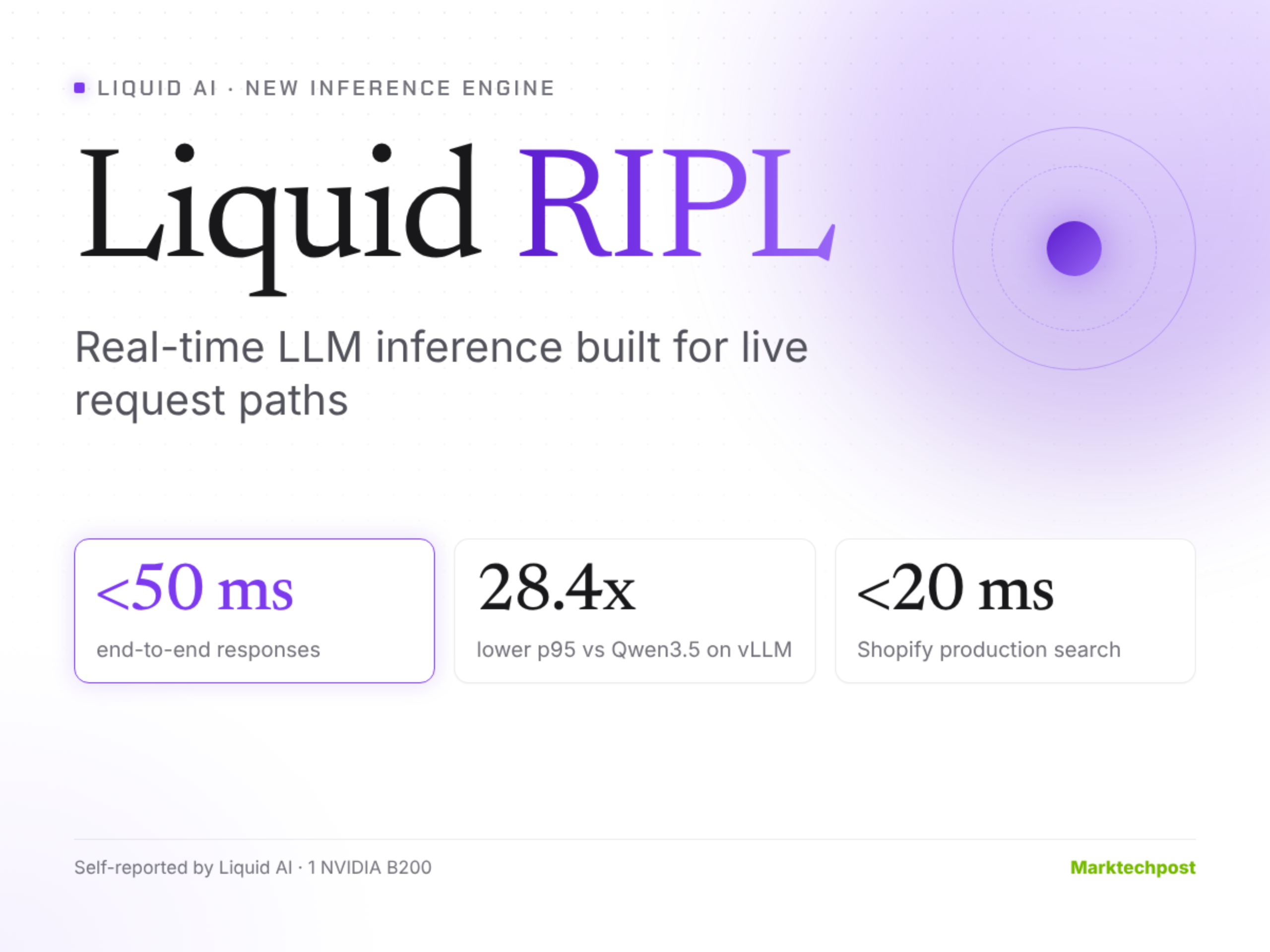
Liquid AI Launches RIPL, a Real-Time Inference Engine for Sub-50 ms LFMs
Liquid AI launched RIPL, a real-time inference engine for its LFM models, claiming 14.4–28.4x lower p95 latency than Qwen3.5-0.8B on vLLM on a single B200 GPU.
Key Takeaways
- Key Highlight:Liquid AI launched RIPL, a real-time inference engine for its LFM models, claiming 14.4–28.4x lower p95 latency than Qwen3.5-0.8B on vLLM on a single B200 GPU.
- Innovation & Tech:Highlights advancements in Qwen, Liquid, AI, demonstrating rapid progress in model capabilities.
- Industry Impact:Reported via MarkTechPost, offering actionable signals for developers and technology leaders.
Liquid AI has released RIPL, a dedicated real-time inference engine designed specifically for its Liquid Foundation Models (LFMs). The engine targets sub-50 ms latency, positioning it for interactive and agentic workloads where response time is critical.
In published benchmarks on a single NVIDIA B200 GPU, Liquid AI reports that LFM2.5-1.2B running on RIPL achieves 14.4 to 28.4 times lower p95 latency compared to Qwen3.5-0.8B served via vLLM. The comparison highlights how architecture-specific inference stacks can dramatically outperform general-purpose serving frameworks when tuned for a particular model family.
RIPL is notable because it is tightly coupled to Liquid AI's proprietary LFM architecture rather than being a generic serving layer. This suggests Liquid AI is investing in a full-stack approach—model architecture plus inference runtime—to differentiate itself in the competitive small-model space.
For practitioners, the launch underscores that inference efficiency is increasingly a differentiator beyond raw model quality. As sub-50 ms latency becomes a practical requirement for real-time agents and interactive assistants, purpose-built inference engines may gain traction alongside general-purpose frameworks like vLLM and TensorRT-LLM.
This page provides an editorial summary based on publicly available information. It is not a republished article. Use the source link below for the original report.
Industry Insights & Analysis
As artificial intelligence rapidly evolves, breakthroughs surrounding Qwen, Liquid, AI, Launches are shifting toward scalable, robust real-world implementations.
Driven by both open-source ecosystems and proprietary model architectures, the integration between compute optimization, data engineering, and agentic workflows is accelerating. This development provides a strategic benchmark for upcoming AI tooling and developer workflows.