Recursive Releases Flint, an Open-Weight 40B MoE Local Coding Model for Agents with 2.5B Active Params
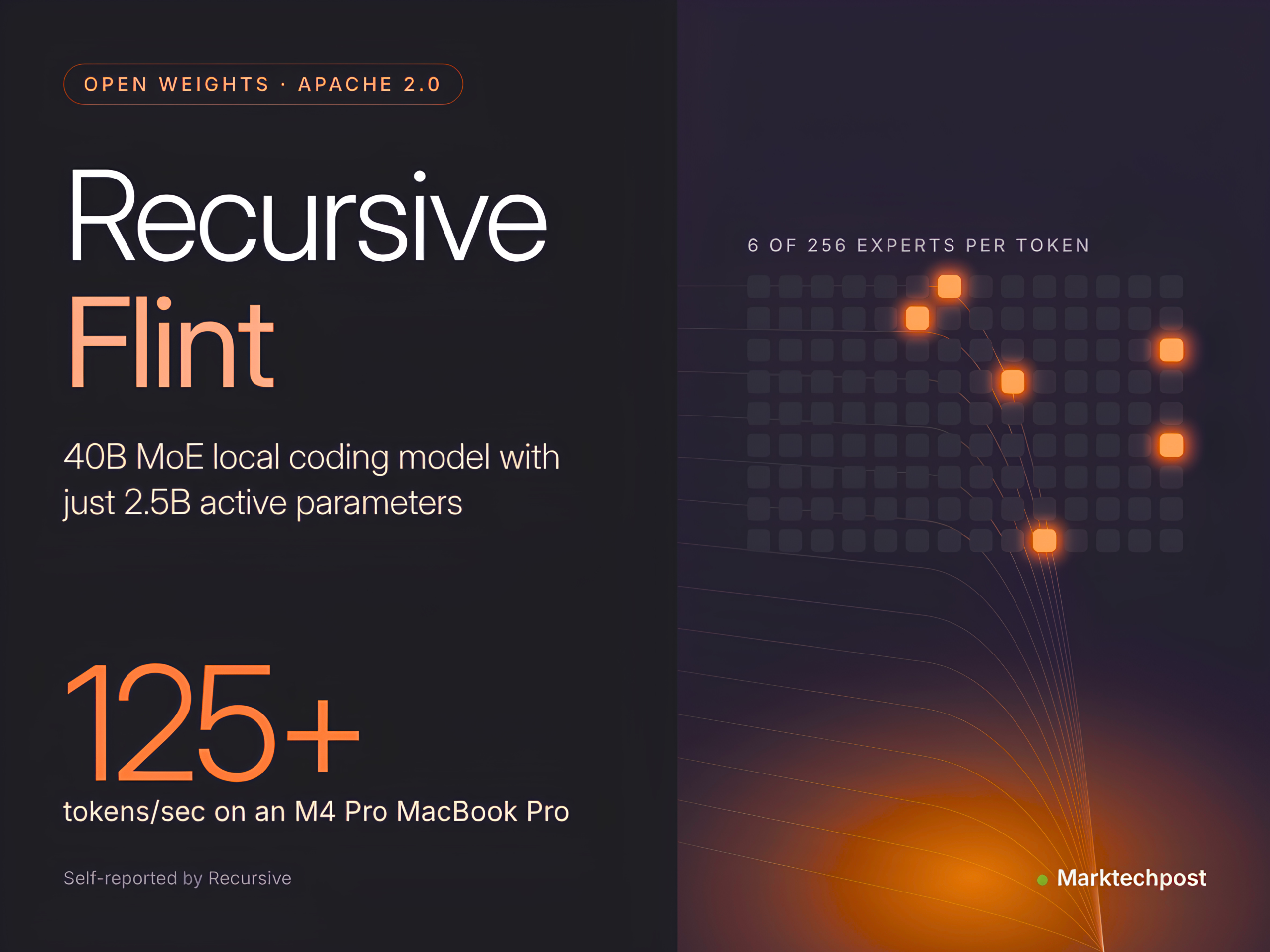
Recursive released Flint, an Apache 2.0 open-weight 40B MoE coding model with 2.5B active parameters, reporting 74.2% on SWE-bench Verified and 125+ tokens/sec on an M4 Pro MacBook Pro.
Key Takeaways
- Key Highlight:Recursive released Flint, an Apache 2.0 open-weight 40B MoE coding model with 2.5B active parameters, reporting 74.2% on SWE-bench Verified and 125+ tokens/sec on an M4 Pro MacBook Pro.
- Innovation & Tech:Highlights advancements in Agent, Recursive, Releases, demonstrating rapid progress in model capabilities.
- Industry Impact:Reported via MarkTechPost, offering actionable signals for developers and technology leaders.
Recursive has released Flint, an open-weight local coding model licensed under Apache 2.0. It employs a Mixture-of-Experts architecture with 40 billion total parameters but only 2.5 billion active per token, a design choice aimed at keeping inference lightweight enough for consumer hardware.
The model reports a score of 74.2% on SWE-bench Verified, a benchmark focused on real-world software engineering tasks, and claims speeds exceeding 125 tokens per second on an Apple M4 Pro MacBook Pro. These figures suggest Flint can operate without cloud infrastructure while still handling complex coding workloads.
Open-weight coding models are increasingly relevant as developers look for alternatives to API-based assistants like GitHub Copilot or Cursor. A MoE design with low active parameters is particularly notable because it allows competitive benchmark performance without requiring high-end GPUs, broadening the range of devices on which the model can run.
If the reported numbers hold under independent testing, Flint could lower the barrier for local AI-assisted coding, especially for teams prioritizing data privacy or low-latency workflows. The permissive Apache 2.0 license also permits commercial use and modification, which may encourage adoption in both open-source and proprietary settings.
This page provides an editorial summary based on publicly available information. It is not a republished article. Use the source link below for the original report.
Industry Insights & Analysis
As artificial intelligence rapidly evolves, breakthroughs surrounding Agent, Recursive, Releases, Flint are shifting toward scalable, robust real-world implementations.
Driven by both open-source ecosystems and proprietary model architectures, the integration between compute optimization, data engineering, and agentic workflows is accelerating. This development provides a strategic benchmark for upcoming AI tooling and developer workflows.