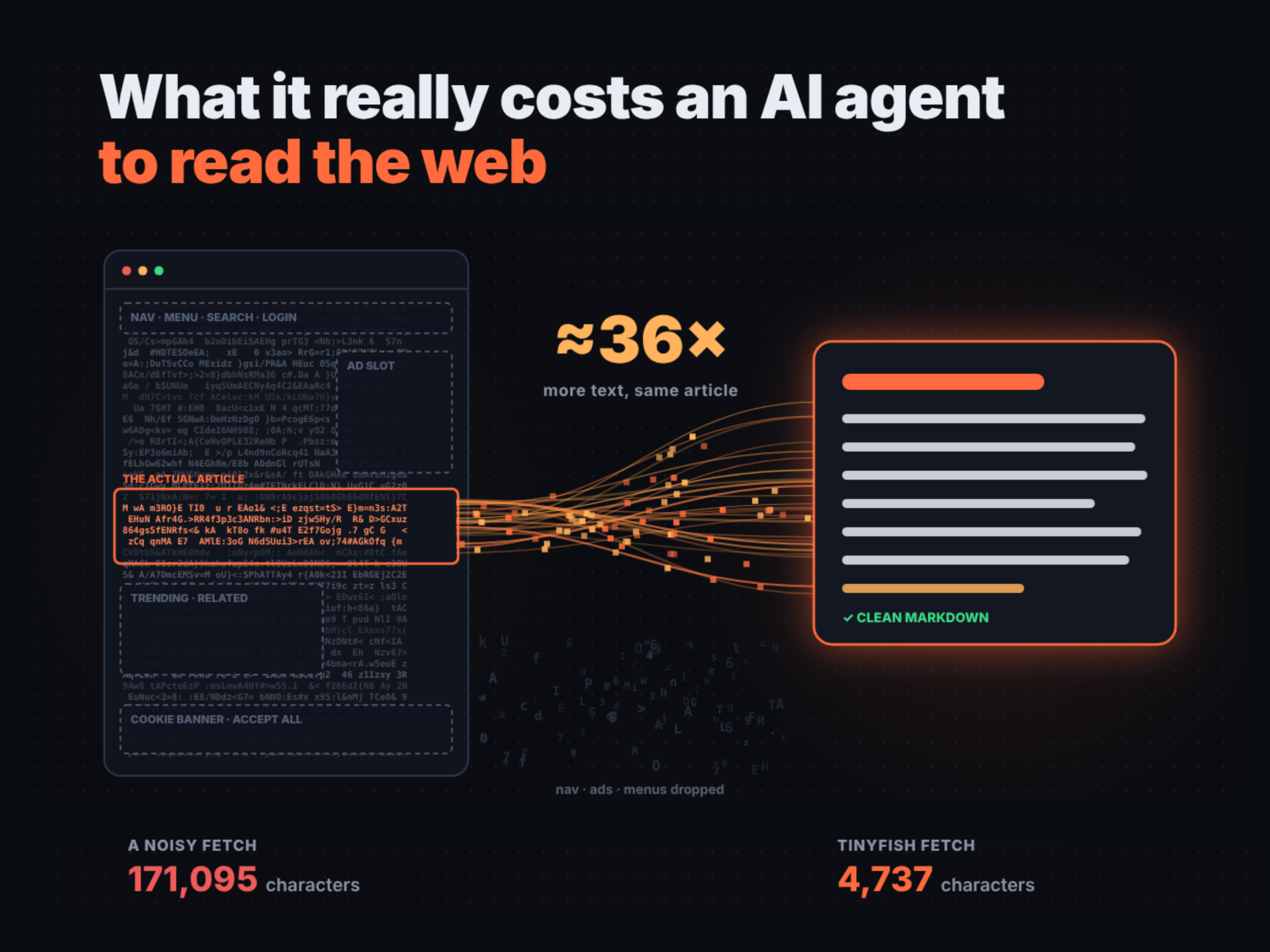
TinyFish Makes Search Free: What It Really Costs an AI Agent to Read the Web
TinyFish is making web search free, but AI agents still face two cost layers: per-request retrieval fees from search APIs and token consumption when passing fetched content into language models.
Key Takeaways
- Key Highlight:TinyFish is making web search free, but AI agents still face two cost layers: per-request retrieval fees from search APIs and token consumption when passing fetched content into language models.
- Innovation & Tech:Highlights advancements in API, Agent, TinyFish, demonstrating rapid progress in model capabilities.
- Industry Impact:Reported via MarkTechPost, offering actionable signals for developers and technology leaders.
TinyFish has announced it is making its search service free, a move that shifts the cost burden of web access for AI agents. While the headline sounds like a win for developers, the real economics of an AI agent reading the web involve two distinct cost categories: the retrieval charge billed per API request, and the model processing cost incurred when retrieved page content is fed into a language model as tokens.
The retrieval layer covers what a search or fetch API bills per query. Even if one provider goes free, agents that rely on multiple sources or high-volume crawling still face per-request fees from other services. The model processing layer is often the larger expense: every page fetched consumes input tokens, and any reasoning or generated response adds output tokens on top.
This matters because AI agents that browse the web at scale—whether for research, summarization, or autonomous task completion—can rack up significant token costs even when search itself is free. Developers building agent pipelines need to account for both layers to estimate true operating costs.
The broader implication is that the economics of agentic AI are shifting from search-as-a-service pricing toward token-consumption pricing. As models grow more capable and agents perform more web-grounded tasks, the token processing layer will likely dominate total cost, making efficiency in retrieval and context management a key engineering concern.
This page provides an editorial summary based on publicly available information. It is not a republished article. Use the source link below for the original report.
Industry Insights & Analysis
As artificial intelligence rapidly evolves, breakthroughs surrounding API, Agent, TinyFish, Makes are shifting toward scalable, robust real-world implementations.
Driven by both open-source ecosystems and proprietary model architectures, the integration between compute optimization, data engineering, and agentic workflows is accelerating. This development provides a strategic benchmark for upcoming AI tooling and developer workflows.