Datalab Releases OmniParseBench: An Open OCR Benchmark With 16,288 Pass/Fail Tests to Audit OCR Parsers
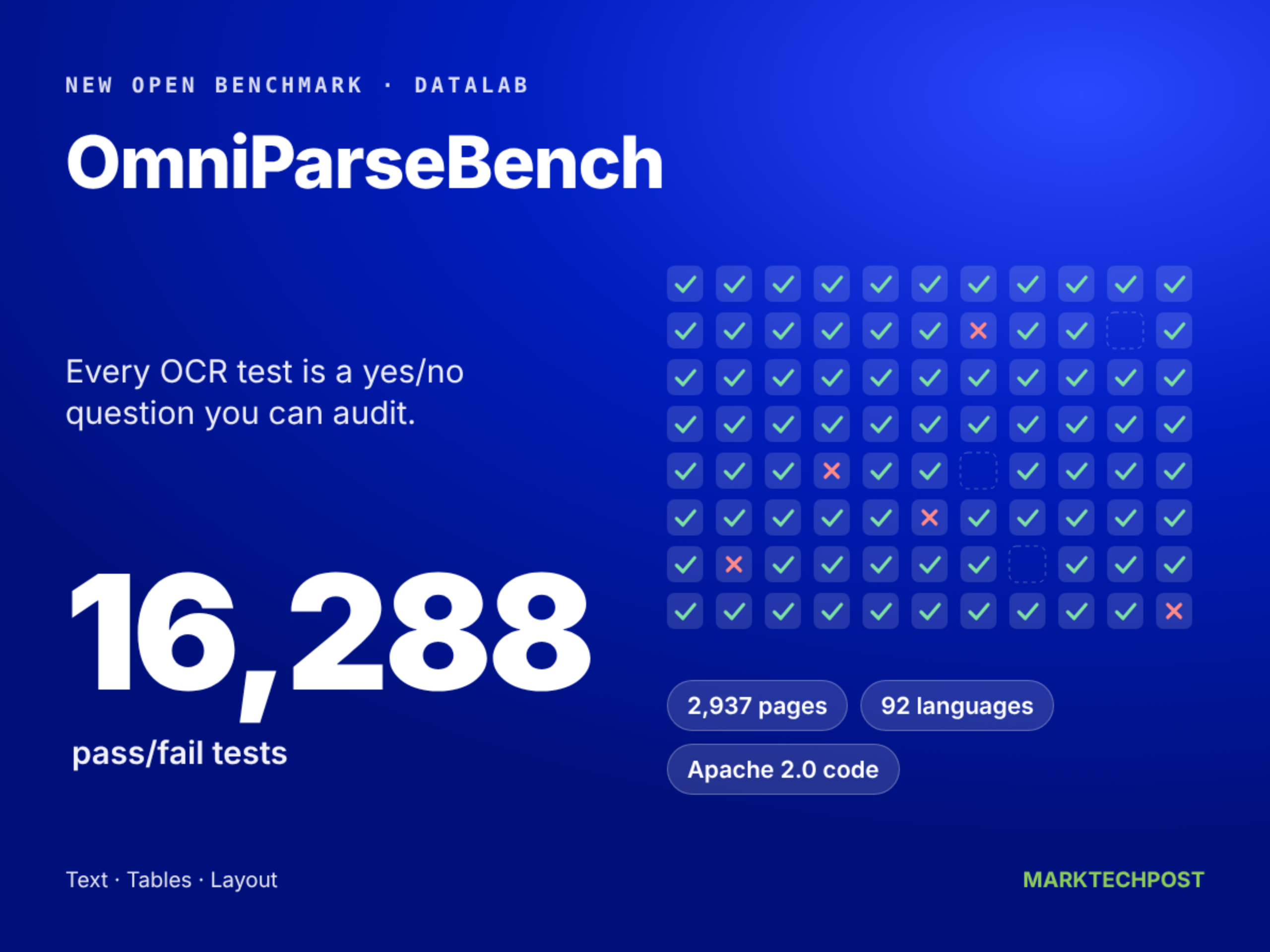
Datalab released OmniParseBench, an open OCR benchmark with 16,288 pass/fail tests across 2,937 pages in 92 languages, enabling auditable evaluation of OCR parsers.
Key Takeaways
- Key Highlight:Datalab released OmniParseBench, an open OCR benchmark with 16,288 pass/fail tests across 2,937 pages in 92 languages, enabling auditable evaluation of OCR parsers.
- Innovation & Tech:Highlights advancements in Datalab, Releases, OmniParseBench, demonstrating rapid progress in model capabilities.
- Industry Impact:Reported via MarkTechPost, offering actionable signals for developers and technology leaders.
Datalab has released OmniParseBench, an open benchmark designed to evaluate OCR (Optical Character Recognition) parsers. The benchmark comprises 16,288 binary pass/fail tests spanning 2,937 pages across 92 languages.
Unlike many benchmarks that rely on aggregate similarity scores, OmniParseBench uses explicit yes/no judgments, making results directly interpretable. Scores can be sliced by tag, script, or language, giving developers granular visibility into where a parser succeeds or fails.
OCR remains a critical component of document AI pipelines, from data extraction to RAG systems that feed LLMs. A standardized, multilingual benchmark helps teams compare parsers objectively rather than relying on vendor-specific evaluations.
The open nature of the benchmark lowers the barrier for independent evaluation and could encourage more transparency in OCR tooling. As document-centric AI applications grow, reliable OCR evaluation infrastructure becomes increasingly important.
This page provides an editorial summary based on publicly available information. It is not a republished article. Use the source link below for the original report.
Industry Insights & Analysis
As artificial intelligence rapidly evolves, breakthroughs surrounding Datalab, Releases, OmniParseBench, An are shifting toward scalable, robust real-world implementations.
Driven by both open-source ecosystems and proprietary model architectures, the integration between compute optimization, data engineering, and agentic workflows is accelerating. This development provides a strategic benchmark for upcoming AI tooling and developer workflows.