Liquid AI Releases d1: A Decision Model That Returns Calibrated Probabilities With Zero Output Tokens
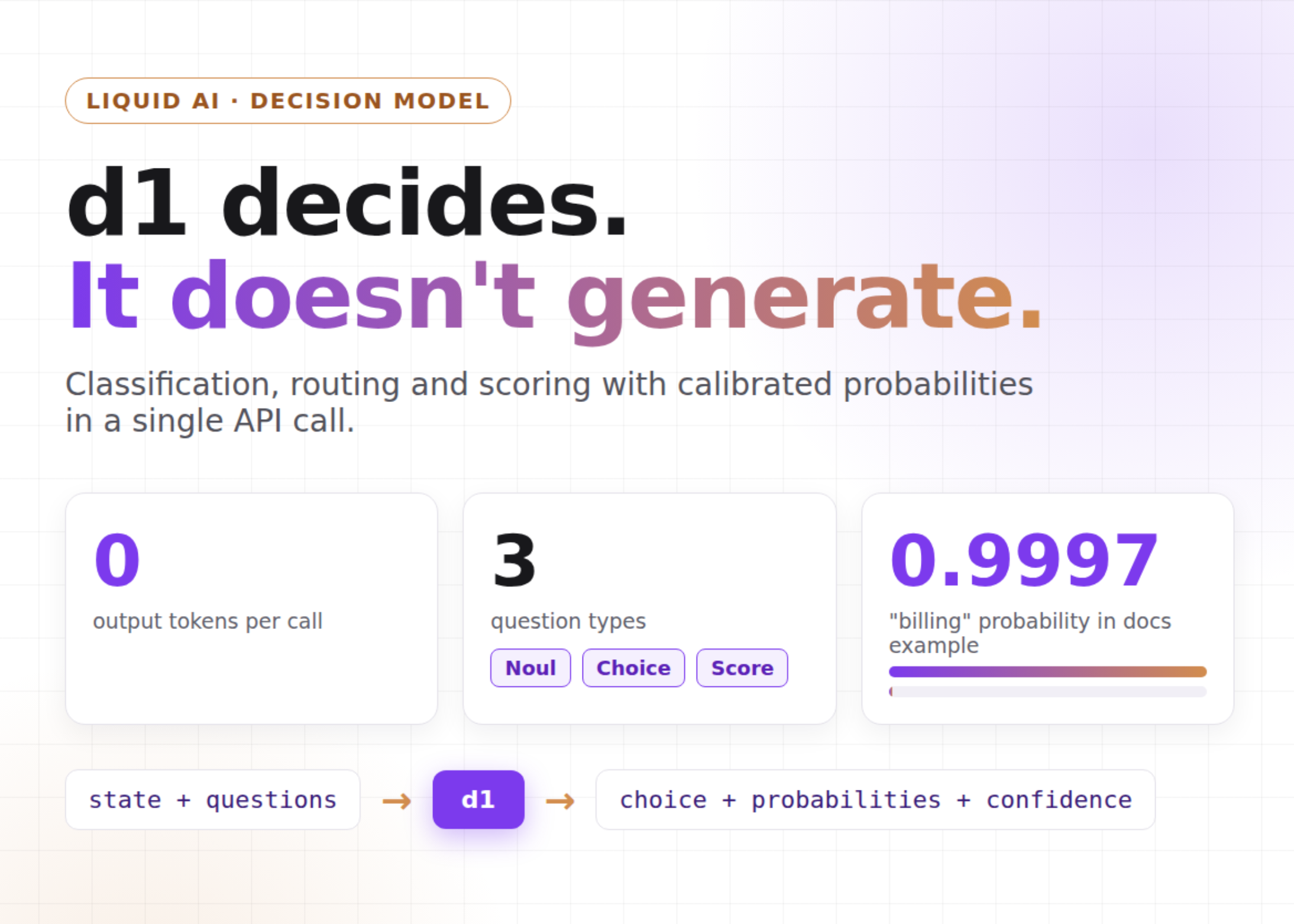
Liquid AI released d1, a decision model that returns calibrated probabilities over fixed outcomes without generating output tokens. It targets structured-choice tasks rather than text generation.
Key Takeaways
- Key Highlight:Liquid AI released d1, a decision model that returns calibrated probabilities over fixed outcomes without generating output tokens. It targets structured-choice tasks rather than text generation.
- Innovation & Tech:Highlights advancements in Liquid, AI, Releases, demonstrating rapid progress in model capabilities.
- Industry Impact:Reported via MarkTechPost, offering actionable signals for developers and technology leaders.
Liquid AI has introduced d1, a model designed specifically for decision-making rather than language generation. Instead of producing text, it accepts context and a set of typed questions, then returns calibrated probabilities across a fixed set of outcomes in a single inference call.
The key technical distinction is that d1 operates with zero generated output tokens. By avoiding autoregressive text generation, it sidesteps the latency and cost typically associated with token-by-token decoding, while still providing structured, probabilistic answers.
This approach matters for applications where decisions must be both fast and quantitatively reliable. Calibrated probabilities are critical in domains like risk assessment, routing, classification, and automated agents that need to choose among discrete options rather than compose prose.
For the broader AI stack, d1 signals a shift toward specialized models optimized for specific operational roles. Rather than treating an LLM as a universal interface, teams can deploy decision-focused models where structured outputs and speed matter more than natural language fluency.
The release also reflects Liquid AI's broader strategy of building efficient, non-traditional architectures. If d1's calibration and latency hold up in production, it could carve out a niche alongside generative LLMs in enterprise pipelines.
This page provides an editorial summary based on publicly available information. It is not a republished article. Use the source link below for the original report.
Industry Insights & Analysis
As artificial intelligence rapidly evolves, breakthroughs surrounding Liquid, AI, Releases, d1 are shifting toward scalable, robust real-world implementations.
Driven by both open-source ecosystems and proprietary model architectures, the integration between compute optimization, data engineering, and agentic workflows is accelerating. This development provides a strategic benchmark for upcoming AI tooling and developer workflows.