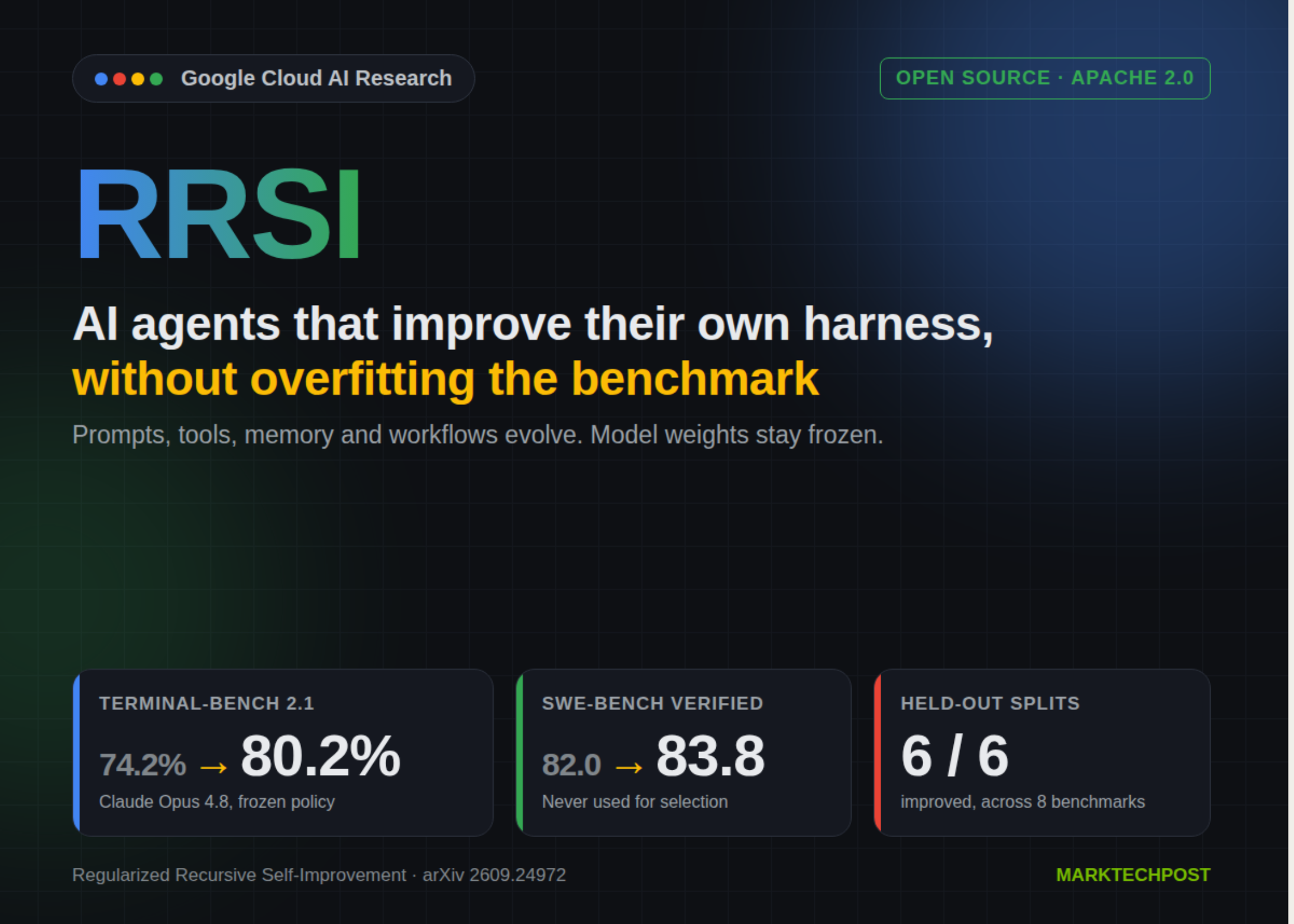
Google Research Open-Sources RRSI: AI Agents That Improve Their Own Harness Without Overfitting
Google Cloud AI Research open-sourced RRSI, a framework enabling LLM agents to rewrite their own prompts, tools, and memory while keeping model weights frozen. It uses a leakage critic, noise floor, cost rule, and pruning to ensure gains transfer to new tasks.
Key Takeaways
- Key Highlight:Google Cloud AI Research open-sourced RRSI, a framework enabling LLM agents to rewrite their own prompts, tools, and memory while keeping model weights frozen. It uses a leakage critic, noise floor, cost rule, and pruning to ensure gains transfer to new tasks.
- Innovation & Tech:Highlights advancements in Google, Agent, Research, demonstrating rapid progress in model capabilities.
- Industry Impact:Reported via MarkTechPost, offering actionable signals for developers and technology leaders.
Google Cloud AI Research has released RRSI, an open-source framework designed to let large language model agents autonomously improve their operational harness. Instead of modifying the underlying model weights, RRSI allows the agent to rewrite its own prompts, tools, and memory during inference.
The framework introduces several mechanisms to ensure that self-improvements are genuine and not the result of overfitting to a specific task. A leakage critic checks for data contamination, while a noise floor establishes a baseline to verify that performance gains exceed random chance. Additionally, a cost rule and pruning strategy are applied to maintain efficiency and prevent the agent from accumulating unnecessary complexity.
By keeping the model weights frozen, RRSI offers a lightweight alternative to traditional fine-tuning. This approach could significantly lower the barrier to deploying adaptive AI systems, as developers can achieve iterative performance gains without the computational expense and data requirements of retraining models.
The open-source release provides the research community with a testbed for exploring self-improving agent architectures. If the framework's task transferability holds up across diverse domains, it could shift how developers approach agent optimization, moving from static prompt engineering toward dynamic, self-correcting systems.
This page provides an editorial summary based on publicly available information. It is not a republished article. Use the source link below for the original report.
Industry Insights & Analysis
As artificial intelligence rapidly evolves, breakthroughs surrounding Google, Agent, Research, Open-Sources are shifting toward scalable, robust real-world implementations.
Driven by both open-source ecosystems and proprietary model architectures, the integration between compute optimization, data engineering, and agentic workflows is accelerating. This development provides a strategic benchmark for upcoming AI tooling and developer workflows.